


Urinary tartaric acid as a biomarker of wine consumption and cardiovascular risk: the PREDIMED trial
- PMID: 39689849
- PMCID: PMC11704392
- DOI: 10.1093/eurheartj/ehae804
Urinary tartaric acid as a biomarker of wine consumption and cardiovascular risk: the PREDIMED trial
Abstract
Background and aims: Moderate wine consumption has been associated with lower cardiovascular disease (CVD) risk in older populations. However, wine consumption information through self-reports is prone to measurement errors inherent to subjective assessments. The aim of this study was to evaluate the association between urinary tartaric acid, an objective biomarker of wine consumption, and the rate of a composite clinical CVD event.
Methods: A case-cohort nested study was designed within the PREDIMED trial with 1232 participants: 685 incident cases of CVD and a random subcohort of 625 participants (including 78 overlapping cases). Wine consumption was registered using validated food frequency questionnaires. Liquid chromatography-tandem mass spectrometry was used to measure urinary tartaric acid at baseline and after one year of intervention. Weighted Cox regression models were used to estimate hazard ratios (HRs) of CVD.
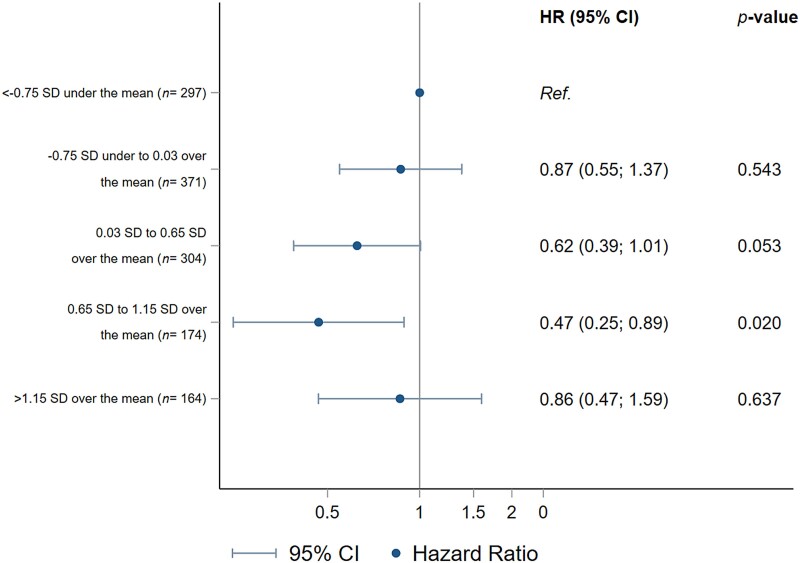
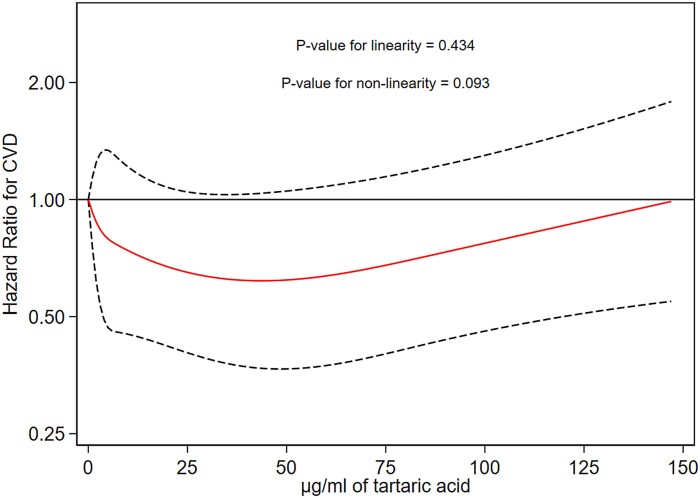
Results: Tartaric acid was correlated with self-reported wine consumption at baseline [r = 0.46 (95% CI 0.41; 0.50)]. Five categories of post hoc urinary tartaric acid excretion were used for better representation of risk patterns. Concentrations of 3-12 and 12-35 μg/mL, which reflect ∼3-12 and 12-35 glasses/month of wine, were associated with lower CVD risk [HR 0.62 (95% CI 0.38; 1.00), P = .050 and HR 0.50 (95% CI 0.27; 0.95), P = .035, respectively]. Less significant associations between self-reported wine consumption and CVD risk were observed.
Conclusions: Light-to-moderate wine consumption, measured through an objective biomarker (tartaric acid), was prospectively associated with lower CVD rate in a Mediterranean population at high cardiovascular risk.
Keywords: Biomarker; Cardiovascular disease; Mediterranean diet; Tartaric acid; Wine.
© The Author(s) 2024. Published by Oxford University Press on behalf of the European Society of Cardiology.
Figures

Comment in
-
Wine consumption and cardiovascular health: the unresolved French paradox and the promise of objective biomarkers.Eur Heart J. 2025 Jan 7;46(2):173-175. doi: 10.1093/eurheartj/ehae726. Eur Heart J. 2025. PMID: 39689843 No abstract available.
References
-
- World Health Organization . Cardiovascular diseases 2023. https://www.who.int/health-topics/cardiovascular-diseases#tab=tab_1 (accessed 21 November 2023).
-
- Guallar-Castillón P, Rodríguez-Artalejo F, Tormo MJ, Sánchez MJ, Rodríguez L, Quirós JR, et al. Major dietary patterns and risk of coronary heart disease in middle-aged persons from a Mediterranean country: the EPIC-Spain cohort study. Nutr Metab Cardiovasc Dis 2012;22:192–9. 10.1016/j.numecd.2010.06.004 - DOI - PubMed
Publication types
MeSH terms
Substances
Grants and funding
LinkOut - more resources
Full Text Sources
