Detection of Hg2+ Using a Dual-Mode Biosensing Probe Constructed Using Ratiometric Fluorescent Copper Nanoclusters@Zirconia Metal-Organic Framework/ N-Methyl Mesoporphyrin IX and Colorimetry G-Quadruplex/Hemin Peroxidase-Mimicking G-Quadruplex DNAzyme
- PMID: 39691776
- PMCID: PMC11650877
- DOI: 10.34133/bmef.0078
Detection of Hg2+ Using a Dual-Mode Biosensing Probe Constructed Using Ratiometric Fluorescent Copper Nanoclusters@Zirconia Metal-Organic Framework/ N-Methyl Mesoporphyrin IX and Colorimetry G-Quadruplex/Hemin Peroxidase-Mimicking G-Quadruplex DNAzyme
Abstract
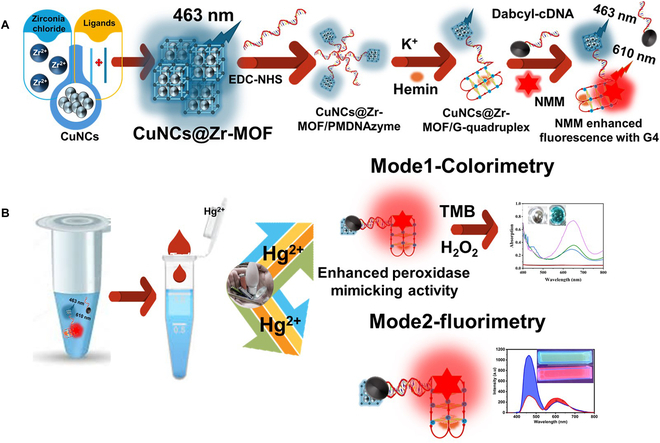
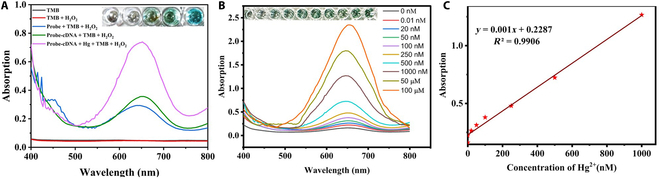
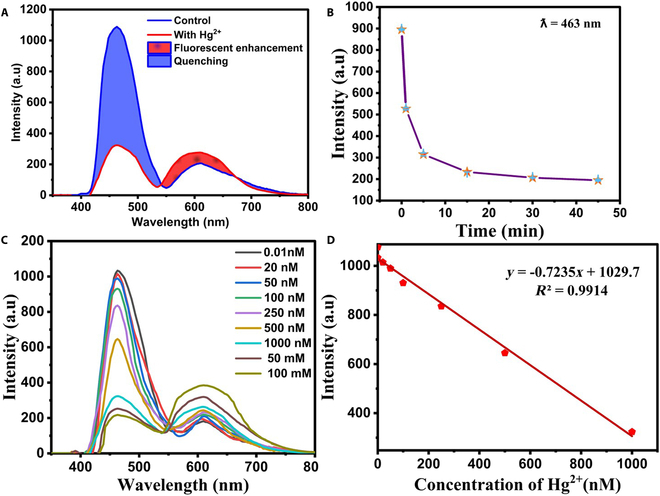
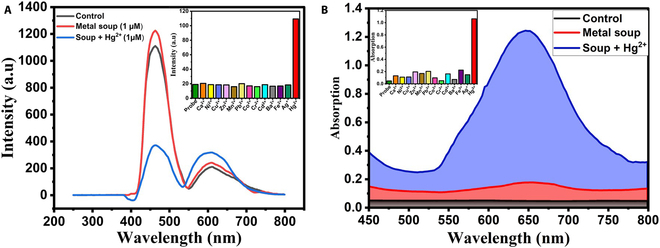
Mercury (Hg2+) has been recognized as a global pollutant with a toxic, mobile, and persistent nature. It adversely affects the ecosystem and human health. Already developed biosensors for Hg2+ detection majorly suffer from poor sensitivity and specificity. Herein, a colorimetric/fluorimetric dual-mode sensing approach is designed for the quantitative detection of Hg2+. This novel sensing approach utilizes nanofluorophores, i.e., fluorescent copper nanoclusters-doped zirconia metal-organic framework (CuNCs@Zr-MOF) nanoconjugate (blue color) and N-methyl mesoporphyrin IX (NMM) (red color) in combination with peroxidase-mimicking G-quadruplex DNAzyme (PMDNAzyme). In the presence of Hg2+, dabcyl conjugated complementary DNA with T-T mismatches form the stable duplex with the CuNCs@Zr-MOF@G-quadruplex structure through T-Hg2+-T base pairing. It causes the quenching of fluorescence of CuNCs@Zr-MOF (463 nm) due to the Förster resonance energy transfer (FRET) system. Moreover, the G-quadruplex (G4) structure of the aptamer enhances the fluorescence emission of NMM (610 nm). Besides this, the peroxidase-like activity of G4/hemin DNAzyme offers the colorimetric detection of Hg2+. The formation of duplex with PMDNAzyme increases the catalytic activity. This novel biosensing probe quantitatively detected Hg2+ using both fluorimetry and colorimetry approaches with a low detection limit of 0.59 and 36.3 nM, respectively. It was also observed that the presence of interfering metal ions in case of real aqueous samples does not affect the performance of this novel biosensing probe. These findings confirm the considerable potential of the proposed biosensing probe to screen the concentration of Hg2+ in aquatic products.
Copyright © 2024 Shikha Jain et al.
Conflict of interest statement
Competing interests: The authors declare that they have no competing interests.
Figures
References
-
- Jiang G, Miao Y, Wang J, Shao H, Chen H, Tao P, Wang W, Yu Q, Peng W, Zhou X. Specific detection of mercury ions based on surface plasmon resonance sensor modified with 1, 6-hexanedithiol. Sensors Actuators A Phys. 2023;356: Article 114343.
-
- Fang Y, Zhang Y, Cao L, Yang J, Hu M, Pang Z, He J. Portable Hg2+ nanosensor with Ppt level sensitivity using nanozyme as the recognition unit, enrichment carrier, and signal amplifier. ACS Appl Mater Interfaces. 2020;12(10):11761–11768. - PubMed
-
- Erdemir E, Suna G, Liv L, Eğlence-Bakır S, Şahin M, Karakuş E. Smartphone-assisted dual-channel discriminative detection of Hg(II) and Cu(II) ions with a simple, unique, readily available probe. Sensors Actuators B Chem. 2023;382: Article 133487.
-
- Amaral CDB, Amais RS, Fialho LL, Schiavo D, Amorim T, Nogueira ARA, Rocha FRP, Nóbrega JA. A novel strategy to determine As, Cr, Hg and V in drinking water by ICP-MS/MS. Anal Methods. 2015;7(3):1215.
LinkOut - more resources
Full Text Sources