


Dental implant site preparation with conventional rotary drill or piezosurgery: five-year after placement results from a within person randomised controlled trial
- PMID: 39692785
- PMCID: PMC11655934
- DOI: 10.1186/s40729-024-00582-7
Dental implant site preparation with conventional rotary drill or piezosurgery: five-year after placement results from a within person randomised controlled trial
Abstract
Purpose: To evaluate whether there are clinical benefits by preparing dental implant sites using piezosurgery instead of conventional rotary drills in healed bone crests and if initial crestal soft tissue thickness could have an impact on marginal bone loss.
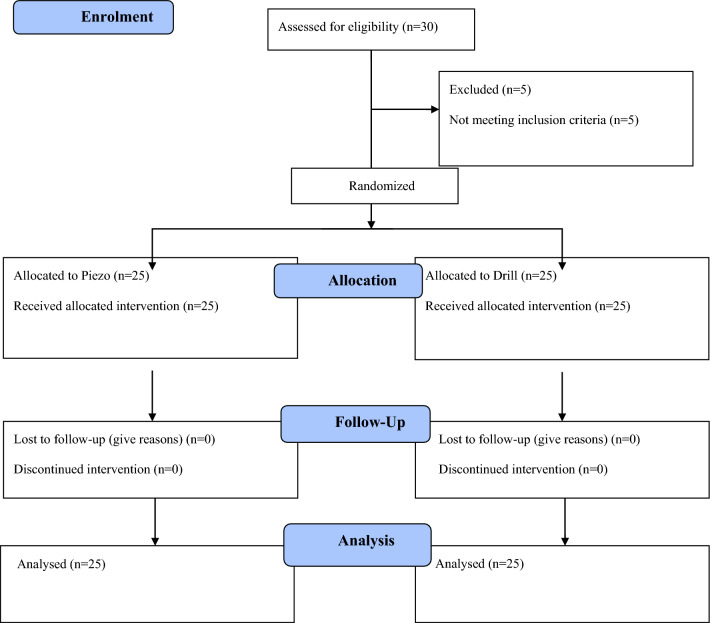
Methods: Twenty-five partially edentulous patients requiring two single implants in molar/premolar areas had each site randomly allocated to either piezosurgery or to conventional rotary drill preparation according to a split-mouth design. Definitive screw-retained metal-ceramic crowns were delivered after 6 months. All patients were followed to 5 years after placement. Outcome measures were: implant/crown failures, complications, peri-implant marginal bone level changes, resonance frequency analysis (RFA), and time required to complete site preparation, recorded, when possible, by blinded assessors.
Results: No patients dropped-out and no implant failed. Five years after placement, there were no statistically significant differences for complications (only one complication in the piezo group: difference = 0.04; P = 1), for peri-implant bone loss (difference = -0.11 mm; 95% CI -0.24 to 0.01; P = 0.083), and for RFA changes (6 months) (difference = -0.35; 95% CI -1.95 to 1.25; P = 0.672 between groups). Significantly more time was needed to prepare implant sites with piezosurgery (difference = 236.8 s; 95% CI -286.12 to -187.48; P < 0.0001). Initial soft tissue thickness had no effect on peri-implant bone loss (estimate = 0.05; 95% CI -0.03; 0.12; P = 0.239).
Conclusions: No clinically appreciable differences were noticed when placing implants using piezosurgery or conventional instrumentation with rotary drill, however, the preparation with rotary drills was on average 4 min faster. No effect of initial crestal soft tissue thickness was observed on peri-implant bone loss.
Keywords: Dental implants; Implant site preparation; Piezoelectric surgery; Rotary drills.
© 2024. The Author(s).
Conflict of interest statement
Declarations. Ethics approval and consent to participate: The study protocol was approved by the University of Mainz Ethics Committee (Ethics Committee No.: 837.1 85.1 5 (9953)). All patients signed a specifically informed consent that was approved by the ethical committee in order to participate in the present trial. Consent for publication: Not applicable. Competing interests: The authors declare no competing interests.
Figures
References
-
- Vercellotti T, Nevins ML, Kim DM, Nevins M, Wada K, Schenk RK, et al. Osseous response following resective therapy with piezosurgery. Int J Periodontics Restorative Dent. 2005;25:543–9. - PubMed
Publication types
MeSH terms
LinkOut - more resources
Full Text Sources
