


A brief effective screening protocol for identifying cataract patients with binocular vision anomalies
- PMID: 39695508
- PMCID: PMC11657689
- DOI: 10.1186/s12886-024-03807-w
A brief effective screening protocol for identifying cataract patients with binocular vision anomalies
Abstract
Background: To compare the effectiveness of a brief binocular vision screening protocol to a comprehensive examination for detecting binocular vision anomalies before and after cataract surgery.
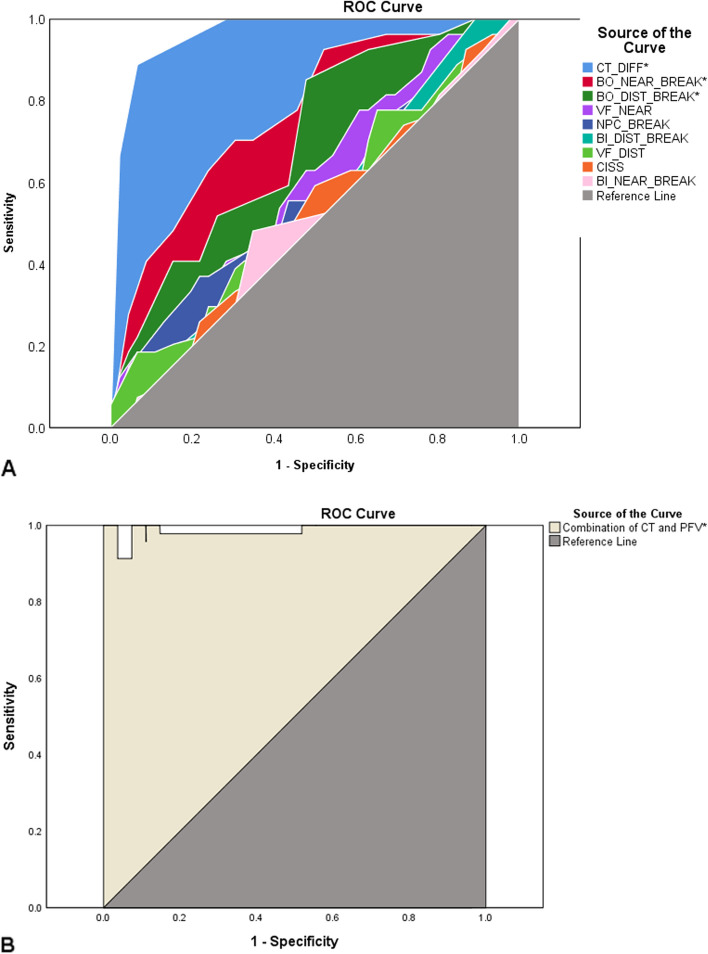
Methods: A comprehensive binocular vision test battery as a gold standard were administered on recruited patients before the first surgery and at the third visit after surgery on the second eye. A receiver operating characteristic (ROC) curve was plotted to illustrate the diagnostic ability of each test. In addition, a univariate logistic regression analysis was performed to further determine the contribution of each preoperative test to the prediction of pre- and post-surgical binocular vision anomalies.
Results: Significant differences were shown for the difference in phoria from distance to near measured by the cover test (Area Under Curve [AUC] = 0.96, P < 0.01), step vergence testing of positive fusional vergence at distance (AUC = 0.71, P < 0.01) and near (AUC = 0.77, P < 0.01). The other tests did not show statistically significant differences. The ROC curve generated by combining the difference in distance and near phoria with positive fusional vergence at both distance and near demonstrated a more robust measure of diagnostic accuracy. (AUC = 0.98, P < 0.01).
Conclusion: Distance and near phoria difference measured by cover test has similar effectiveness as a comprehensive binocular vision testing protocol for the diagnosis of binocular vision anomalies. Distance and near positive fusional vergence measured by step vergence testing also have significant predictive value. A combination of the two tests is an outstanding screening protocol for binocular vision anomalies before cataract surgery.
Trial registration: The study was registered at ClinicalTrials.gov (NCT03592615, Date of registration: July 19, 2018).
Keywords: Age-related; Binocular vision anomaly; Cataract; Screening protocol.
© 2024. The Author(s).
Conflict of interest statement
Declarations. Ethics approval and consent to participate: The study followed the tenets of the Declaration of Helsinki and the study protocol was approved by the Institutional Review Board of Salus University. Eligible subjects were asked to sign a written informed consent and a Health Insurance Portability and Accountability (HIPPA) authorization before any study testing was administered. Consent for publication: Not applicable. Competing interests: The authors declare no competing interests.
Figures
References
Publication types
MeSH terms
Associated data
Grants and funding
LinkOut - more resources
Full Text Sources
Medical
