


Striking a balance: health behaviour changes in Chinese spouses of people with dementia to manage dementia risk: a qualitative study
- PMID: 39695536
- PMCID: PMC11656962
- DOI: 10.1186/s12912-024-02588-3
Striking a balance: health behaviour changes in Chinese spouses of people with dementia to manage dementia risk: a qualitative study
Abstract
Background: Multiple studies have shown that spouses of people with dementia (PwD) are two to six times more likely to develop dementia compared to the general population. Encouraging healthy behaviours and addressing modifiable risk factors could potentially prevent or delay up to 40% of dementia cases. However, little is known about how health behaviours change when a spouse assumes the role of primary caregiver. Therefore, the aim of this study was to explore the shared lived experience of spousal caregivers of PwD, focusing on identifying the trajectory and key events of that shape health behaviour changes after their partner's diagnosis. These findings seek to inform strategies for adopting and sustaining healthy behaviours among spousal caregivers.
Method: A qualitative descriptive study was conducted. Using maximum variation and purposive sampling, 20 spouses of PwD who exhibited two or more risk factors were recruited for semistructured interviews. The interviews were transcribed verbatim and analysed using thematic analysis.
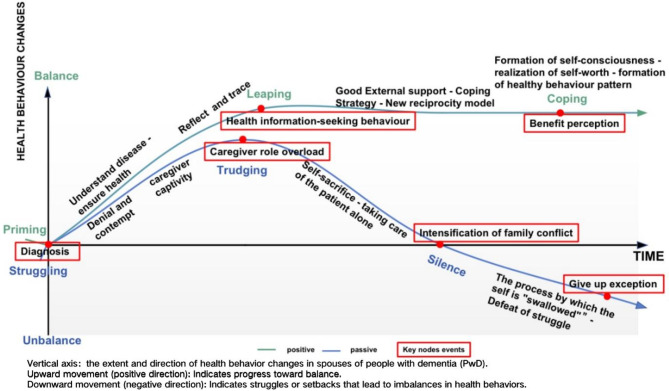
Results: We found that in traditional Chinese culture health behaviour changes for spouses and people with dementia coping with the challenges of dementia occurred in two directions; (a) priming-leaping-coping: becoming a "smart" caregiver and (b) struggling-trudging-silence: the process by which the self is "swallowed."
Conclusion: This study highlights how caregiving experiences influence spouses' health behaviors and dementia prevention, particularly in the Chinese context. The findings underscore the challenges of balancing caregiving with self-care. Culturally tailored, family-centered interventions are needed to support both caregivers and their long-term well-being.
Keywords: Dementia; Health behaviour; Qualitative studies; Risk factors; Spouses.
© 2024. The Author(s).
Conflict of interest statement
Declarations. Ethics approval and consent to participate: All methods were performed in accordance with the relevant guidelines and regulations of the declaration of Helsinki (ethical approval and consent to participate). This study was approved by the ethics committee of Jilin university (No:2021121504)(Ethics Committee of School of Nursing, Jilin University). The aims and methods of the project were explained to all participants, and necessary assurance was given to them about the anonymity and confidentiality of their information and audio files. Informed consent was taken from all participants. The participants had the right to withdraw from the study during or at any other time. Consent for publication: Not applicable. Competing interests: The authors declare no competing interests.
Figures
References
-
- International AsD. World Alzheimer Report 2022-Life after diagnosis: Navigating treatment, care and support. 2022 [ https://www.alzint.org/resource/world-alzheimer-report-2022/
Grants and funding
LinkOut - more resources
Full Text Sources
