


Scoping review of fidelity strategies used in behaviour change trials delivered in primary dental care settings
- PMID: 39695740
- PMCID: PMC11653899
- DOI: 10.1186/s13063-024-08659-9
Scoping review of fidelity strategies used in behaviour change trials delivered in primary dental care settings
Abstract
Background: Primary dental care settings are strategically important locations where randomised controlled trials (RCTs) of behaviour change interventions (BCIs) can be tested to tackle oral diseases. Findings have so far produced equivocal results. Improving treatment fidelity is posed as a mechanism to improve scientific rigour, consistency and implementation of BCIs. The National Institutes of Health Behaviour Change Consortium (NIH BCC) developed a tool to assess and evaluate treatment fidelity in health behaviour change interventions, which has yet to be applied to the primary dental care BCI literature.
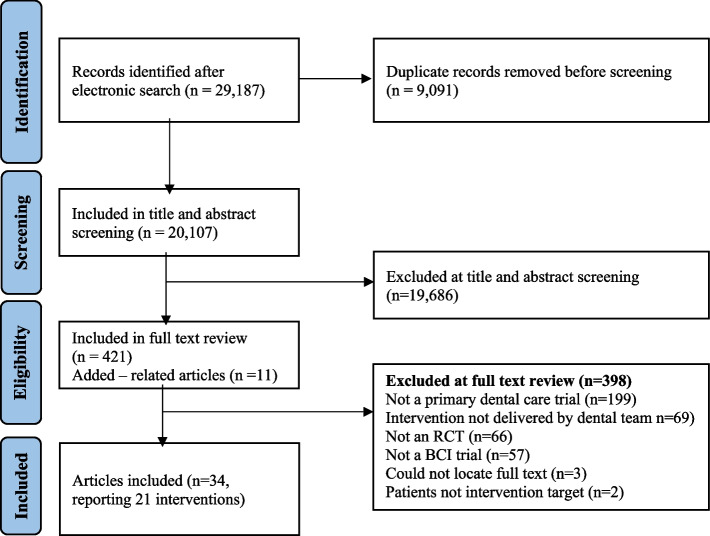
Method: We conducted a scoping review of RCTs delivered in primary dental care by dental team members (in real-world settings) between 1980 and 2023. Eligible studies were coded using the NIH BCC checklist to determine the presence of reported fidelity strategies across domains: design, training, delivery, receipt and enactment.
Results: We included 34 eligible articles, reporting 21 RCTs. Fidelity reporting variations were found both between and within NIH BCC domains: strategy reporting ranged from 9.5 to 85.7% in design, 9.5 to 57.1% in training, 0 to 66.7% in delivery, 14.3 to 36.8% in receipt and 13.3 to 33.3% in enactment. The most reported domain was design (M = 0.45), and the least reported domain was delivery (M = 0.21). Only one study reported over 50% of the recommended strategies in every domain.
Conclusions: This review revealed inconsistencies in fidelity reporting with no evidence that fidelity guidelines or frameworks were being used within primary dental care trials. This has highlighted issues with interpretability, reliability and reproducibility of research findings. Recommendations are proposed to assist primary dental care trialists with embedding fidelity strategies into future research.
Keywords: Behaviour change; Dental teams; Fidelity; Intervention implementation; Primary dental care.
© 2024. The Author(s).
Conflict of interest statement
Declarations. Ethics approval and consent to participate: Not applicable. Consent for publication: Not applicable. Competing interests: The authors declare that they have no competing interests.
References
-
- Kassebaum NJ, Smith AG, Bernabe E, Fleming TD, Reynolds AE, Vos T, et al. Global, regional, and national prevalence, incidence, and disability-adjusted life years for oral conditions for 195 countries, 1990–2015: a systematic analysis for the global burden of diseases, injuries, and risk factors. J Dent Res. 2017;96(4):380–7. - DOI - PMC - PubMed
-
- World Health Organization. Oral Health [Internet]. Geneva: World Health Organization; [cited 2024 Mar 14]. Available from: https://www.who.int/news-room/fact-sheets/detail/oral-health.
Publication types
MeSH terms
LinkOut - more resources
Full Text Sources
Medical
