. 2024 Dec 18;17(1):514.
doi: 10.1186/s13071-024-06602-0.

Hosts and vectors of scrub typhus in Chile: epidemiological study and molecular analyses of Orientia infection in rodents and rodent-associated mites

Affiliations

Hosts and vectors of scrub typhus in Chile: epidemiological study and molecular analyses of Orientia infection in rodents and rodent-associated mites

Constanza Martínez-Valdebenito et al. Parasit Vectors. .

Abstract

Candidatus Orientia chiloensis causes scrub typhus over a wide geographical range in southern Chile. The life cycle, including vectors and reservoirs of this novel rickettsial pathogen, is incompletely understood. We analyzed rodent tissue and rodent-associated mite samples collected during a field study in six localities on Chiloé Island, where human scrub typhus cases have occurred. Using molecular methods, we detected Orientia DNA in 24.8% of rodents, belonging to five of seven captured species. Orientia-infection rates showed geographical variations, but were not influenced by rodent species, sex, age, and mite infestation. Phylogenetic analysis showed that Orientia sequences from trombiculid mites (Proschoengastia eloisae) were identical to those from scrub typhus patients from the same region. The results suggest that these rodent-associated mites serve as vectors and play an important role in the ecology of scrub typhus in southern Chile. Further studies are required to determine whether Orientia-infected rodents can also serve as reservoir of Orientia in Chile.

Keywords: Epidemiology; Rickettsiales; Scrub typhus; South America; Vector-borne diseases; Zoonotic diseases.


Conflict of interest statement

Declarations. Ethics approval and consent to participate: The protocol used for rodent capture and sampling was approved by the Chilean Animal Health Service (no. 7034/2017) and the Scientific Ethics Committee for the Care of Animals and the Environment, Pontificia Universidad Católica de Chile (no. 160816007, 07 Nov 2017). Competing interests: The authors declare no competing interests. Consent for Publication: Not applicable. Disclaimers: The views expressed in this article are those of the authors and do not necessarily reflect the official policy or position of the Department of the Navy, Department of Defense, nor the U.S. Government. At the time of the investigation, A.L.R. was an employee of the U.S. Government, and this work was prepared as a part of his official duties. Title 17 U.S.C. §105 provides that ‘Copyright protection under this title is not available for any work of the United States Government.’ Title 17 U.S.C. §101 defines a U.S. Government work as a work prepared by a military service member or employee of the U.S. Government as part of that person’s official duties.

Figures
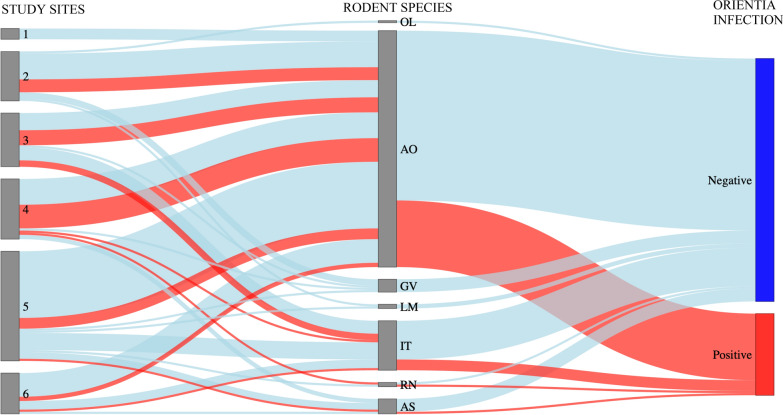
Fig. 1
Fig. 1
Sankey diagram showing distribution of Orientia infection (red, positive; blue, negative) among different rodent species captured in six study sites (1–6) on Chiloé Island (n = 151). OL, Oligoryzomys longicaudatus; AO, Abrothrix olivacea; GV, Geoxus valdivianus; LM, Loxodontomys micropus; IT, Irenomys tarsalis; RN, Rattus norvegicus; AS, Abrothrix sanborni
Fig. 2
Fig. 2
Phylogenetic tree of 16S RNA gene (rrs) of Candidatus Orientia chiloensis (OC) from trombiculid mites and patients with scrub typhus, as well as Orientia tsutsugamushi strains (OT), Candidatus Orientia chuto, and other bacteria. The evolutionary history was inferred by using the maximum likelihood method and Tamura-Nei model [18]. The tree with the highest log likelihood (−2747.08) is shown. The percentage of trees in which the associated taxa clustered together is shown next to the branches. Initial tree(s) for the heuristic search were obtained automatically by applying Neighbor-Join and BioNJ algorithms to a matrix of pairwise distances estimated using the maximum composite likelihood (MCL) approach, and then selecting the topology with superior log likelihood value. A discrete Gamma distribution was used to model evolutionary rate differences among sites [five categories (+ G, parameter = 0.1974)]. This analysis involved 42 nucleotide sequences. All positions with less than 95% site coverage were eliminated, i.e., fewer than 5% alignment gaps, missing data, and ambiguous bases were allowed at any position (partial deletion option). There was a total of 859 positions in the final dataset. Evolutionary analyses were conducted in MEGA X [19]. Red circles indicate the sequences from trombiculid mites of this study. Sequences retrieved from GenBank have the genus, followed by the species, strain, and GenBank accession number. Sequences from the different Orientia tsutsugamushi strains are named OT, followed by the strain

References

    1. Paris DH, Shelite TR, Day NP, Walker DH. Unresolved problems related to scrub typhus: a seriously neglected life-threatening disease. Am J Trop Med Hyg. 2013;89:301–7. - PMC - PubMed
    1. Izzard L, Fuller A, Blacksell SD, Paris DH, Richards AL, Aukkanit N, et al. Isolation of a novel Orientia species (O. chuto sp. nov.) from a patient infected in Dubai. J Clin Microbiol. 2010;48:4404–9. - PMC - PubMed
    1. Blair PW, Kobba K, Okello S, Alharthi S, Naluyima P, Clemens E, et al. Illness AF; Sepsis in Uganda study teams. Evidence of Orientia spp. endemicity among severe infectious disease cohorts, Uganda. Emerg Infect Dis. 2024;30:1442–6. - PMC - PubMed
    1. Weitzel T, Martínez-Valdebenito C, Acosta-Jamett G, Abarca K. Notes from the field: scrub typhus outbreak—Los Lagos Region, Chile, January–February 2023. MMWR Morb Mortal Wkly Rep. 2023;72:753–4. - PMC - PubMed
    1. Luce-Fedrow A, Lehman ML, Kelly DJ, Mullins K, Maina AN, Stewart RL, et al. A review of scrub typhus (Orientia tsutsugamushi and related organisms): then, now, and tomorrow. Trop Med Infect Dis. 2018;3:8. - PMC - PubMed

MeSH terms

LinkOut - more resources
