


Non-surgical therapy for intermittent exotropia: a systematic review and network analysis
- PMID: 39696091
- PMCID: PMC11657624
- DOI: 10.1186/s12886-024-03804-z
Non-surgical therapy for intermittent exotropia: a systematic review and network analysis
Abstract
Objective: This study aimed to conduct a network meta-analysis to evaluate the efficacy of various non-surgical treatments for intermittent exotropia(IXT).
Methods: A comprehensive search of the PubMed, EMbase, and Cochrane Library databases was performed to identify relevant randomized controlled trials (RCTs) up to June 2024. Following independent screening, data extraction, and bias assessment by two researchers, network meta-analysis was conducted using R 4.2.2 software.
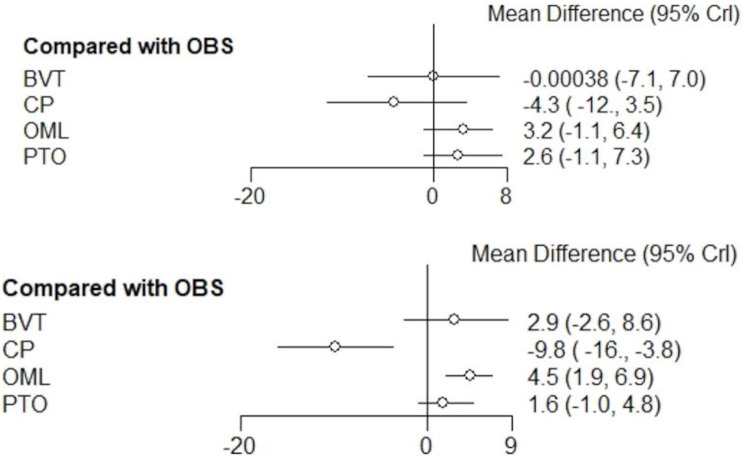
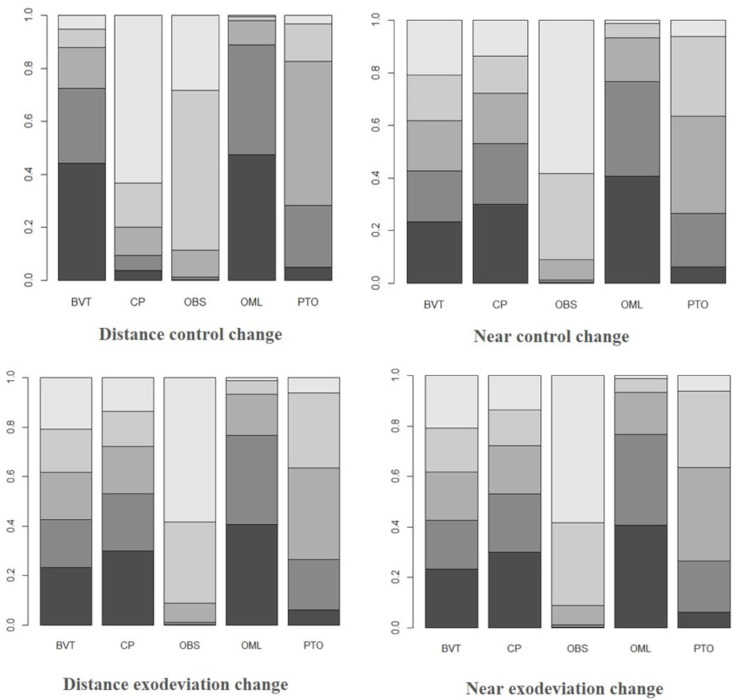
Results: A total of 11 RCTs involving 1411 patients were included. Treatment options included overminus lenses (OML), conventional prisms(base-in prism) (CP), part time occlusion (PTO), and binocular vision training (BVT). OML demonstrated superior efficacy in improving distance and near control(1.1, 95% confidence interval (CI), 0.22 ∼ 1.8); 0.67, 95% CI :0.027 ∼ 1.2), as well as reducing near exodeviation compared to observation(4.5, 95% CI, 1.9 ∼ 6.9), but failed to reduce distance angle of deviation(3.2, 95%CI, -1.1 ∼ 6.4). No significant effect in improving control and reducing exodeviation angle at both distance and near was observed in PTO, BVT, and CP. Probability ranking indicated that the top-ranking three non-surgical interventions were OML, BVT and PTO for improving distance control and reducing near exodeviation; the top three non-surgical interventions for reducing distance exodevition were OML, PTO and BVT; the best non-surgical intervention for improving near control was OML, BVT、 PTO and CP have similar effects. The four non-surgical treatments had no significant impact on near stereoacuity.
Conclusion: Overall, OML ranks first among the four conservative treatment methods. These four commonly used non-surgical interventions did not significantly impact near stereoacuity. Clinicians should tailor personalized treatment strategies for patients with intermittent exotropia based on disease severity, characteristics, efficacy, and cost considerations.
Keywords: Intermittent exotropia; Meta-analysis; Non-surgical therapy.
© 2024. The Author(s).
Conflict of interest statement
Declarations. Ethics approval and consent to participate: For this type of study formal consent is not required. Consent for publication: Not applicable. Competing interests: The authors declare no competing interests.
Figures



References
-
- Govindan M, Mohney BG, Diehl NN, Burke JP. Incidence and types of childhood exotropia: a population-based study. Ophthalmology. 2005;112(1):104–8. - PubMed
-
- Mohney BG. Common forms of childhood strabismus in an incidence cohort. Am J Ophthalmol. 2007;144(3):465–7. - PubMed
-
- von Noorden GK, Campos ECJT. strabismus mo. Binocul Vis Ocular Motil. 2002:340–5.
-
- Song D, Yang M, Qian J, Chen Z, Zhou Q, Chen J. The influence of part-time occlusion therapy on control of intermittent Exotropia: a Meta-analysis of Randomized controlled trials. Ophthalmic Res. 2023;66(1):801–8. - PubMed
Publication types
MeSH terms
LinkOut - more resources
Full Text Sources
Miscellaneous
