


Enhancing multi-sectoral collaborations for the prevention and control of NCDs in Thailand with a new approach
- PMID: 39696316
- PMCID: PMC11657278
- DOI: 10.1186/s12961-024-01262-z
Enhancing multi-sectoral collaborations for the prevention and control of NCDs in Thailand with a new approach
Abstract
Background: To achieve the Sustainable Development Goals (SDGs) by 2030, Thailand must engage in effective multi-sectoral collaboration (MSC). However, implementing MSC in Thailand presents significant challenges. Although Thailand had a 2011-2020 MSC strategic plan for the control of non-communicable diseases (NCDs) with the prime minister taking the lead, joined by many non-health ministers, not a single meeting was called over those 10 years. This paper describes the development of a new tool created to enhance MSC between health and non-health sectors in controlling NCDs in Thailand. Stakeholder-engaged research will be used to implement and evaluate this tool. This paper also describes the research planned to test the new approach.
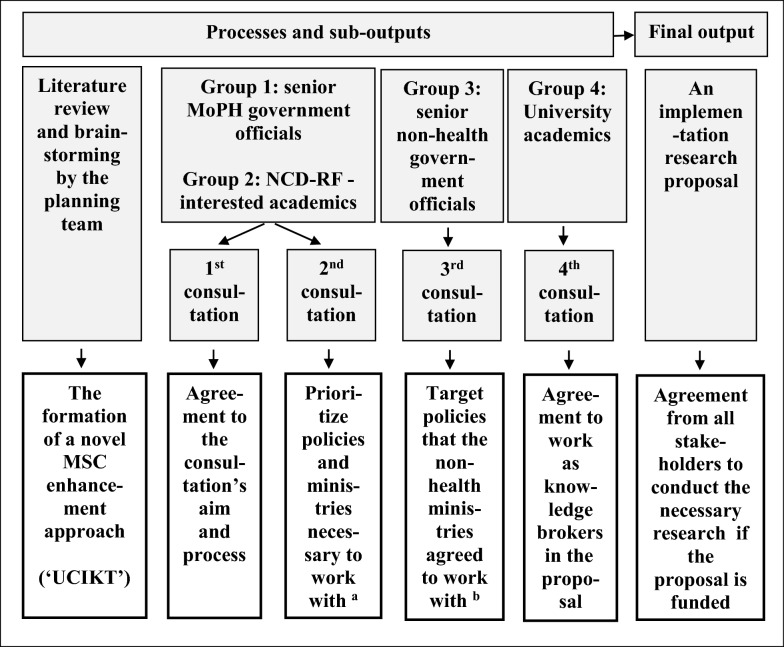
Methods: The authors used two main methods: (1) a narrative review on MSC enhancement and (2) a series of four consultation meetings with key stakeholders - in the health, non-health and academic sectors - to develop a research study to implement and evaluate the new approach.
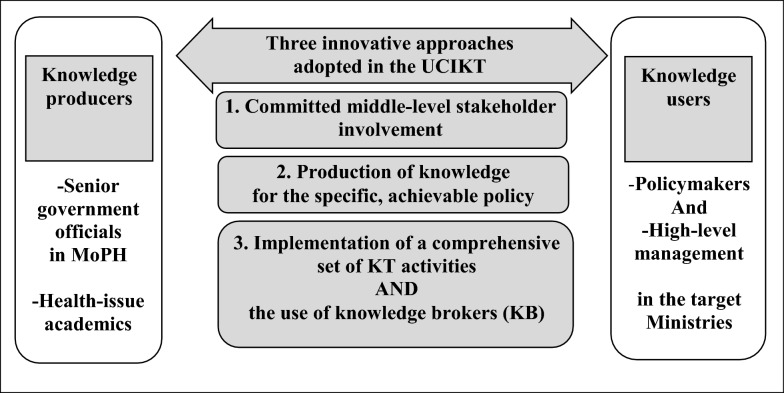
Results: To address previous MSC implementation problems, the proposed novel MSC enhancement approach emphasizes three principles: (1) pursuit of committed-stakeholder involvement at the middle-management level, instead of relying on the top-management level, an approach which has never been successful; (2) production of knowledge to support specific, achievable target policies; and (3) use of a comprehensive set of knowledge-translation activities and knowledge brokers to solve the problem of ineffective routine official communications between members of the MSC. Using participatory consultations during the research proposal development, middle-level officials from three non-health ministries (the Ministries of Agriculture, Finance and Education) agreed to join the MSC to work together to solve specific problems regarding the control of NCDs. A target-advocated policy for each ministry was formulated and agreed upon by both non-health-sector and health-sector stakeholders.
Conclusions: This new approach (middle-management oriented), if implemented, may encourage more commitment from the Ministries' representatives, policy-relevant knowledge generation and effective communications between ministries involved in an MSC. Ideally, it would complement the conventional approach (top-management oriented) in enhancing the MSC for controlling NCDs, and thereby bring hope for achieving the NCD-related SDGs for Thailand and possibly other countries as well.
Keywords: Knowledge broker; Knowledge generation and dissemination; Knowledge translation; Multi-sectoral collaboration (MSC); Non-communicable diseases (NCDs); Stakeholder involvement; Sustainable Development Goals (SDGs).
© 2024. Crown.
Conflict of interest statement
Declarations. Ethics approval and consent to participate: This article discussed the results of a research proposal development process. As it was not a research study, it did not require ethics approval. Consent for publication: Not applicable. Competing interests: The authors declare no competing interests.
Figures
References
-
- World Health Organization. Noncommunicable diseases progress monitor 2020. WHO. https://www.who.int/publications/i/item/9789240000490/. Accessed 22 Mar 2023.
-
- World Health Organization. Noncommunicable diseases. Cairo: World Health Organization Regional Office for the Eastern Mediterranean. http://www.emro.who.int/noncommunicable-diseases/publications/questions-.... Accessed 15 Mar 2023.
-
- Wickramasinghe K, Wilkins E, Foster C, et al. The development of national multisectoral action plans for the prevention and control of noncommunicable diseases: experiences of national-level stakeholders in four countries. Glob Health Action. 2018;11(1):1532632. 10.1080/16549716.2018.1532632. - PMC - PubMed
MeSH terms
Grants and funding
LinkOut - more resources
Full Text Sources
