


Asymptomatic Plasmodium falciparum infections and determinants of carriage in a seasonal malaria chemoprevention setting in Northern Cameroon and south Senegal (Kedougou)
- PMID: 39696387
- PMCID: PMC11657642
- DOI: 10.1186/s12936-024-05150-3
Asymptomatic Plasmodium falciparum infections and determinants of carriage in a seasonal malaria chemoprevention setting in Northern Cameroon and south Senegal (Kedougou)
Abstract
Background: Among the several strategies recommended for the fight against malaria, seasonal malaria chemoprevention (SMC) with sulfadoxine-pyrimethamine and amodiaquine combination (SPAQ) targets children 3 months to 5 years in Sahel regions of Africa to reduce mortality and mortality. Since SMC with SPAQ is administered to symptoms-free children for prevention of malaria, it is anticipated that a proportion of asymptomatic parasitaemic children will also be treated and may result in a drop in both the overall population prevalence of asymptomatic malaria infections, subsequent risk of symptomatic malaria infections and transmission. Age-specific carriage of asymptomatic Plasmodium spp. infections (API) was evaluated in target children and adults in Cameroon and Senegal, prior to the 2018 SMC campaign in both countries.
Methods: A baseline household survey was carried out in August 2018 in two areas in Cameroon and one in Senegal just before the beginning of distribution of SPAQ for SMC. The survey included collection of fingerpick blood for malaria rapid diagnostic testing (RDT) and administration of a pre-tested questionnaire on demographics and malaria risk factors to participants. The age-specific prevalence of API in all study sites was analysed, first as a distribution of RDT-positives in 5-year age categories and secondly, with age as a continuous variable in the whole sample, using the Wilcoxon rank sum test. Risk factors for carriage of asymptomatic infections were examined using logistic regression analysis in STATA v.16 and Rv4.1.2.
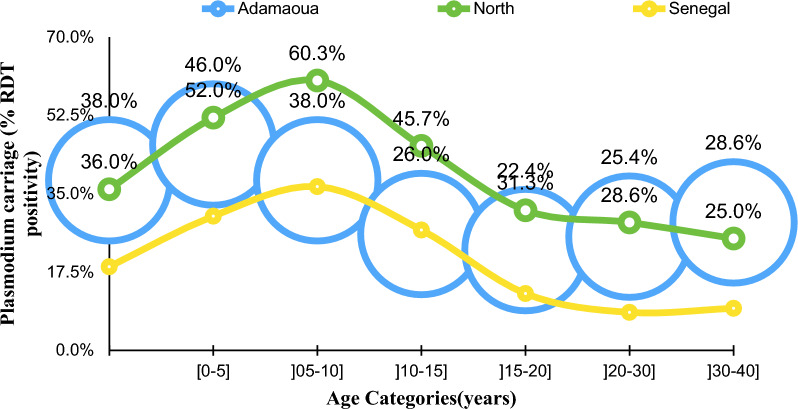
Results: In total, 6098 participants were surveyed. In Cameroon, overall prevalence of API was 34.0% (32.1-36.0%) in Adamaoua, and 43.5% (41.0-45.7%) in the North. The median age of RDT positivity was higher in Senegal: 11 years (IQR 7-16) than in Cameroon-Adamaoua: 8 years (4-17) and North: 8 years (4-12) and significantly different between the three study regions. In all three study sites, asymptomatic carriage was significantly higher in the older age group (5-10 in Cameroon, and 7-14 in Senegal), compared to the younger age group, although the median age of participants was lower among RDT-negatives in the North compared to RDT-positives. Health area, gender and last infection within past year significantly confounded the relationship between age and parasite carriage in Adamaoua and Senegal but not in North Cameroon. Absence of bed net and previous infection within one month of the survey all independently predicted carriage of asymptomatic parasites in multivariate regression analysis.
Conclusion: Under five years asymptomatic Plasmodium infection in northern Cameroon prior to SMC season remained high in 2018, irrespective of history of SMC implementation in the study areas in Cameroon. Compared to Adamaoua, peak asymptomatic malaria parasite rate was observed in children 5-10 years, which is out of the SMC target age-range. Health area, last infection within the past month and to a lesser extent gender affected the association between age and asymptomatic carriage in all sites except the North region of Cameroon, indicating wide heterogeneity in risk of malaria among the general population in that geography. Follow-up studies designed to measure SMC effects in Cameroon are warranted as it may become necessary to extend age of SMC eligibility to 10 years, as is practiced in Senegal.
Keywords: Adamaoua; Asymptomatic malaria; Kedougou; Plasmodium; Seasonal malaria chemoprevention.
© 2024. The Author(s).
Conflict of interest statement
Declarations. Ethics approval and consent to participate: Ethical clearance for the study was provided by the National Ethics Committee in Senegal and the National Ethics Committee for Human Health Research (CNERSH) in Cameroon through reference numbers 000179/MSAS/DPRS/CNERS of 22 December, 2017 for Senegal and 2018/01/961/CE/CNERSH/SP of 04 January, 2018). Consent for publication: All participants to this research provided consent for the research procedures and for potential publication of anonymized de-identified data resulting for the research.
Figures


References
-
- WHO. World malaria report. 20 years of global progress and challenges. Geneva: World Health Organization; 2020. p. 2020.
-
- WHO. World Malaria Report 2019. Geneva: World Health Organization, 2019.
-
- Björkman AB. Asymptomatic low-density malaria infections: a parasite survival strategy? Lancet Infect Dis. 2018;18:485–6. - PubMed
MeSH terms
Substances
Grants and funding
LinkOut - more resources
Full Text Sources
Miscellaneous
