


Embedding a culture of research in Canadian community hospitals: a qualitative study
- PMID: 39696396
- PMCID: PMC11653816
- DOI: 10.1186/s12961-024-01243-2
Embedding a culture of research in Canadian community hospitals: a qualitative study
Abstract
Background: In Canada, academic hospitals are the principal drivers of research and medical education, while community hospitals provide patient care to a majority of the population. Benefits of increasing community hospital research include improved patient outcomes and access to research, enhanced staff satisfaction and retention and increased research efficiency and generalizability. While the resources required to build Canadian community hospital research capacity have been identified, strategies for strengthening organizational research culture in these settings are not well defined. This study aimed to understand how research culture is experienced and shaped in Canadian community hospitals to provide strategies for strengthening research culture in these settings.
Methods: This qualitative descriptive study, as part of a larger study, explored the underlying dimensions of research culture. Participants were purposefully sampled and included healthcare providers, research staff or hospital administrators from community hospitals across Canada, with non-existent, emerging or established research programs. Data were collected via virtual semi-structured interviews and a demographic questionnaire. Interview transcripts were analyzed using reflexive thematic analysis and Schein's Model of Organizational Culture as a sensitizing framework. Demographic data were analyzed using descriptive statistics.
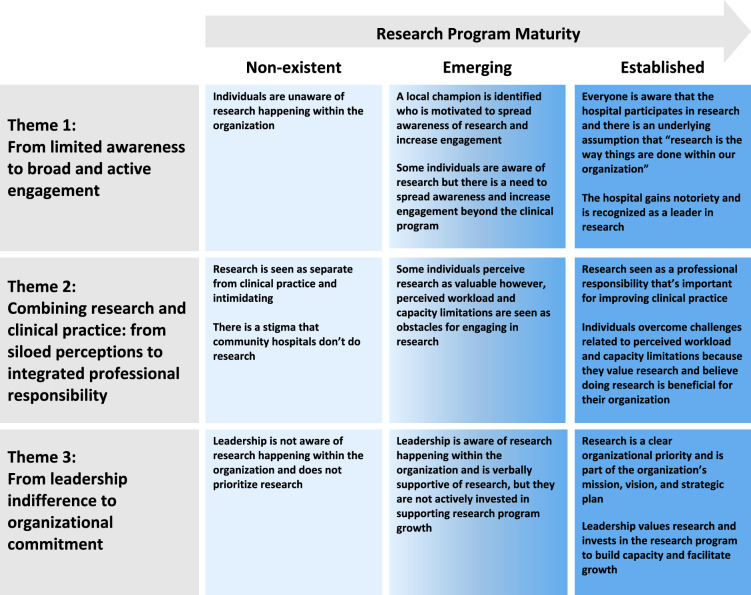
Results: A total of 38 participants from 20 Canadian community hospitals described their experiences of research culture illustrating three key themes. As community hospital research programs matured, participants described a shift in research culture whereby research became more embedded in "the way things are done" within the community hospital. Recommended strategies to achieve an embedded culture of research involve: communications; relationship building; mentorship, training and education opportunities; selecting locally relevant studies; and systems-level support. A top-down approach to embedding research culture was contrasted with a bottom-up approach.
Conclusions: This study described the underlying dimensions of community hospital research culture and targeted strategies for strengthening research culture at different levels of research program maturity. Community hospitals without pre-existing research infrastructure were able to foster a culture of research from the bottom-up by emphasizing the value of embedding research in clinical practice. Although challenging, fostering a culture of research from the bottom-up may be necessary to propel research forward and initiate the process to build research capacity within a community hospital.
Keywords: Community hospitals; Critical care; Organizational culture; Research capacity; Research culture.
© 2024. The Author(s).
Conflict of interest statement
Declarations. Ethics approval and consent to participate: This study received approval from the Hamilton Integrated Research Ethics Board (Study 14222). Informed written consent for participation was obtained for all participants prior to each interview. Participants were informed that they were free to withdraw from the study at any time and up to 2 weeks after the interview. Participant confidentiality was maintained by de-identifying the data. Consent for publication: Not applicable. Competing interests: J.T. and A.B. are clinician–scientists and clinical research program leads working in Canadian community hospitals with established research programs. J.T. is the Executive Director and Chief Scientist of a community hospital-based research institute. A.B. leads the Critical Care Research Program at a community hospital. Both A.B. and J.T. are co-founders and co-chair of the Canadian Community ICU Research Network. K.R. is a research coordinator, and E.O. and R.M. are research managers working in Canadian community hospitals with established research programs.
Figures

References
-
- Hospital Beds Staffed and In Operation, 2022–2023 [Internet]. Ottawa, Ont.: Canadian Institute for Health Information; 2024. https://www.google.com/url?sa=t&source=web&rct=j&opi=89978449&url=https:...
MeSH terms
LinkOut - more resources
Full Text Sources
Research Materials
