


Detecting and classifying eco-anxiety: development of clinical cut-off scores for the climate change anxiety scale
- PMID: 39696553
- PMCID: PMC11657576
- DOI: 10.1186/s40359-024-02240-4
Detecting and classifying eco-anxiety: development of clinical cut-off scores for the climate change anxiety scale
Abstract
Background: Climate change anxiety, that is worry and fear in relation to the awareness of the impacts of climate change, is widely observed around the world. Some evidence suggests that while climate change anxiety can, at times, be adaptive, a growing body of research has reported that climate change anxiety is also related to a range of negative mental health outcomes and psychological distress. Currently, however, there is limited ability to assess for elevated levels of climate change anxiety and to identify those who may need support. The present study, therefore, aimed to develop clinical cut-off scores on a measure of climate change anxiety.
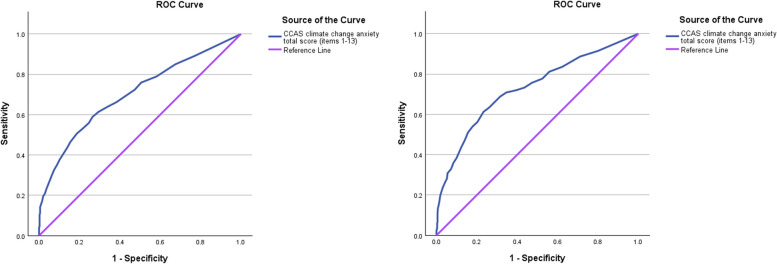
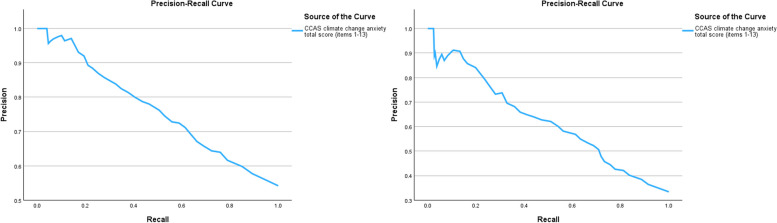
Methods: A largely representative sample of Australian young adults (aged 16-25 years) completed measures of psychological distress (Depression, Anxiety and Stress Scale-21) and the Climate Change Anxiety Scale. Markers of clinically meaningful psychological distress - elevated depression, anxiety, and stress symptoms-were used to classify cases. Receiver Operating Characteristics analyses were performed to assess the predictive ability of the indicators of psychological distress (mild, moderate, severe, and extremely severe thresholds of anxiety, depression, and stress symptoms) for detecting climate change anxiety and to ascertain optimal cut-off scores.
Results: The Area Under the Curve was acceptable to moderate for detecting climate change anxiety across all analyses. Across symptom severity thresholds and markers of psychological distress, based on consideration of balancing sensitivity and specificity, results consistently suggested that a cut-score of 21 was indicative of mild-moderate climate change anxiety, with a cut-off score of 23 indicating severe-extremely severe climate change anxiety.
Conclusions: The proposed cut-offs can feasibly be used to identify those with elevated climate change anxiety. Use of these cut-off scores can inform research as well as be used to guide screening, assessment, and inform clinical practice. Results also highlight a high rate of climate change anxiety in young adults.
Keywords: Climate change worry; Eco-worry; Ecological concern; Ecological distress; Psychological disorders; Wellbeing.
© 2024. The Author(s).
Conflict of interest statement
Declarations. Ethics approval and consent to participate: Ethics approval was provided by the University of New England Human Research Ethics Committee. Informed consent was obtained from participants prior to proceeding to the study survey. Consent for publication: Not Applicable. Competing interests: The authors declare no competing interests.
Figures
References
-
- IPCC. Climate change 2022: Impacts, adaptation, and vulnerability. C. U. Press; 2022.
-
- WHO. Mental health and climate change: policy brief. 2022.
-
- Ma T, Moore J, Cleary A. Climate change impacts on the mental health and wellbeing of young people: a scoping review of risk and protective factors. Soc Sci Med. 2022;301:114888. - PubMed
MeSH terms
LinkOut - more resources
Full Text Sources
Medical
