


Dyslipidemia and metabolic syndrome in childhood-onset systemic lupus erythematosus: is it time to screen?
- PMID: 39696576
- PMCID: PMC11654144
- DOI: 10.1186/s12944-024-02395-4
Dyslipidemia and metabolic syndrome in childhood-onset systemic lupus erythematosus: is it time to screen?
Erratum in
-
Correction: Dyslipidemia and metabolic syndrome in childhood-onset systemic lupus erythematosus: is it time to screen?Lipids Health Dis. 2025 Jan 31;24(1):34. doi: 10.1186/s12944-025-02453-5. Lipids Health Dis. 2025. PMID: 39891154 Free PMC article. No abstract available.
Abstract
Background: Childhood-onset systemic lupus erythematosus (cSLE) is associated with significant morbidity and mortality. Dyslipidemia and metabolic syndrome are recognized risk factors for premature atherosclerosis. This study aimed to determine the prevalence of dyslipidemia and metabolic syndrome, and to explore the relationships between lipid profiles, anthropometry, and disease status in cSLE.
Methods: This cross-sectional study was conducted at a university-based tertiary referral center from April 2023-March 2024. Patients aged 10-19 years with cSLE diagnosed before 18 years and at least 1 year follow-up were enrolled, excluding those with other autoimmune disorders, chronic kidney disease, infections, receiving lipid lowering drugs prior, and pregnancy. Demographic data, metabolic laboratory tests, disease status, dietary intake, anthropometry, and body composition via bioelectric impedance analysis were evaluated. The prevalence of dyslipidemia and metabolic syndrome were documented. Variables were compared between patients with and without dyslipidemia. Correlations between lipid profiles, metabolic laboratory variables, and SLE disease-related variables were explored.
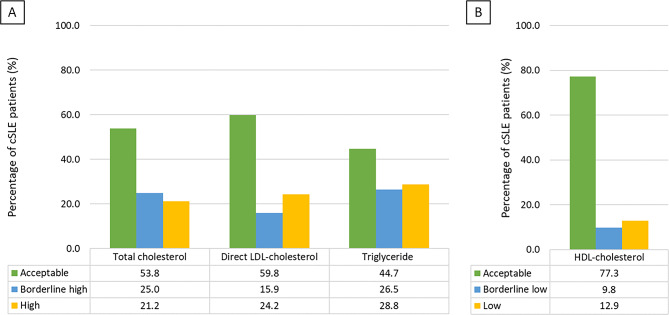
Results: A total of 132 cSLE patients (94.7% female, mean age 11.6 ± 2.6 years) were included. Dyslipidemia was present in 48.5%, hypertriglyceridemia being the most common (28.8%); metabolic syndrome and hyperuricemia were present in 3.8% and 20.5%, respectively. Patients with dyslipidemia were significantly younger at cSLE diagnosis, had higher percentage of hypertension and active features of organ involvement, lower percentage of Lupus Low Disease Activity State, more use of mycophenolate mofetil and antihypertensive medications, higher uric acid level, higher waist circumference, body mass index, body mass index z-score, and fat mass (P < 0.05). Triglycerides, low-density lipoprotein cholesterol, and total cholesterol correlated positively with urine protein-to-creatinine ratio (r = 0.472, 0.469, and 0.591, respectively; P < 0.001) and negatively with serum albumin (r = -0.372, -0.506, and - 0.528, respectively; P < 0.001). Total cholesterol and low-density lipoprotein cholesterol correlated positively with cumulative prednisolone equivalent dose (rho = 0.350 and rho = 0.351, respectively, P < 0.001).
Conclusions: Nearly half of cSLE patients had dyslipidemia, especially those with younger age at diagnosis, higher body mass index, proteinuria, and suboptimal-controlled disease. Metabolic syndrome and hyperuricemia were present. Lipid profile assessment in early adolescents is recommended to identify metabolic comorbidities in cSLE.
Keywords: Adolescent; Child; Childhood-onset; Dyslipidemia; Hyperuricemia; Metabolic syndrome; Systemic lupus erythematosus.
© 2024. The Author(s).
Conflict of interest statement
Declarations. Ethical approval: This study was approved by the Siriraj Institutional Review Board (certificate of approval Si 190/2023) and was conducted in accordance with the Declaration of Helsinki. All participants provided written informed consent and assent before participating in the study. Consent for publication: Not applicable. Competing interests: The authors declare no competing interests.
Figures
References
-
- Harry O, Yasin S, Brunner H. Childhood-Onset Systemic Lupus Erythematosus: A Review and Update. J Pediatr. 2018;196:22–30 e2. - PubMed
-
- Peng J, Donnes P, Ardoin SP, Schanberg LE, Lewandowski L, investigators At, et al. Atherosclerosis progression in the APPLE Trial can be predicted in Young People with Juvenile-Onset systemic lupus erythematosus using a novel lipid metabolomic signature. Arthritis Rheumatol. 2024;76(3):455–68. - PMC - PubMed
-
- Su-Angka N, Khositseth A, Vilaiyuk S, Tangnararatchakit K, Prangwatanagul W. Carotid intima-media thickness and arterial stiffness in pediatric systemic lupus erythematosus. Lupus. 2017;26(9):989–95. - PubMed
MeSH terms
LinkOut - more resources
Full Text Sources
Medical
Miscellaneous
