


Serotonin enhances neurogenesis biomarkers, hippocampal volumes, and cognitive functions in Alzheimer's disease
- PMID: 39696587
- PMCID: PMC11654273
- DOI: 10.1186/s13041-024-01169-4
Serotonin enhances neurogenesis biomarkers, hippocampal volumes, and cognitive functions in Alzheimer's disease
Abstract
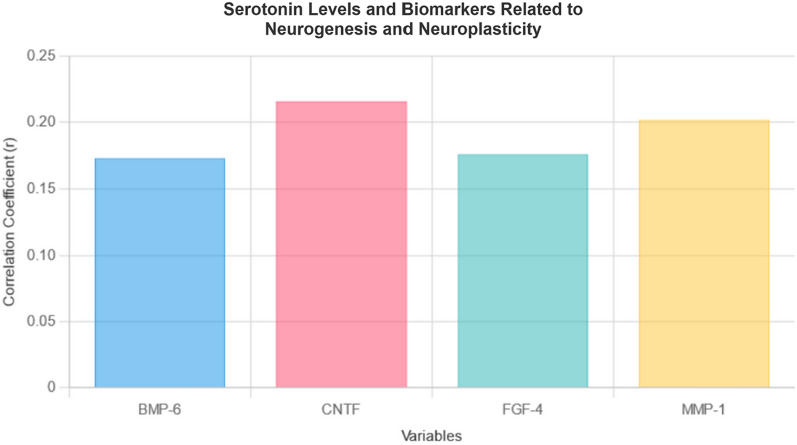
Research on serotonin reveals a lack of consensus regarding its role in brain volume, especially concerning biomarkers linked to neurogenesis and neuroplasticity, such as ciliary neurotrophic factor (CNTF), fibroblast growth factor 4 (FGF-4), bone morphogenetic protein 6 (BMP-6), and matrix metalloproteinase-1 (MMP-1) in Alzheimer's disease (AD). This study aimed to investigate the influence of serotonin on brain structure and hippocampal volumes in relation to cognitive functions in AD, as well as its link with biomarkers like CNTF, FGF-4, BMP-6, and MMP-1. Data from 133 ADNI participants with AD included cognitive assessments (CDR-SB), serotonin measurements (Biocrates AbsoluteIDQ p180 kit, UPLC-MS/MS), and neurotrophic factors quantified via multiplex proteomics. Gray matter volume changes were analyzed using Voxel-Based Morphometry (VBM) with MRI. Statistical analyses employed Pearson correlation, bootstrap methods, and FDR-adjusted p-values (< 0.05 or < 0.01) via the Benjamini-Hochberg procedure, alongside nonparametric methods. The analysis found a positive correlation between serotonin levels and total brain (r = 0.229, p = 0.023) and hippocampal volumes (right: r = 0.186, p = 0.032; left: r = 0.210, p = 0.023), even after FDR adjustment. Higher serotonin levels were linked to better cognitive function (negative correlation with CDR-SB, r = -0.230, p = 0.024). Notably, serotonin levels were positively correlated with BMP-6 (r = 0.173, p = 0.047), CNTF (r = 0.216, p = 0.013), FGF-4 (r = 0.176, p = 0.043), and MMP-1 (r = 0.202, p = 0.019), suggesting a link between serotonin and neurogenesis and neuroplasticity. However, after adjusting for multiple comparisons and controlling for confounding factors such as age, gender, education, and APOE genotypes (APOE3 and APOE4), none of the correlations of biomarkers remained statistically significant. In conclusion, increased serotonin levels are associated with improved cognitive function and increased brain volume. However, associations with CNTF, FGF-4, BMP-6, and MMP-1 were not statistically significant after adjustments, highlighting the complexity of serotonin's role in AD and the need for further research.
Keywords: Alzheimer’s disease; Brain structural volume; Cognitive function; Gray matter volume; Neurogenesis; Neuroplasticity; Serotonin.
© 2024. The Author(s).
Conflict of interest statement
Declarations. Ethics approval and consent to participate: This study was conducted using ADNI data. The ADNI study is ethically approved and operated in accordance with the Declaration of Helsinki, 1964. Consent for publication: Not applicable. Competing interests: There is no competing interests to be declared.
Figures
References
-
- Alenina N, Klempin F. The role of serotonin in adult hippocampal neurogenesis. Behav Brain Res. 2015;277:49–57. - PubMed
-
- Benninghoff J, Van Der Ven A, Schloesser RJ, Moessner R, Möller HJ, Rujescu D. The complex role of the serotonin transporter in adult neurogenesis and neuroplasticity. A critical review. World J Biol Psychiatry. 2012;13(4):240–7. - PubMed
-
- Nitsche MA, Kuo M-F, Karrasch R, Wächter B, Liebetanz D, Paulus W. Serotonin affects transcranial direct current–induced neuroplasticity in humans. Biol Psychiat. 2009;66(5):503–8. - PubMed
-
- Bird CM, Burgess N. The hippocampus and memory: insights from spatial processing. Nat Rev Neurosci. 2008;9(3):182–94. - PubMed
MeSH terms
Substances
LinkOut - more resources
Full Text Sources
Medical
Miscellaneous
