


Scoping Review of Economic Analyses of Rare Kidney Diseases
- PMID: 39698356
- PMCID: PMC11652074
- DOI: 10.1016/j.ekir.2024.09.004
Scoping Review of Economic Analyses of Rare Kidney Diseases
Abstract
Introduction: Rare kidney diseases (RKDs) place a substantial economic burden on patients and health systems, the extent of which is unknown and may be systematically underestimated by health economic techniques. We aimed to investigate the economic burden and cost-effectiveness evidence base for RKDs.
Methods: We conducted a systematic scoping review to identify economic evaluations, health technology assessments, and cost-of-illness studies relating to RKDs, published since 2012.
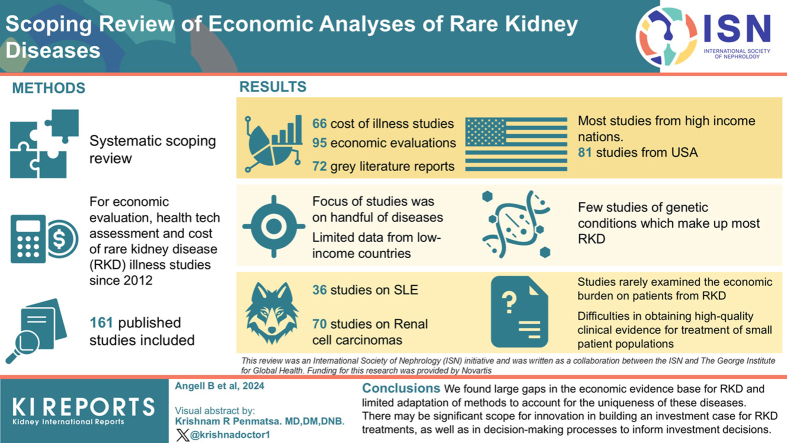
Results: A total of 161 published studies, including 66 cost-of-illness studies and 95 economic evaluations; 72 grey literature reports were also included. Most published literature originated from high-income nations, particularly the USA (81 studies), and focused on a handful of diseases, notably renal cell carcinomas (70) and systemic lupus erythematosus (36). Limited evidence was identified from lower-income settings and there were few studies of genetic conditions, which make up most RKDs. Some studies demonstrated the cost-effectiveness of existing treatments; however, there were limited considerations of broader economic impacts on patients that may be important to those with RKDs. Included health technology assessments highlighted difficulties in obtaining high-quality clinical evidence for treatments in very small patient populations, and often considered equity issues and other patient impacts qualitatively alongside clinical and economic evidence in their recommendations.
Conclusion: We found large gaps in the economic evidence base for RKDs and limited adaptation of methods to account for the uniqueness of these diseases. There may be significant scope for innovation in building an investment case for RKD treatments, as well as in decision-making processes to inform investment decisions.
Keywords: cost-effectiveness; economic burden; rare kidney disease.
© 2024 International Society of Nephrology. Published by Elsevier Inc.
References
-
- Devuyst O., Knoers N.V., Remuzzi G., Schaefer F. Board of the Working Group for Inherited Kidney Diseases of the European Renal Association and European Dialysis and Transplant Association. Rare inherited kidney diseases: challenges, opportunities, and perspectives. Lancet. 2014;383:1844–1859. doi: 10.1016/S0140-6736(14)60659-0. - DOI - PMC - PubMed
Publication types
LinkOut - more resources
Full Text Sources
