


From Virtual Reality to Reality: Fine-Tuning the Taxonomy for Extended Reality Simulation in Dental Education
- PMID: 39698875
- PMCID: PMC12288003
- DOI: 10.1111/eje.13064
From Virtual Reality to Reality: Fine-Tuning the Taxonomy for Extended Reality Simulation in Dental Education
Abstract
Introduction: Digital simulation in dental education has substantially evolved, addressing several educational challenges in dentistry. Following global lockdowns and sustainability concerns, dental educators are increasingly adopting digital simulation to enhance or replace traditional training methods. This review aimed to contribute to a uniform taxonomy for extended reality (XR) simulation within dental education.
Methods: This scoping review followed the PRISMA and PRISMA-ScR guidelines. PubMed/MEDLINE, EMBASE, Web of Science and Google Scholar were searched. Eligible studies included English-written publications in indexed journals related to digital simulation in dental/maxillofacial education, providing theoretical descriptions of extended reality (XR) and/or immersive training tools (ITT). The outcomes of the scoping review were used as building blocks for a uniform of XR-simulation taxonomy.
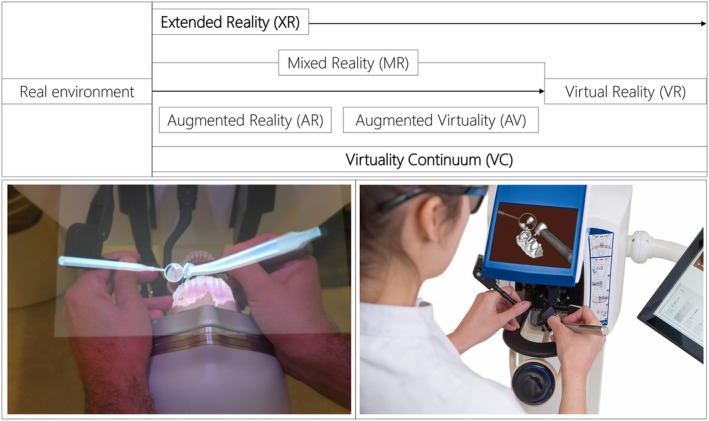
Results: A total of 141 articles from 2004 to 2024 were selected and categorised into Virtual Reality (VR), Mixed Reality (MR), Augmented Reality (AR), Augmented Virtuality (AV) and Computer Simulation (CS). Stereoscopic vision, immersion, interaction, modification and haptic feedback were identified as recurring features across XR-simulation in dentistry. These features formed the basis for a general XR-simulation taxonomy.
Discussion: While XR-simulation features were consistent in the literature, the variety of definitions and classifications complicated the development of a taxonomy framework. VR was frequently used as an umbrella term. To address this, operational definitions were proposed for each category within the virtuality continuum, clarifying distinctions and commonalities.
Conclusion: This scoping review highlights the need for a uniform taxonomy in XR simulation within dental education. Establishing a consensus on XR-related terminology and definitions facilitates future research, allowing clear evidence reporting and analysis. The proposed taxonomy may also be of use for medical education, promoting alignment and the creation of a comprehensive body of evidence in XR technologies.
Keywords: augmented reality; dental education; extended reality; haptics; mixed reality; virtual reality.
© 2024 The Author(s). European Journal of Dental Education published by John Wiley & Sons Ltd.
Conflict of interest statement
The authors declare no conflicts of interest.
Figures

References
-
- Perry S., Bridges S. M., and Burrow M. F., “A Review of the Use of Simulation in Dental Education,” Simulation in Healthcare 10 (2015): 31–37. - PubMed
-
- Serrano C. M., Wesselink P. R., and Vervoorn J. M., “First Experiences With Patient‐Centered Training in Virtual Reality,” Journal of Dental Education 84 (2020): 607–614. - PubMed
-
- Towers A., Field J., Stokes C., Maddock C., and Martin N., “A Scoping Review of the Use and Application of Virtual Reality in Pre‐Clinical Dental Education,” British Dental Journal 226 (2019): 358–366. - PubMed
-
- De Boer I. R., Bakker D. R., Serrano C. M., Koopman P., Wesselink P. R., and Vervoorn J. M., “Innovation in Dental Education: The “On‐The‐Fly” Approach to Simultaneous Development, Implementation and Evidence Collection,” European Journal of Dental Education 22 (2018): 215–222. - PubMed
-
- Chu T.‐M. G., Makhoul N. M., Silva D. R., Gonzales T. S., Letra A., and Mays K. A., “Should Live Patient Licensing Examinations in Dentistry Be Discontinued? Two Viewpoints,” Journal of Dental Education 82 (2018): 246–251. - PubMed
Publication types
MeSH terms
LinkOut - more resources
Full Text Sources
Research Materials
