. 2025 Mar 3;85(5):956-972.
doi: 10.1158/0008-5472.CAN-24-0323.

A Pan-RAS Inhibitor with a Unique Mechanism of Action Blocks Tumor Growth and Induces Antitumor Immunity in Gastrointestinal Cancer

Affiliations

A Pan-RAS Inhibitor with a Unique Mechanism of Action Blocks Tumor Growth and Induces Antitumor Immunity in Gastrointestinal Cancer

Jeremy B Foote et al. Cancer Res. .

Abstract

Activated RAS is a common driver of cancer that was considered undruggable for decades. Recent advances have enabled the development of RAS inhibitors, but the efficacy of these inhibitors remains limited by resistance. In this study, we developed a pan-RAS inhibitor, ADT-007, (Z)-2-(5-fluoro-1-(4-hydroxy-3,5-dimethoxybenzylidene)-2-methyl-1H-inden-3-yl)-N-(furan-2-ylmethyl)acetamide, that binds nucleotide-free RAS to block GTP activation of effector interactions and MAPK/AKT signaling, resulting in mitotic arrest and apoptosis. ADT-007 potently inhibited the growth of RAS-mutant cancer cells irrespective of the RAS mutation or isozyme. Wild-type RAS (RASWT) cancer cells with GTP-activated RAS from upstream mutations were equally sensitive. Conversely, RASWT cancer cells harboring downstream BRAF mutations and normal cells were essentially insensitive to ADT-007. Sensitivity of cancer cells to ADT-007 required activated RAS and dependence on RAS for proliferation, whereas insensitivity was attributed to metabolic deactivation by UDP-glucuronosyltransferases that were expressed in RASWT and normal cells but repressed in RAS-mutant cancer cells. ADT-007 displayed unique advantages over KRAS mutant-specific, pan-KRAS, and pan-RAS inhibitors that could impact in vivo antitumor efficacy by escaping compensatory mechanisms that lead to resistance. Local administration of ADT-007 showed robust antitumor activity in syngeneic immunocompetent and xenogeneic immune-deficient mouse models of colorectal and pancreatic cancers. The antitumor activity of ADT-007 was associated with the suppression of MAPK signaling and activation of innate and adaptive immunity in the tumor immune microenvironment. Oral administration of ADT-007 prodrug also inhibited tumor growth. Thus, ADT-007 has the potential to address the complex RAS mutational landscape of many human cancers and to improve treatment of RAS-driven tumors. Significance: ADT-007, a first-in-class pan-RAS inhibitor, has unique selectivity for cancer cells with mutant RAS or activated RAS protein and the capability to circumvent resistance to suppress tumor growth, supporting further development of ADT-007 analogs.


Conflict of interest statement

Disclosure of Potential Conflicts of Interest: G.A. Piazza, A.B. Keeton, X. Chen, and M.R. Boyd are co-founders of ADT Pharmaceuticals Inc. and consultants. All other authors declare no potential conflicts of interest.

Figures

Figure 1.
Figure 1.. ADT-007 selectively inhibits growth of RAS mutant cancer cells by blocking activated RAS and MAPK/AKT signaling and superior in comparison with other RAS inhibitors.
(A) Chemical structure of ADT-007. (B) ADT-007 inhibition of KRASG13D HCT-116 vs. KRASWT, BRAFV600E HT-29 CRC cell growth following 72 h of treatment (CTG assay). Quadruplicate samples ± SEM. Inset: Activated RAS-GTP-RBD pulldown evaluated by WB using pan-RAS antibodies. Total RAS and GAPDH served as loading controls. (C) Ectopic expression of HRASG12V sensitized HT-29 cells to ADT-007 growth inhibition (quadruplicates ± SEM). Inset: Activated RAS in untreated parental, vector control (retro), and transfected cells (H-Ras). (D) HCT-116 KRASG13D CRC cells were treated with increasing concentrations of ADT-007 overnight in complete medium (10% FBS). Activated RAS-GTP pulldowns, phospho(P)-cRAF, P-MEK, P-ERK, P-AKT, and total RAS and GAPDH as loading controls were detected by WB. Data represent 3 independent experiments. (E, F) Serum-starved MIA PaCa-2 KRASG12C PDA cells were treated overnight with vehicle or increasing concentrations of ADT-007, then EGF stimulated (30 ng/mL, 10 min). (E) P-cRAF, P-MEK, P-ERK, P-AKT and GAPDH were detected by WB. Data represent two independent experiments. (F) Activated RAS-GTP was isolated by RAS-RBD pulldown followed by WB with pan-RAS, KRAS, NRAS, or HRAS specific antibodies and GAPDH. Data represent at least two independent experiments. (G) Growth inhibition of MIA PaCa-2 cells by ADT-007 vs. BI-2865 or AMG-510 as determined by CTG assay following 72-h treatment (H, I) Growth inhibition of LLC cells (KRASG12C / NRASQ61H) by ADT-007 vs. BI-2865 or AMG-510 following 72-h treatment. (J) Apoptosis induction of MIA PaCa-2 cells following 48-h treatment with ADT-007, BI-2865 or RMC-6236 as measured by cleaved caspase-3/7 using a luminescence assay (Promega). Error bars represent SEM.
Figure 2.
Figure 2.. Phenolic moiety is critical for RAS selectivity of ADT-007 and renders sensitivity to metabolic deactivation.
(A) Left panel: ADT-007 selectively inhibits the growth of KRASG12C MIA PaCa-2 vs. RASWT BxPC-3 PDA cells (72 h, CTG assay; triplicates ± SEM). (B) Left panel: ADT-106 lacking a phenolic OH moiety was less potent and nonselective (72 h, CTG assay; triplicates ± SEM). Right panels (A, B): MIA PaCa-2 cells were treated for 18 h with increasing concentrations of ADT-007 (A) or ADT-106 (B) and activated RAS-GTP-RBD pulldown evaluated by WB using pan-RAS antibodies. Total RAS and GAPDH served as loading controls. (C) ADT-007 is rapidly degraded by mouse liver microsomes with a corresponding increase in ADT-007-glucuronide (ADT-007-Glu) levels (D). (E) UGT1 protein expression in ADT-007 sensitive vs. resistant tumor cells by WB. (F) UGT1 protein expression and control GAPDH (WB) from (E) were quantified and normalized using Image J. Representative of two independent experiments. (G) ADT-007 and ADT-007-glucuronide levels in HCT-116 and HT-29 cell pellets following 24 h treatment with ADT-007. Levels were quantified in triplicate by LC-MS/MS (mean ± SEM), * = p < 0.05. (H) Conditioned medium (CM) from MIA PaCa-2 (low UGT expression) and BxPC-3 (high UGT expression) PDA cells pretreated with ADT-007 at 100 nM for 24 h was collected for growth inhibition assays involving MIA PaCa-2 cells. CM from MIA PaCa-2 cells showed similar growth inhibitory activity as the control group using freshly prepared ADT-007. CM from BxPC-3 cells resulted in complete loss of potency of ADT-007 to inhibit the growth of MIA PaCa-2 cells (96 h, CTG assay; triplicates ± SEM).
Figure 3.
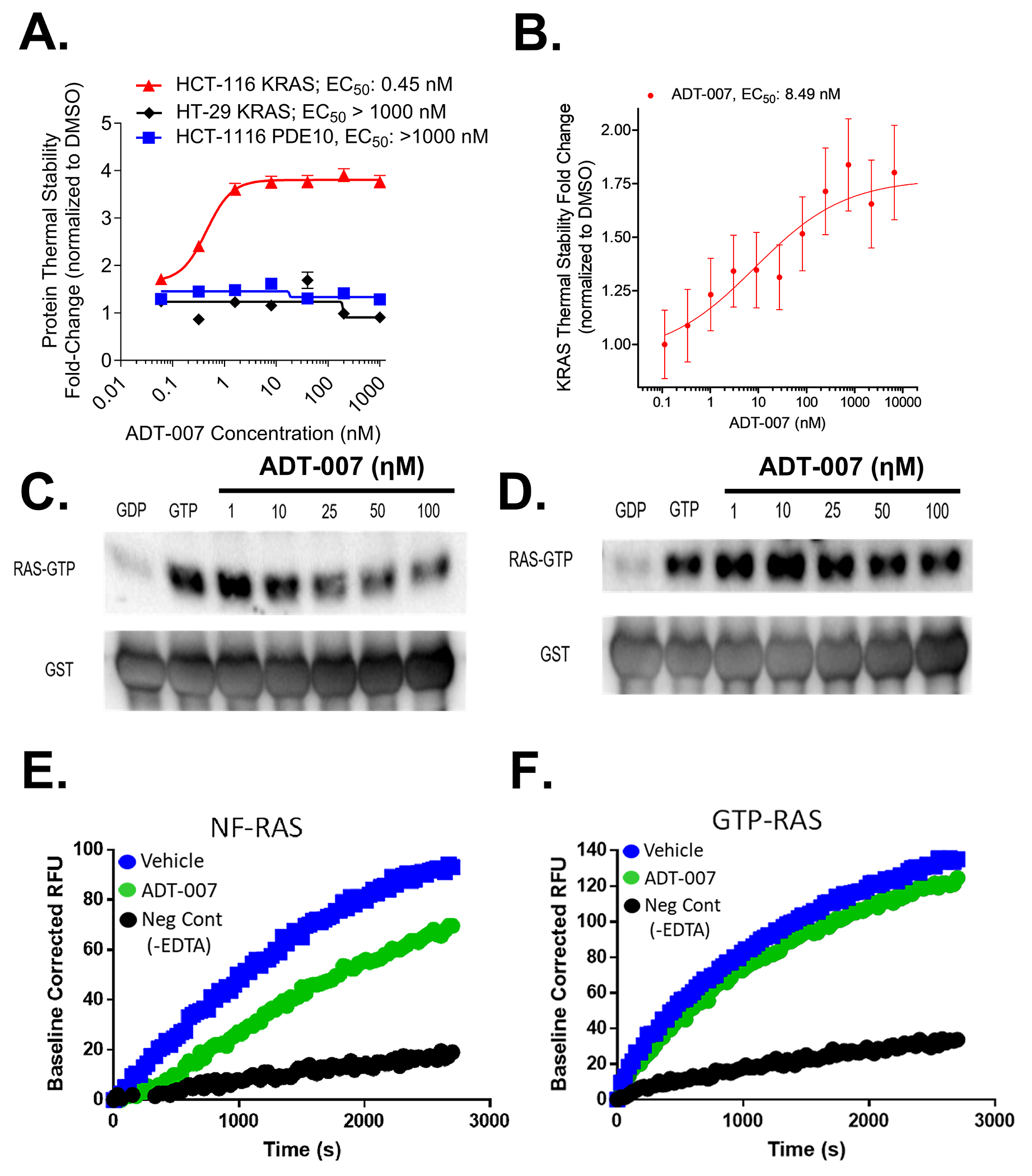
Figure 3.. ADT-007 binds KRAS in cells and inhibits nucleotide loading and effector binding using recombinant RAS.
Cellular target engagement assays show: (A) ADT-007 binds KRAS with high affinity in KRASG13D HCT-116 but not KRASWT HT-29 CRC cells. Graphs show levels of compound stabilized KRAS detected by WB compared with vehicle control. Curves are graphed as the average of two replicates ± SEM. (B) Binding affinity of ADT-007 for mutant KRASG12C was assessed by 45 min treatment of HEK293 cells expressing KRASG12C-Micro-Tag construct compared with DMSO vehicle. Curve is graphed as the average of two replicates ± SEM. (C-D) The inhibitory activity of ADT-007 to block recombinant KRASWT activation (effector binding) in a cell-free system was evaluated by RAS-RBD pulldown assays. (C) ADT-007 inhibited KRASWT-RAF activation before GTP addition. (D) ADT-007 did not significantly inhibit KRASWT activation when added after GTP loading. (E-F) Kinetics of GTP binding to KRAS were measured using a fluorescent GTP analog (Mant-GTP). ADT-007 reduced the rate of Mant-GTP binding to KRAS if pretreated with EDTA to chelate Mg2+ (E), but not if added after non-hydrolysable GTPγS before incubation with ADT-007 (F). Data are representative of at least two independent experiments.
Figure 4.
Figure 4.. NMR analysis of ADT-007 binding to KRAS.
(A) NMR spectrum of full length KRAS in the presence (blue) or absence of Mg2+ (red) representing nucleotide-loaded or nf-RAS, respectively. (B) The addition of ADT-007 (red) to nf-KRAS (blue) (5:1 ratio) resulted in statistically significant NMR signal attenuation at G13 and K16 and other residues (described in methods). Assignments for G13 and K16, due to their unique resonance frequencies, are shown to the left.
Figure 5.
Figure 5.. ADT-007 induces growth arrest and regression in mouse tumor models
(A) Left panel: Growth inhibition of SQ KRASG12V PDX gall bladder adenocarcinoma (PT 5 mg/kg, BID, 13 days, n = 5 mice/group, mean ± SEM). Right panel: % change in tumor volume. (B-D) Left panels: Growth inhibition of mucinous PDX colorectal adenocarcinomas (B) PMCA-1, (C) PMP1, and (D) PC244 in nude mice (IP, 2.5 mg/kg, BID, treatment periods as indicated, n = 5-6 mice/group, mean ± SEM). Right panels: % change in tumor volume. (E) Left panel: Growth inhibition of SQ CT26 CRC tumors (IT, 10 mg/kg, QD, 13 days, mean ± SEM, n=12). Right panel: % change in tumor volume. (F-H) Left panels: Growth inhibition of SQ (F) 2838c3, (G) 7160c2, (H) 5363 PDA tumors in C57BL/6 mice (PT, 5 mg/kg, BID, treatment periods as indicated) (n = 7 - 10 mice/group, mean ± SEM). Right Panels: % change in tumor volume. All animal studies are representative of 2-3 independent experiments. Left panels: Statistical significance was assessed using 2-way ANOVA with Sadik’s multiple comparisons test. Right panels: Statistical significance was assessed with Welch’s t-test.
Figure 6.
Figure 6.. ADT-007 modulates tumor immunity in the PDA TME.
(A) % CD45 YFP+ tumor cells in in SQ 7160c2 (left) and 2838c3 (right) tumors post ADT-007 vs. sham treatments. (B-D) Numbers/mg tumor of total myeloid (B) CD11b+/−CD11c+/−, (C-D) macrophage, gMDSC, and mMDSCin (C) 7160c2 and (D) 2838c3 tumors post ADT-007 vs. sham treatments. (E-F) Tumor growth in SQ, syngeneic (E) 7160c2 and (F) 2838c3 PDA tumor-bearing C57BL/6 WT vs. C57BL/6 Rag 1−/− mice (PT, 5 mg/kg, BID, days 7-28, n = 6-22 mice/group, mean ± SEM). (G-H) Numbers/mg tumor of γδ+ (TCRγδ+), NK T (CD3+ NK1.1+), and DN (CD3+CD4CD8TCRγδ) T cells in (G) 7160c2 and (H) 2838c3 tumors post ADT-007 vs. sham treatments. (I) Numbers/mg tumor of NK (CD3 NK1.1+) cells in ADT-007 vs. sham treatments. (J-M) % intracellular cytokine (IL-2, granzyme B, and IFNγ) production (ICS) CD4+ and CD8+ T cells from 7160c2 (J-K) and 2838c3 tumors (L-M) were evaluated after 5-h stimulation with PMA/ionomycin + brefeldin A in ADT-007 vs. sham. For all column graphs - 2 independent experiments, n = 8 mice/group, mean +/− SD. Statistical significance was determined using Welch’s t-test. For tumor growth curves - aggregate of 2 independent experiments, mean +/− SEM. Statistical significance was determined using 2-way ANOVA with Tukey’s multiple comparison.

Update of

References

    1. Siegel RL, Giaquinto AN, Jemal A: Cancer statistics, 2024. CA Cancer J Clin 2024, 74(1):12–49. - PubMed
    1. Yang Y, Zhang H, Huang S, Chu Q: KRAS Mutations in Solid Tumors: Characteristics, Current Therapeutic Strategy, and Potential Treatment Exploration. J Clin Med 2023, 12(2): 709. - PMC - PubMed
    1. Hingorani SR, Petricoin EF, Maitra A, Rajapakse V, King C, Jacobetz MA, Ross S, Conrads TP, Veenstra TD, Hitt BA et al. Preinvasive and invasive ductal pancreatic cancer and its early detection in the mouse. Cancer Cell 2003, 4(6):437–450. - PubMed
    1. Kojima K, Vickers SM, Adsay NV, Jhala NC, Kim HG, Schoeb TR, Grizzle WE, Klug CA: Inactivation of Smad4 accelerates Kras(G12D)-mediated pancreatic neoplasia. Cancer Res 2007, 67(17):8121–8130. - PubMed
    1. Boutin AT, Liao WT, Wang M, Hwang SS, Karpinets TV, Cheung H, Chu GC, Jiang S, Hu J, Chang K et al. Oncogenic Kras drives invasion and maintains metastases in colorectal cancer. Genes Dev 2017, 31(4):370–382. - PMC - PubMed

LinkOut - more resources