


Metabolomic and lipidomic pathways in aneurysmal subarachnoid hemorrhage
- PMID: 39701893
- PMCID: PMC11840353
- DOI: 10.1016/j.neurot.2024.e00504
Metabolomic and lipidomic pathways in aneurysmal subarachnoid hemorrhage
Abstract
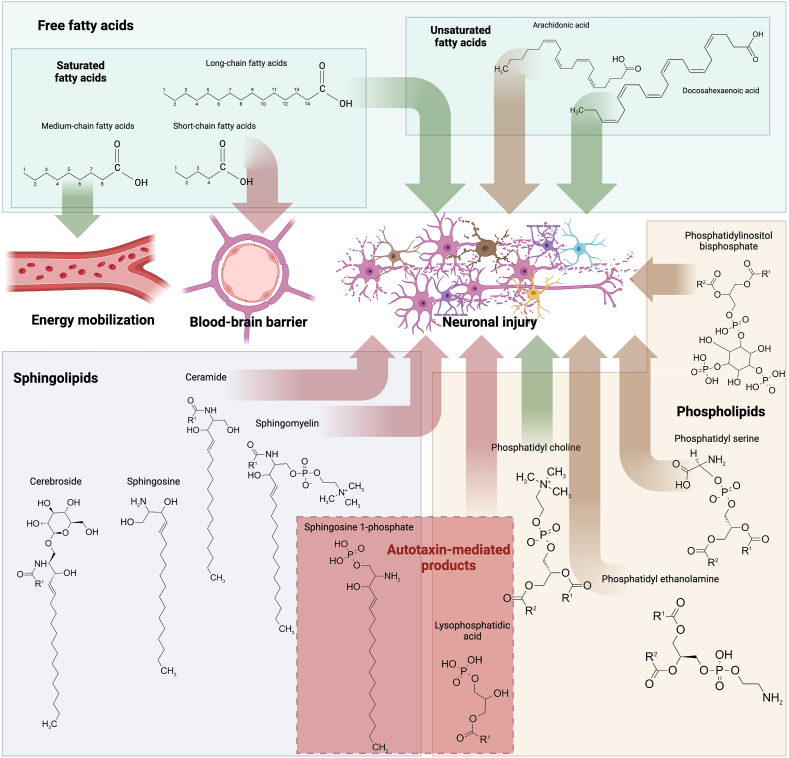
Aneurysmal subarachnoid hemorrhage (aSAH) results in a complex systemic response that is critical to the pathophysiology of late complications and has important effects on outcomes. Omics techniques have expanded our investigational scope and depth into this phenomenon. In particular, metabolomics-the study of small molecules, such as blood products, carbohydrates, amino acids, and lipids-can provide a snapshot of dynamic subcellular processes and thus broaden our understanding of molecular-level pathologic changes that lead to the systemic response after aSAH. Lipids are especially important due to their abundance in the circulating blood and numerous physiological roles. They are comprised of a wide variety of subspecies and are critical for cellular energy metabolism, the integrity of the blood-brain barrier, the formation of cell membranes, and intercellular signaling including neuroinflammation and ferroptosis. In this review, metabolomic and lipidomic pathways associated with aSAH are summarized, centering on key metabolites from each metabolomic domain.
Keywords: Aneurysmal subarachnoid hemorrhage; Lipidome; Metabolome.
Copyright © 2024 The Authors. Published by Elsevier Inc. All rights reserved.
Conflict of interest statement
Declaration of competing interest AMG received support from the NINDS (K23NS121628). HAC received support from the NINDS (R01NS131469, R61NS119640).
Figures
References
-
- English S.W. Long-term outcome and economic burden of aneurysmal subarachnoid hemorrhage: are we only seeing the tip of the iceberg? Neurocrit Care. Springer. 2020:37–38. - PubMed
-
- Modi S., Shah K., Schultz L., Tahir R., Affan M., Varelas P. Cost of hospitalization for aneurysmal subarachnoid hemorrhage in the United States. Clin Neurol Neurosurg. 2019;182:167–170. - PubMed
-
- Vergouwen M.D.I., Vermeulen M., van Gijn J., Rinkel G., Wijdicks E., Muizelaar J.P., et al. Definition of delayed cerebral ischemia after aneurysmal subarachnoid hemorrhage as an outcome event in clinical trials and observational studies. Stroke. 2010;41(10):2391–2395. - PubMed
Publication types
MeSH terms
Grants and funding
LinkOut - more resources
Full Text Sources
