


Quality of life and quality of care experience in Australian residential aged care: a retrospective cohort study of 1,772 residents
- PMID: 39702089
- PMCID: PMC11657633
- DOI: 10.1186/s12877-024-05472-6
Quality of life and quality of care experience in Australian residential aged care: a retrospective cohort study of 1,772 residents
Abstract
Background: In April 2023, quality of life (QOL) and quality of care experience (QCE) indicators were introduced as mandatory indicators in Australian residential aged care (RAC) to measure and monitor wellbeing and consumer experience respectively. In this study, we used data for the initial four months after their introduction to describe QOL and QCE scores, explore related factors and assess variations by completion mode and facility.
Methods: A retrospective cohort study using electronic data (Mar-Jun 2023) from 1,772 residents in 22 RAC facilities in metropolitan Sydney, Australia. QOL was measured by the Quality of Life-Aged Care Consumer (QOL-ACC) scale, and QCE by the Quality of Care Experience-Aged Care Consumer (QCE-ACC) scale, both through three completion modes: self, interviewer-facilitated and proxy completion. Propensity score matching was used to compare QOL/QCE differences by completion mode; multilevel ordinal logistic regression to investigate QOL-/QCE-related factors; and funnel plots to explore facility-level score variations.
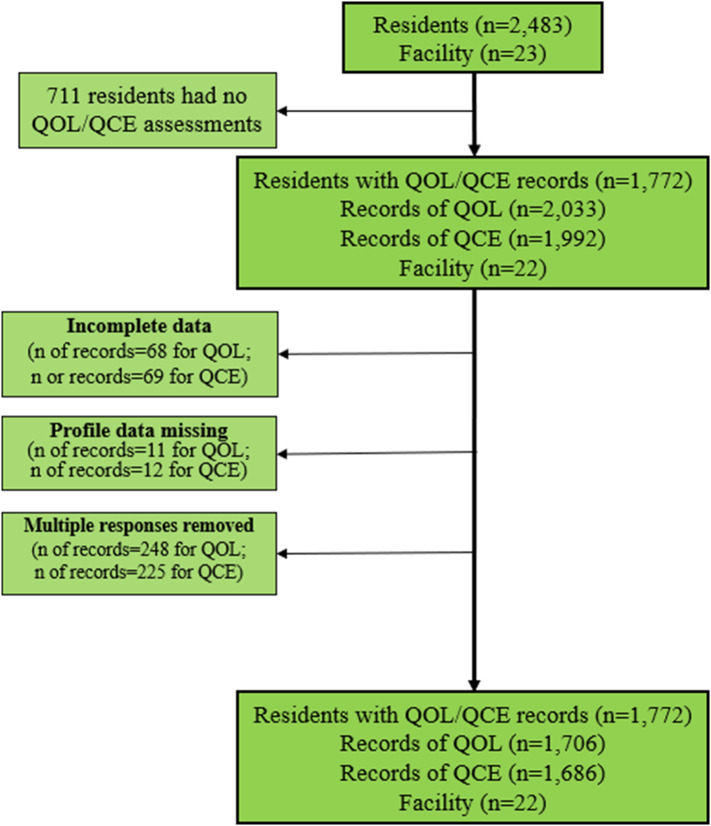
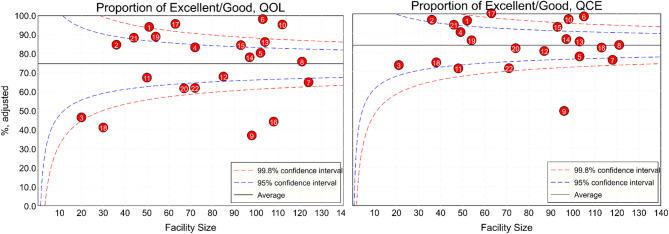
Results: Of 1,772 residents, 1,706 completed the QOL-ACC survey and 1,686 the QCE-ACC. The median score was 21 (interquartile range 18-24) for QOL and 23 (interquartile range 20-24) for QCE, both indicating 'excellent' outcomes. The leisure activities component of QOL, and social relationships and complaint lodging of QCE, were rated relatively lower than other dimensions. The scores of both indicators were significantly higher for self-completion versus other completion modes. Significant variation in QOL and QCE scores by facility were also observed, with seven and four facilities with lower-than-expected proportions of residents with 'excellent' or 'good' ratings of QOL and QCE, respectively. A longer length of stay (odd ratio [OR] = 0.70, 95% CI: 0.53-0.92 for ≥ 3 years of stay versus < 1 year of stay) and fall history (OR = 0.74, 95% CI: 0.60-0.91) were associated with lower QOL, while having a visual impairment (OR = 0.74, 95% CI: 0.55-0.99) and fall history (OR = 0.80, 95% CI: 0.64-0.99) were associated with lower QCE.
Conclusion: We found high QOL and QCE across the 22 Australian RAC facilities. Enhancing residents' leisure activities, social relationships, and addressing specific needs (e.g., visual impairment and fall history) may enhance QOL and QCE.
Keywords: Multilevel ordinal logistic regression; Propensity score matching; Quality of care experience; Quality of life; Residential aged care.
© 2024. The Author(s).
Conflict of interest statement
Declarations. Ethical approval and consent to participate: The study was reviewed and approved by Macquarie University Human Research Ethics Committee (No. 52019614412614). All methods and analysis in this study were carried out in accordance with the principles of the Declaration of Helsinki. Because de-identified data were used, requirement of obtaining participants’ consent was waived by Macquarie University Human Research Ethics Committee. Consent for publication: Not applicable. Competing interests: The authors declare no competing interests.
Figures
References
-
- United Nations. World Population Prospects 2022. website. https://population.un.org/wpp/Download/Standard/Population/. Published 2022.
-
- Parliament of Australia. Reforming Australia’s aged care system: are we there yet? website. https://www.aph.gov.au/About_Parliament/Parliamentary_Departments/Parlia.... Published 2012. Accessed 17 July, 2023.
MeSH terms
Grants and funding
LinkOut - more resources
Full Text Sources
Miscellaneous
