


Community-based physical and social activity for older adults with mild frailty: a rapid qualitative study of a collaborative intervention pilot
- PMID: 39702114
- PMCID: PMC11657703
- DOI: 10.1186/s12877-024-05604-y
Community-based physical and social activity for older adults with mild frailty: a rapid qualitative study of a collaborative intervention pilot
Abstract
Background: Intervening to modify frailty trajectories may be critical to maintain health and independence in later life. The Active Ageing Programme (AAP) is a 16-week community-based intervention for older people with mild frailty that combines physical activity and social interaction. The programme aims to positively impact resilience and wellbeing, changing the physical, mental and social factors that impact on frailty trajectories. We conducted a rapid qualitative study with the first cohort to understand the acceptability and feasibility of the AAP.
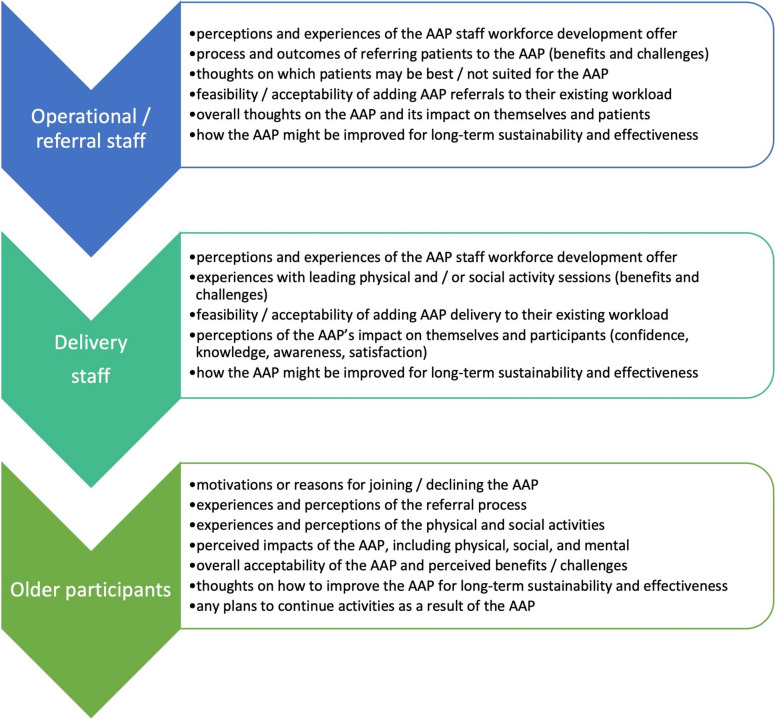
Methods: Purposive sampling was used to identify and recruit staff and participants involved in the AAP for semi-structured interviews. The topic guides covered experiences and perceptions of training and referral, delivery and participation in activities, and benefits and challenges. Data from 20 interviews were analysed using a reflexive thematic approach with inductive coding. The Theoretical Domains Framework prompted consideration of potential individual, social and environmental factors influencing changes in behaviour and practice.
Results: Sixteen AAP staff (10) and participants (6) completed interviews. Two themes were developed: combining motivating components; addressing what matters. The AAP brought together a number of components that supported its acceptability and successful implementation by motivating older people and staff and sustaining their engagement. These included the convenient and familiar location, the opportunity to improve physical health (participants) and to gain experience of an activity intervention, training and confidence (staff), and the variety of activities on offer. The programme was perceived to have potential to improve physical and mental health and increase the personal resources (e.g. knowledge, confidence, motivation) of those taking part. Areas identified as important for the AAP's future sustainability and success were: tailoring recruitment practices; enhancing organisational communication; and strengthening support for participants to achieve long-term increased physical and social activity and resilience.
Conclusions: Our findings suggest that community-based physical and social activity interventions targeting frailty may be acceptable, feasible and useful. Further work is needed to investigate the impact of such programmes on health and service utilisation. Efforts should be targeted at improving the potential for long-term sustainability of programmes and their impacts.
Keywords: Active ageing; Ageing; Exercise; Frailty; Older adults; Physical activity; Social; Vulnerable.
© 2024. The Author(s).
Conflict of interest statement
Declarations. Ethics approval and consent to participate: This rapid qualitative study was conducted in July – November 2022. The study received ethical approval from Newcastle University Research Ethics Committee (REC) (Ref. 21499 − 2022). Health Research Authority (HRA) approvals and NHS REC review were not required because the project was defined as a service evaluation according to the UK Policy Framework for Health and Social Care Research. Written informed consent was obtained from all participants. Participants were informed that they were able to withdraw from the study at any stage up until the findings were produced. To ensure confidentiality, data was anonymised and securely stored. All methods were carried out in accordance with relevant guidelines and regulations. Consent for publication: Consent for publication was confirmed with all participants at the same time as consent to participate was obtained. Competing interests: The authors declare no competing interests.
Figures
References
-
- Age UK. Briefing: Health and Care of Older People in England. London: Age UK; 2019.
-
- Storey A. Living longer: how our population is changing and why it matters. London: Office for National Statistics; 2018.
MeSH terms
Grants and funding
- NIHR200173/National Institute for Health and Care Research (NIHR) Applied Research Collaboration (ARC) North East and North Cumbria (NENC)
- NIHR200173/National Institute for Health and Care Research (NIHR) Applied Research Collaboration (ARC) North East and North Cumbria (NENC)
- NIHR200173/National Institute for Health and Care Research (NIHR) Applied Research Collaboration (ARC) North East and North Cumbria (NENC)
LinkOut - more resources
Full Text Sources
Medical
Miscellaneous
