


Challenges in data-driven geospatial modeling for environmental research and practice
- PMID: 39702456
- PMCID: PMC11659326
- DOI: 10.1038/s41467-024-55240-8
Challenges in data-driven geospatial modeling for environmental research and practice
Abstract
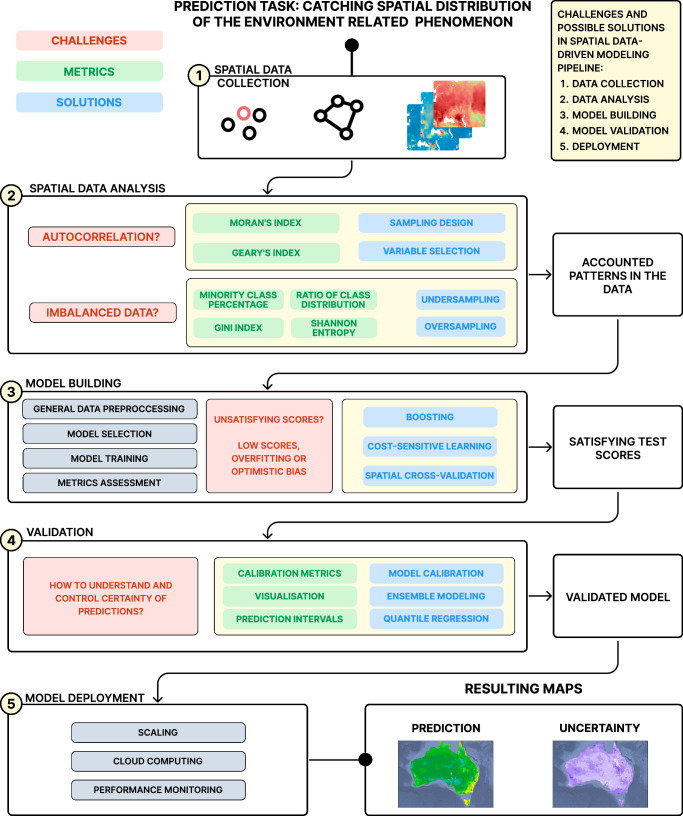
Machine learning-based geospatial applications offer unique opportunities for environmental monitoring due to domains and scales adaptability and computational efficiency. However, the specificity of environmental data introduces biases in straightforward implementations. We identify a streamlined pipeline to enhance model accuracy, addressing issues like imbalanced data, spatial autocorrelation, prediction errors, and the nuances of model generalization and uncertainty estimation. We examine tools and techniques for overcoming these obstacles and provide insights into future geospatial AI developments. A big picture of the field is completed from advances in data processing in general, including the demands of industry-related solutions relevant to outcomes of applied sciences.
© 2024. The Author(s).
Conflict of interest statement
Competing interests: The authors declare no competing interests.
Figures

References
-
- Gewin, V. Mapping opportunities. Nature427, 376–377 (2004). - PubMed
-
- Fick, S. E. & Hijmans, R. J. Worldclim 2: new 1-km spatial resolution climate surfaces for global land areas. Int. J. Climatol.37, 4302–4315 (2017).
-
- Chuvieco, E. et al. Historical background and current developments for mapping burned area from satellite earth observation. Remote Sens. Environ.225, 45–64 (2019).
-
- Reichstein, M. et al. Deep learning and process understanding for data-driven earth system science. Nature566, 195–204 (2019). - PubMed
-
- Brown, C. F. et al. Dynamic world, near real-time global 10 m land use land cover mapping. Sci. Data9, 251 (2022).
Publication types
LinkOut - more resources
Full Text Sources
