


Adipose tissue as target of environmental toxicants: focus on mitochondrial dysfunction and oxidative inflammation in metabolic dysfunction-associated steatotic liver disease
- PMID: 39704874
- PMCID: PMC12048461
- DOI: 10.1007/s11010-024-05165-z
Adipose tissue as target of environmental toxicants: focus on mitochondrial dysfunction and oxidative inflammation in metabolic dysfunction-associated steatotic liver disease
Erratum in
-
Correction to: Adipose tissue as target of environmental toxicants: focus on mitochondrial dysfunction and oxidative inflammation in metabolic dysfunction-associated steatotic liver disease.Mol Cell Biochem. 2025 Jun;480(6):3927. doi: 10.1007/s11010-025-05221-2. Mol Cell Biochem. 2025. PMID: 39907947 Free PMC article. No abstract available.
Abstract
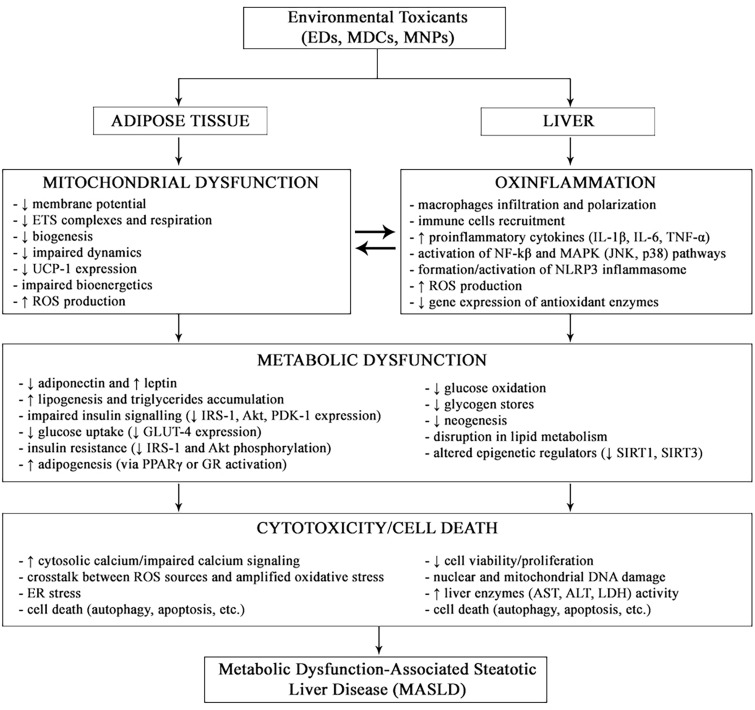
Obesity, diabetes, and their cardiovascular and hepatic comorbidities are alarming public health issues of the twenty-first century, which share mitochondrial dysfunction, oxidative stress, and chronic inflammation as common pathophysiological mechanisms. An increasing body of evidence links the combined exposure to multiple environmental toxicants with the occurrence and severity of metabolic diseases. Endocrine disruptors (EDs) are ubiquitous chemicals or mixtures with persistent deleterious effects on the living organisms beyond the endocrine system impairment; in particular, those known as metabolism-disrupting chemicals (MDCs), increase the risk of the metabolic pathologies in adult organism or its progeny. Being largely lipophilic, MDCs mainly target the adipose tissue and elicit mitochondrial dysfunction by interfering with mitochondrial bioenergetics, biogenesis, dynamics and/or other functions. Plastics, when broken down into micro- and nano-plastics (MNPs), have been detected in several human tissues, including the liver. The harmful interplay between inflammatory and redox processes, which mutually interact in a positive feed-back loop, hence the term oxidative inflammation ("OxInflammation"), occurs both at systemic and organ level. In both liver and adipose tissue, oxinflammation contributes to the progression of the metabolic dysfunction-associated steatotic liver disease (MASLD). Moreover, it has been reported that individuals with MASLD may be more susceptible to the harmful effects of toxicants (mainly, those related to mitochondria) and that chronic exposure to EDs/MDCs or MNPs may play a role in the development of the disease. While liver has been systematically investigated as major target organ for ambient chemicals, surprisingly, less information is available in the literature with respect to the adipose tissue. In this narrative review, we delve into the current literature on the most studied environmental toxicants (bisphenols, polychlorinated biphenyls, phthalates, tolylfluanid and tributyltin, per-fluoroalkyl and polyfluoroalkyl substances, heavy metals and MNPs), summarize their deleterious effects on adipose tissue, and address the role of dysregulated mitochondria and oxinflammation, particularly in the setting of MASLD.
Keywords: Adipocytes; Adipose tissue; Endocrine disruptors; Liver; Metabolic dysfunction-associated steatotic liver disease (MASLD); Micro-/nano-plastics; Mitochondrial dysfunction; Oxinflammation.
© 2024. The Author(s).
Conflict of interest statement
Declarations. Conflict of interest: The authors declare no competing interests. Informed consent: Not applicable. Institutional review board statement: Not applicable.
Figures
References
-
- Engin A (2024) The definition and prevalence of obesity and metabolic syndrome: correlative clinical evaluation based on phenotypes. Adv Exp Med Biol 1460:1–25. 10.1007/978-3-031-63657-8_1 - PubMed
-
- Heindel JJ, Howard S, Agay-Shay K, Arrebola JP, Audouze K, Babin PJ, Barouki R, Bansal A, Blanc E, Cave MC, Chatterjee S, Chevalier N, Choudhury M, Collier D, Connolly L, Coumoul X, Garruti G, Gilbertson M, Hoepner LA, Holloway AC, Howell G 3rd, Kassotis CD, Kay MK, Kim MJ, Lagadic-Gossmann D, Langouet S, Legrand A, Li Z, Le Mentec H, Lind L, Monica Lind P, Lustig RH, Martin-Chouly C, Munic Kos V, Podechard N, Roepke TA, Sargis RM, Starling A, Tomlinson CR, Touma C, Vondracek J, Vom Saal F, Blumberg B (2022) Obesity II: establishing causal links between chemical exposures and obesity. Biochem Pharmacol 199:115015. 10.1016/j.bcp.2022.115015 - PMC - PubMed
Publication types
MeSH terms
Substances
LinkOut - more resources
Full Text Sources
