. 2025 Jan 28;44(1):115087.
doi: 10.1016/j.celrep.2024.115087. Epub 2024 Dec 19.

The differential interactomes of the KRAS splice variants identify BIRC6 as a ubiquitin ligase for KRAS4A

Affiliations

The differential interactomes of the KRAS splice variants identify BIRC6 as a ubiquitin ligase for KRAS4A

Juan Kochen Rossi et al. Cell Rep. .

Abstract

Transcripts of the KRAS locus are alternatively spliced to generate two proteins, KRAS4A and KRAS4B, which differ in their membrane-targeting sequences. These splice variants have been conserved for more than 450 million years, suggesting non-overlapping functions driven by differential membrane association. Here, we use proximity labeling to map the differential interactomes of the KRAS splice variants. We find 24 and 10 proteins that interact specifically with KRAS4A or KRAS4B, respectively. The KRAS interacting protein most specific to KRAS4A is BIRC6, a large member of the inhibitor of apoptosis protein family unique in possessing E2/E3 ubiquitin ligase activity. We find that this interaction takes place on the Golgi apparatus and results in the mono- and di-ubiquitination of KRAS4A at lysines 128 and 147. Silencing BIRC6 diminishes GTP loading of and growth stimulation by KRAS4A but not KRAS4B. Thus, BIRC6 is a ubiquitin ligase that inhibits apoptosis and also modifies KRAS4A.

Keywords: BIRC6; CP: Molecular biology; KRAS; KRAS4A; alternative splicing; inhibitor of apoptosis proteins; oncogene; post-translational modification; ubiquitination.


Conflict of interest statement

Declaration of interests E.S.F. is a founder, scientific advisory board (SAB) member, and equity holder of Civetta Therapeutics, Proximity Therapeutics, Stelexis Biosciences, and Neomorph, Inc. (also board of directors). He is an equity holder and SAB member for Avilar Therapeutics, Photys Therapeutics, and Ajax Therapeutics and an equity holder in Lighthorse Therapeutics and Anvia Therapeutics. E.S.F. is a consultant to Novartis, EcoR1 capital, Odyssey, and Deerfield. The Fischer lab receives or has received research funding from Deerfield, Novartis, Ajax, Interline, Bayer, and Astellas.

Figures

Figure 1.
Figure 1.. Proximity labeling identifies differential interactions of the KRAS splice variants
(A) TurboID-KRAS fusion protein constructs. (B) Time course of doxycycline (Dox, 1 μg/mL) induction of V5-TurboID-KRAS fusion protein expression in 293 FlpIn T-REx cells stably transduced by single-site integration. (C) Protocol for TurboID-KRAS differential proximity screen. (D) Volcano plots of KRAS4A- or KRAS4B-specific protein interactions. (E) Table of KRAS4A-specific protein-protein interactions, defined as a SAINT score >0.9. Total and average peptide spectral matches (Spec) are listed for the n = 3 analysis as is the fold enrichment, KRAS4A/KRAS4B. Proteins shaded orange are not reported as interacting proteins in the BioGRID database. See also Figure S1.
Figure 2.
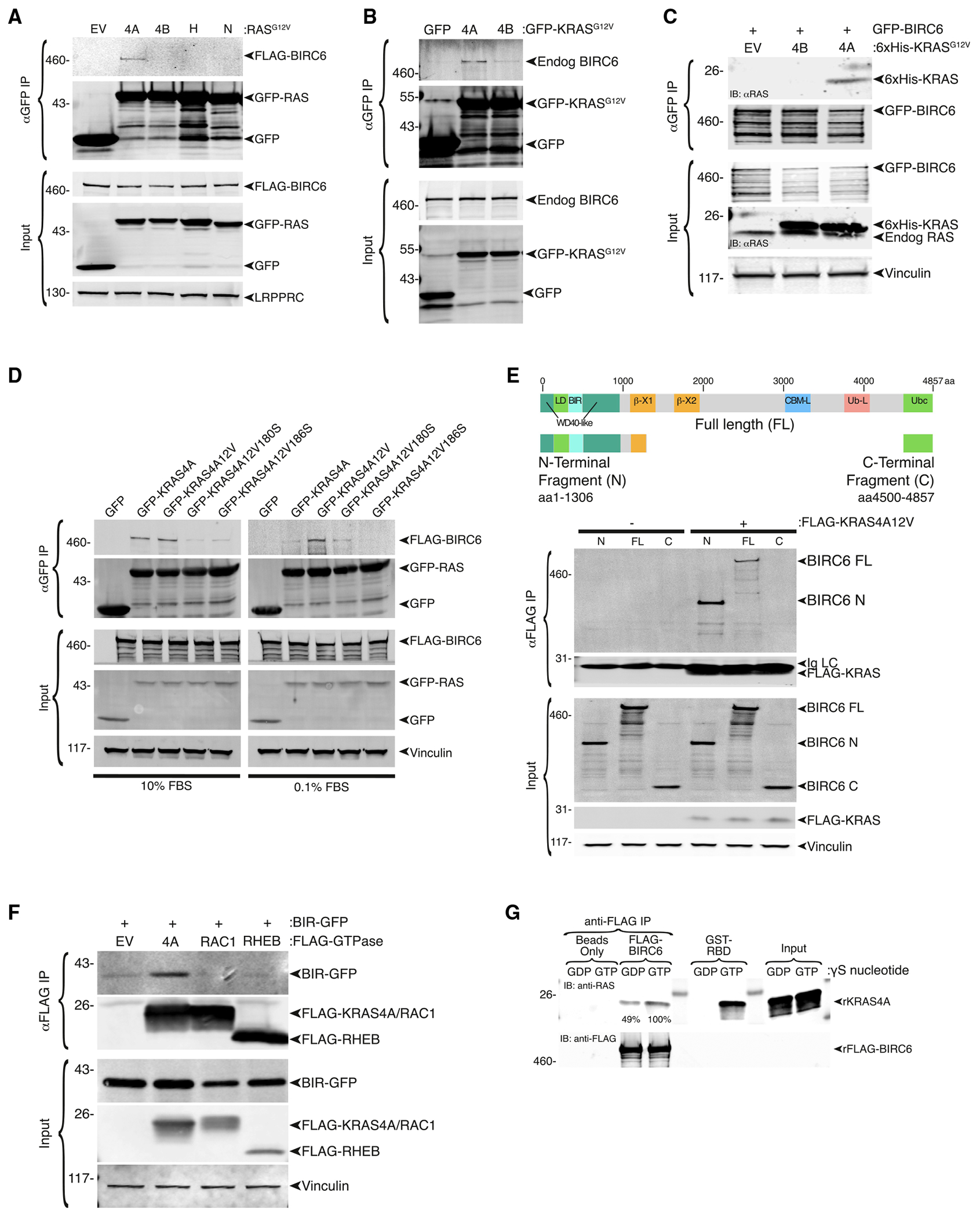
Figure 2.. Membrane-targeted, GTP-loaded KRAS4A interacts directly with the BIR domain of BIRC6
(A) Co-immunoprecipitation (IP) of FLAG-BIRC6 with GFP-KRAS4A. HEK293 cells were transfected with the indicated RAS protein tagged with GFP along with 3×FLAG-BIRC6, and anti-GFP immunoprecipitates from cell lysates were analyzed by immunoblot as indicated. LRPPRC served as a loading control. (B) Co-immunoprecipitation of endogenous BIRC6 in HEK293 cells by GFP-KRAS4A-12V but not GFP-KRAS4B-12V. (C) Reciprocal co-immunoprecipitation of 6×His-KRAS4A but not 6×His-KRAS4B with GFP-BIRC6. Vinculin served as a loading control. (D) The interaction of KRAS4A with BIRC6 as demonstrated in (A) requires prenylation (186S mutant is prenylation deficient) and palmitoylation (180S is palmitoylation deficient) and is enhanced by GTP loading (12V mutant in serum-starved cells). (E) The interaction of KRAS4A and BIRC6 involves the N-terminal 1,306 amino acids of BIRC6 that include the BIR and WD40 domains. (F) Co-immunoprecipitation of the isolated BIR domain extended with GFP (BIR-GFP) by FLAG-tagged KRAS4A but not RAC1 or RHEB. Vinculin served as a loading control. (G) In vitro affinity capture of GDPβS- or GTPγS-loaded recombinant KRAS4A (rKRAS4A) by rFLAG-BIRC6. rKRAS4A pulled down by rFLAG-BIRC6 was quantified by Li-Cor Odyssey scan and normalized first to immunoreactive rFLAG-BIRC6 input and then to the GTPγS-loaded pull-down set to 100%. Affinity capture of GTPγS-loaded rKRAS4A by GST-RBD served as a control. Data shown are representative of n = 2. Experiments in (A)–(F) are representative of n ≥ 3. See also Figure S2.
Figure 3.
Figure 3.. KRAS4A interacts with BIRC6 on the Golgi apparatus
(A) Indirect immunofluorescent staining of endogenous BIRC6 and GM130 (cis Golgi protein) in HEK293 cells reveals BIRC6 on the Golgi apparatus as well as on cytoplasmic vesicles. Nuclei are stained with Hoechst. (B) Indirect immunofluorescent staining of GFP-KRAS4A or GFP-KRAS4B expressed in HEK-293 cells and endogenous GM130. Cells were kept on ice for 10 min before fixation. (C) Indirect immunofluorescent staining of GFP-KRAS4A, GFP-KRAS4A180S or GFP-KRAS4B expressed in HEK-293 cells and endogenous BIRC6. Cells were kept on ice for 10 min before fixation. Enlargements of Golgi regions allow better resolution. (D) Co-localization within the Golgi region of each KRAS isoform and BIRC6 shown in (C) as determined by Pearson’s correlation coefficient (50 cells examined, mean ± SD plotted, ****p < 0.0001, *p < 0.05, Student’s t test). Scale bars in (A)–(C) represent 5 μm except enlargements in (C) where they represent 2.5 μm. See also Figures S3 and S4.
Figure 4.
Figure 4.. BIRC6 mono- and di-ubiquitinates KRAS4A
(A) In vitro ubiquitination of the indicated, previously validated recombinant substrates (caspase-7 or LC3B) or a negative control (PKM2) incubated with recombinant Strep-BIRC6, FLAG-UBA6 (an E1 ubiquitin-activating enzyme), and HA-ubiquitin, with or without MgATP. Unmodified and ubiquitinated proteins are revealed by immunoblot (IB). (B) In vitro ubiquitination reactions as in (A) utilizing recombinant KRAS4A or KRAS4B as substrates. Unmodified and ubiquitinated KRAS proteins are detected by anti-RAS and anti-Ub immunoblots. Mono- and di-ubiquitinated KRAS is revealed by the merged immunoblots. The in vitro reaction shows no isoform specificity. (C) In vitro ubiquitination reactions as in (A) utilizing the recombinant KRAS4B G domain (aa 1–165) as substrate, FLAG-UBA6, and buffer (Cont) or the indicated BIRC6 mutant (BIRmut, BIRC6C328S/C331S; ΔHelix, BIRC6Δ1,616–1,666; ΔUbl, BIRC6Δ3,819–4,068). Proteins are revealed by Coomassie stain (top) and anti-RAS immunoblot (bottom). Mono-ubiquitinated KRAS is the predominant species. (D) KRAS4A ubiquitination in intact cells. HA-KRAS4A-12V was expressed in BIRC6-deficient HEK293 cells with 8xHis-Ub with or without GFP-BIRC6. Cell lysates were analyzed by anti-HA immunoblot before (input) or after enrichment for ubiquitinated proteins with a cobalt affinity matrix. Mono-, di-, tri-, and polyubiquitinated KRAS4A were detected with anti-HA and anti-Ub immunoblots with mono- and di-ubiquitinated species predominant. Tubulin served as a loading control. (E) HA-KRAS4A-12V was expressed with 8×His-Ub in HEK293 cells expressing a CRISPR-Cas9 control single guide RNA (sgRNA) targeting Tomato (sgTM) or an sgRNA targeting BIRC6 (sgB6). BIRC6 was reintroduced in sgB6 cells by expressing GFP-BIRC6. Tubulin served as loading control. (F) Ubiquitination of KRAS4A and KRAS4B in intact, BIRC6-deficient cells transfected with empty vector (EV) or GFP-BIRC6 (B6), was assayed as in (D) except KRAS-12V was His-tagged and no exogenous Ub was expressed. Vinculin served as a loading control. Immunoreactive bands were quantified by Li-Cor Odyssey scan, and the percentage of ubiquitinated proteins was calculated as 100 × (mono + di + tri)/(unmodified + mono + di + tri) and plotted on the right (mean ± SD, n = 7 for KRAS4A and n = 4 for KRAS4B, **p < 0.01, Student’s t test). Experiments in (A)–(E) are representative of n ≥ 3. See also Figure S5.
Figure 5.
Figure 5.. BIRC6 supports KRAS4A GTP loading and KRAS4A-12V-driven cell growth
(A) GTP loading of GFP-KRAS4A and GFP-KRAS4B before and after 5 and 15 min of stimulation with 5 ng/mL EGF assessed using GST-RAF1-RBD pull-down from lysates of serum-starved cells without (sgTm) or with (sgB6) prior silencing of BIRC6. Mean ± SEM plotted for n = 4 for GFP-KRAS4A and n = 3 for GFP-KRAS4B. (B) Cell proliferation represented as fold change after 72 h of control (sgTm) or BIRC6-deficient (sgB6) 293 Flp-In T-REx-FLAG-KRAS4A/KRAS4B G12V cells. Oncogene expression was achieved by addition of 1 μg/mL doxycycline (Dox). Vinculin served as a loading control. Mean ± SEM plotted, n =4. Knockdown of BIRC6 and KRAS expression was confirmed by immunoblot. **p < 0.01, Student’s t test. See also Figure S6.

References

    1. Prior IA, Hood FE, and Hartley JL (2020). The Frequency of Ras Mutations in Cancer. Cancer Res. 80, 2969–2974. 10.1158/0008-5472.CAN-19-3682. - DOI - PMC - PubMed
    1. Moore AR, Rosenberg SC, McCormick F, and Malek S (2021). RAS-targeted therapies. Nat. Rev. Drug Discov 19, 533–552. 10.1038/s41573-021-00220-6. - DOI - PMC - PubMed
    1. Nuevo-Tapioles C, and Philips MR (2022). The role of KRAS splice variants in cancer biology. Front. Cell Dev. Biol 10, 1033348. 10.3389/fcell.2022.1033348. - DOI - PMC - PubMed
    1. Tsai FD, Lopes MS, Zhou M, Court H, Ponce O, Fiordalisi JJ, Gierut JJ, Cox AD, Haigis KM, and Philips MR (2015). K-Ras4A splice variant is widely expressed in cancer and uses a hybrid membrane-targeting motif. Proc. Natl. Acad. Sci. USA 112, 779–784. 10.1073/pnas.1412811112. - DOI - PMC - PubMed
    1. Hood FE, Sahraoui YM, Jenkins RE, and Prior IA (2023). Ras protein abundance correlates with Ras isoform mutation patterns in cancer. Oncogene 42, 1224–1232. 10.1038/s41388-023-02638-1. - DOI - PMC - PubMed

Publication types

MeSH terms

LinkOut - more resources