


Essential and nonessential fatty acid composition and use in overwintering monarch butterflies
- PMID: 39706992
- PMCID: PMC12003445
- DOI: 10.1007/s00359-024-01727-0
Essential and nonessential fatty acid composition and use in overwintering monarch butterflies
Abstract
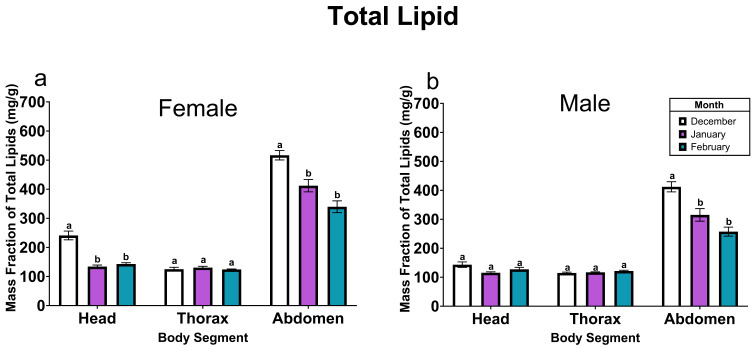
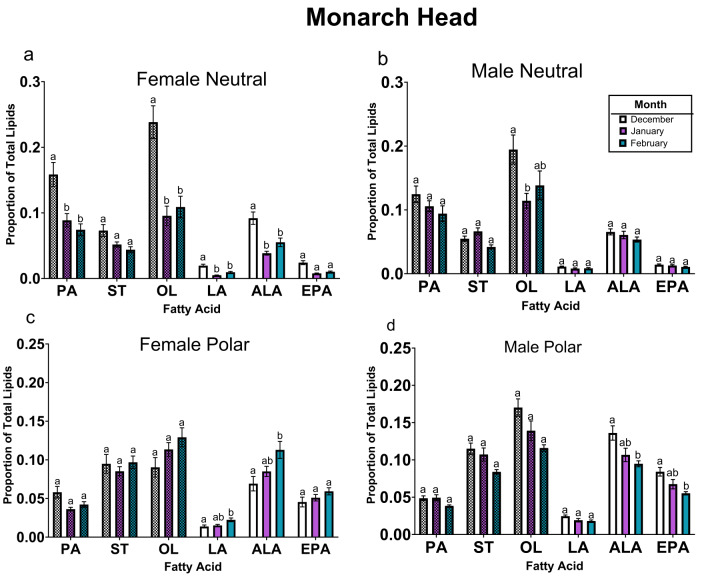
Monarch butterflies (Danaus plexippus) undertake one of the most remarkable long-distance insect migrations, travelling thousands of kilometres to overwinter in the central trans-volcanic belt of Mexico. This study explored how monarch butterflies use essential fatty acids (EFA) and nonessential fatty acids (NFA) during overwintering. We collected 150 (male/female) butterflies from the Sierra Chincua wintering colony from the time of arrival (December 2022) to before departure (February 2023) and analysed their lipid content. Our findings revealed that although females have a higher mass fraction of lipids, male and female monarch butterflies depleted their lipids similarly over time, resulting in low abdominal lipid mass fractions by late February. NFA, including oleic and palmitic acid, were predominantly used for energy during overwintering by male and female butterflies. In contrast, the EFA alpha-linolenic and linoleic acids, critical for reproductive success and cellular functions, were conserved in both sexes. Males began the overwintering period with a higher mass fraction of EFA in the polar components of the head and thorax, which may impact the degree of cold acclimation of these tissues during this period. Strategic lipid utilisation, prioritising the preservation of EFA over NFA and optimizing overwintering survival probably enhance readiness for spring remigration and reproduction. This differential fatty acid use underscores the delicate balance monarch butterflies maintain to survive overwintering and highlights the potential impacts of environmental changes on their lipid dynamics and survival.
Keywords: Energetics; Fatty acids; Lipids; Monarch butterfly; Wintering.
© 2024. The Author(s).
Conflict of interest statement
Declarations. Competing interests: The authors declare no competing interests.
Figures


References
-
- Alonso-Mejia A, Rendon-Salinas E, Montesinos-Patino E, Brower LP (1997) Use of lipid reserves by monarch butterflies overwintering in Mexico: implications for conservation. Ecol Appl 7:934–947. 10.2307/2269444
-
- Altizer SM, Davis AK (2010) Populations of monarch butterflies with different migratory behaviors show divergence in wing morphology. Evolution 64:1018–1028. 10.1111/j.1558-5646.2009.00946.x - PubMed
-
- Altizer SM, Oberhauser KS (1999) Effects of the protozoan parasite Ophryocystis elektroscirrha on the fitness of monarch butterflies (Danaus plexippus). J Invertebr Pathol 74:76–88. 10.1006/jipa.1999.4853 - PubMed
-
- Anderson JB, Brower LP (1996) Freeze-protection of overwintering monarch butterflies in Mexico: critical role of the forest as a blanket and an umbrella. Ecol Entomol 21:107–116. 10.1111/j.1365-2311.1996.tb01177.x
-
- Anparasan L (2023) Effect of rearing conditions on the allocation of larval and adult acquired essential and nonessential fatty acids to flight in two adult Lepidoptera: Danaus plexippus and Mythimna unipuncta. [PhD Dissertation], University of Western Ontario, London, Ontario, Canada
MeSH terms
Substances
Grants and funding
LinkOut - more resources
Full Text Sources
