


Tracing the transmission of carbapenem-resistant Enterobacterales at the patient: ward environmental nexus
- PMID: 39707381
- PMCID: PMC11662836
- DOI: 10.1186/s12941-024-00762-8
Tracing the transmission of carbapenem-resistant Enterobacterales at the patient: ward environmental nexus
Abstract
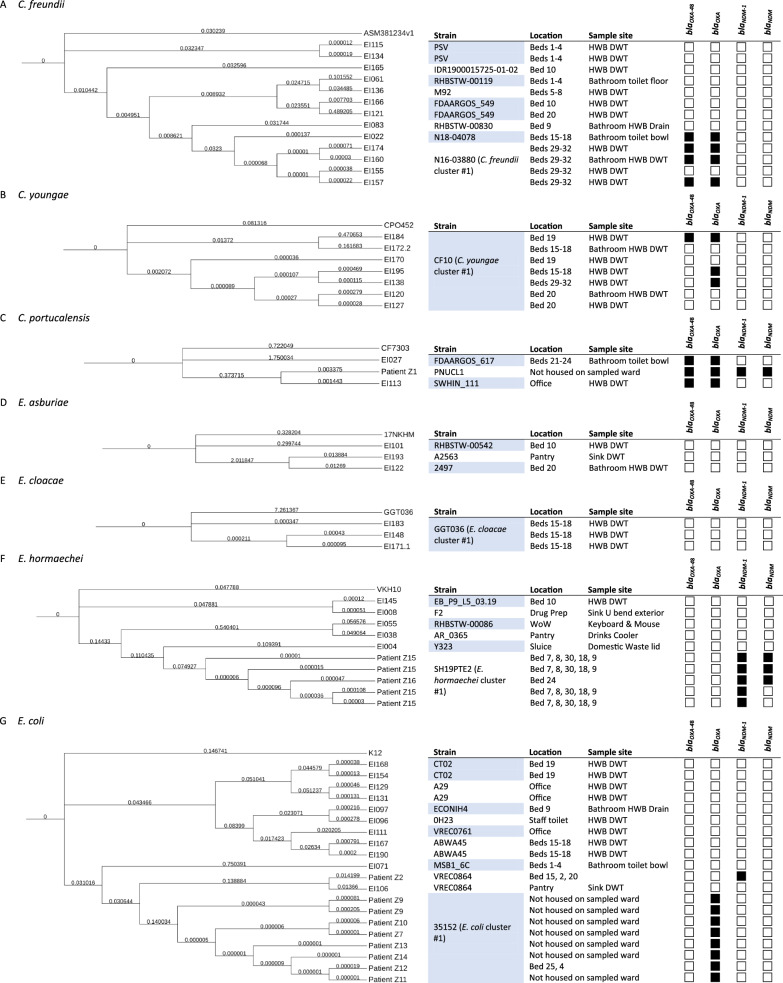
Introduction: Colonisation and infection with Carbapenem-resistant Enterobacterales (CRE) in healthcare settings poses significant risks, especially for vulnerable patients. Genomic analysis can be used to trace transmission routes, supporting antimicrobial stewardship and informing infection control strategies. Here we used genomic analysis to track the movement and transmission of CREs within clinical and environmental samples.
Methods: 25 isolates were cultured from clinical patient samples or swabs, that tested positive for OXA-48-like variants using the NG-Test® CARBA-5 test and whole genome sequenced (WGS) using Oxford Nanopore Technologies (ONT). 158 swabs and 52 wastewater samples were collected from the ward environment. 60 isolates (matching clinical isolate genera; Klebsiella, Enterobacter, Citrobacter and Escherichia) were isolated from the environmental samples using selective agar. Metagenomic sequencing was undertaken on 36 environmental wastewater and swab samples.
Results: 21/25 (84%) clinical isolates had > 1 blaOXA gene and 19/25 (76%) harboured > 1 blaNDM gene. Enterobacterales were most commonly isolated from environmental wastewater samples 27/52 (51.9%), then stick swabs 5/43 (11.6%) and sponge swabs 5/115 (4.3%). 11/60 (18%) environmental isolates harboured > 1 blaOXA gene and 1.9% (1/60) harboured blaNDM-1. blaOXA genes were found in 2/36 (5.5%) metagenomic environmental samples.
Conclusions: Potential for putative patient-patient and patient-ward transmission was shown. Metagenomic sampling needs optimization to improve sensitivity.
Keywords: Antimicrobial resistance; CRE; Carbapenem-resistant Enterobacterales; Environment; Hospital; Metagenomics; NDM; OXA48; Oxford Nanopore; Plasmids; Transmission.
© 2024. The Author(s).
Conflict of interest statement
Declarations. Ethical approval and consent to participate: This diagnostic service evaluation was undertaken at the request of the Division of Nursing in support of the Infection Prevention and Control team as part of enhanced standard of care practices for IPC outbreak investigation, in accordance with the Declaration of Helsinki. This project is under HRA approval for ELCID and registered with Health Services London. IRAS project ID: 283,831, National HRA REC reference: 20/HRA/4928, Local REC: RFL R&D ref: 134,895, HSL Project number: 1529. Consent for publications: Not applicable. Competing interests: The authors declare no competing interests.
Figures
References
-
- World Health Organization. Guidelines for the prevention and control of carbapenem-resistant enterobacteriaceae, Acinetobacter baumannii and Pseudomonas aeruginosa in health care facilities. 2017. http://apps.who.int/bookorders. - PubMed
MeSH terms
Substances
LinkOut - more resources
Full Text Sources
