. 2024 Dec 20;12(1):261.
doi: 10.1186/s40168-024-01973-z.

Neonates exposed to HIV but uninfected exhibit an altered gut microbiota and inflammation associated with impaired breast milk antibody function

Affiliations

Neonates exposed to HIV but uninfected exhibit an altered gut microbiota and inflammation associated with impaired breast milk antibody function

Audrey Byrne et al. Microbiome. .

Abstract

Background: Infants exposed to HIV but uninfected have altered immune profiles which include heightened systemic inflammation. The mechanism(s) underlying this phenomenon is unknown. Here, we investigated differences in neonatal gut bacterial and viral microbiome and associations with inflammatory biomarkers in plasma. Further, we tested whether HIV exposure impacts antibody-microbiota binding in neonatal gut and whether antibodies in breast milk impact the growth of commensal bacteria.

Results: Neonates exposed to HIV but uninfected (nHEU) exhibited altered gut bacteriome and virome compared to unexposed neonates (nHU). In addition, HIV exposure differentially impacted IgA-microbiota binding in neonates. The relative abundance of Blautia spp. in the whole stool or IgA-bound microbiota was positively associated with plasma concentrations of C-reactive protein. Finally, IgA from the breast milk of mothers living with HIV displayed a significantly lower ability to inhibit the growth of Blautia coccoides which was associated with inflammation in nHEU.

Conclusion: nHEU exhibits profound alterations in gut bacterial microbiota with a mild impact on the enteric DNA virome. Elevated inflammation in nHEU could be due to a lower capacity of breast milk IgA from mothers living with HIV to limit growth the of gut bacteria associated with inflammation. Video Abstract.

Keywords: Gut microbiota; Inflammation; Neonates exposed to HIV but uninfected.


Conflict of interest statement

Declarations. Ethics approval and consent to participate: Infants were recruited as part of an ongoing observational study of mother-infant pairs in Cape Town, South Africa [22]. The study was approved by the University of Cape Town’s Human Research Ethics Committee (reference 285/2012). Consent for publication: This declaration is not applicable. Competing interests: The authors declare that they have no competing interests.

Figures

Fig. 1
Fig. 1
Mothers living with HIV have comparable antibody concentrations to mothers living without HIV in breast milk. Total immunoglobulins were measured 4 weeks after delivery. AF Total immunoglobulins in breast milk. GI Total immunoglobulins in neonate’s stools. Data is shown as median with interquartile range. Comparisons with p values < 0.05 are significant
Fig. 2
Fig. 2
HIV exposure impacts gut bacteriomein neonates. A Alpha diversity between neonates exposed or unexposed to HIV. B PCoA and PERMANOVA test of neonatal stool microbiota. C Differentially abundant taxa between nHEU and nHU determined by both DESeq2 and corncob. D Functional profiling of the microbiota by HUMAnN3
Fig. 3
Fig. 3
HIV exposure has a modestimpact on the enteric DNA virome in neonates at week 4 of life. A Viral alpha diversity in stool. B PCoA of enteric virome constructed by Bray–Curtis distance. C Relative abundance of enteric virome at the family level. D Differentially abundant gut viruses between nHEU and nHU by DESeq2 and corncob. EH Predicted hosts of differentially abundant phages in the guts of nHEU and nHU. I Total number of lytic phages between nHEU and nHU by VIBRANT. J Total number of lysogenic phages between nHEU and nHU by VIBRANT analysis. Comparisons with p values < 0.05 are significant
Fig. 4
Fig. 4
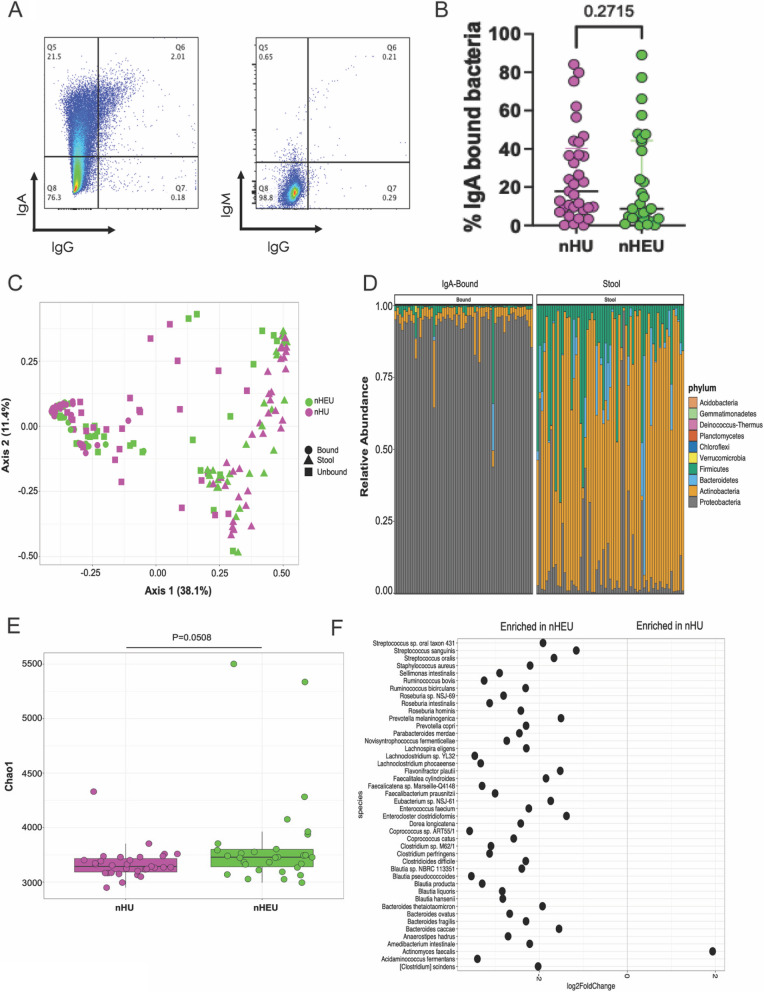
Neonates exposed to HIV have altered IgA-microbiota binding in stool. A Representative flow plot of bacteria flow cytometry in stool. Plots are from the same infant stool sample with a left panel showing IgA coating and the right showing IgM. B Percentage of IgA-bound bacteria in stool. C PCoA showing IgA-bound, IgA-unbound, and stool microbiota in nHEU and nHU infants. D Relative abundance of microbiota at phylum level comparing IgA-bound microbiota in stool and whole stool (input). E Alpha diversity of IgA bound microbiota in stool between nHEU and nHU. F Differentially abundant bacterial taxa in IgA bound fraction
Fig. 5
Fig. 5
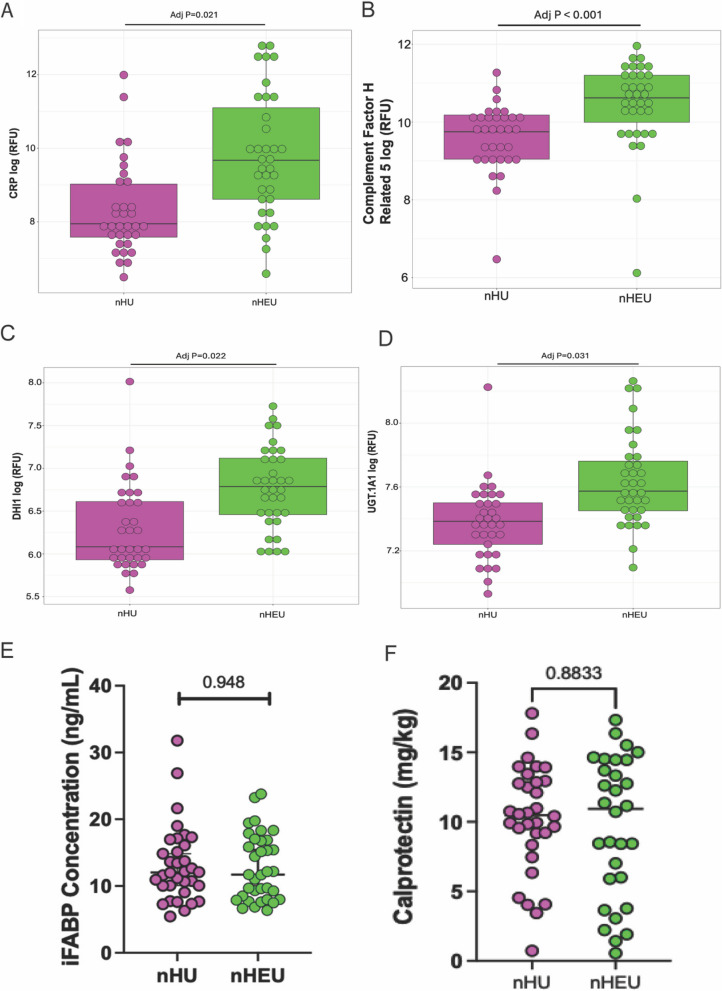
Neonates exposed to HIV have heightened systemic inflammation at four weeks of age. AD Concentrations of biomarkers in plasma measured by SomaScan assay. E iFABP concentration in infant plasma. The concentration of calprotectin in stool in nHEU and nHU. Comparisons with adjusted p values < 0.05 are significant
Fig. 6
Fig. 6
Abundance of Blautia species positively correlated with plasma CRP. A Correlation between stool relative abundance of Blautia pseudococcoides and plasma CRP concentration. B Spearman correlation between the relative abundance of bacteria in IgA bound fraction and plasma CRP concentration
Fig. 7
Fig. 7
IgA in the breast milk of mothers living with HIV exhibits an impaired ability to inhibit the growth of specific gut commensals. B. thetaiotaomicron or B. coccoides were cultured in the presence of IgA purified from the breast milk of MLWoH or MLWH. Breast milk IgA from 5 mothers per group was used, and each participant’s antibody was tested separately in triplicates. A total of six wells per bacteria were used as positive controls (no IgA). A Growth curve of B. thetaiotaomicron co-cultured with IgA purified from the breast milk of MLWH or MLWoH. B Growth curve of B. coccoides co-cultured with IgA purified from breast milk of MLWH or MLWoH. C, D Area under the curve for bacterial growth curves. EF Levels of B. thetaiotaomicron and B. coccoides specific IgA in the breast milk of MLWH or MLWoH respectively. Data is shown as mean ± SEM

References

    1. UNAIDS. Fact Sheet-World AIDS Day 2017. Geneva: UN Joint Programme on HIV/AIDS (UNAIDS); Programme on HIV/AIDS. 2017. 978–92–9173–945–5.
    1. Weinberg A, et al. Factors associated with lower respiratory tract infections in HIV-exposed uninfected infants. AIDS Res Hum Retroviruses. 2018;34:527–35. - PMC - PubMed
    1. Slogrove AL, Cotton MF, Esser MM. Severe infections in HIV-exposed uninfected infants: clinical evidence of immunodeficiency. J Trop Pediatr. 2010;56:75–81. - PubMed
    1. Abu-Raya B, Kollmann TR, Marchant A, MacGillivray DM. The immune system of HIV-exposed uninfected infants. Front Immunol. 2016;7:1–10. - PMC - PubMed
    1. Lohman-Payne B, et al. HIV-exposed uninfected infants: elevated cord blood Interleukin 8 (IL-8) is significantly associated with maternal HIV infection and systemic IL-8 in a Kenyan cohort. Clin Transl Med. 2018;7:26. - PMC - PubMed

LinkOut - more resources