


Estimated potassium intake and major adverse cardiovascular events in individuals with type 2 diabetes: a prospective cohort study with trans-ethnic validation
- PMID: 39709437
- PMCID: PMC11662727
- DOI: 10.1186/s12933-024-02546-y
Estimated potassium intake and major adverse cardiovascular events in individuals with type 2 diabetes: a prospective cohort study with trans-ethnic validation
Abstract
Background: Data on the relationship between potassium intake and major cardiovascular events (MACE) in patients with diabetes are scarce. We aim to study the association between estimated potassium intake and risk of MACE in individuals with type 2 diabetes.
Methods: The discovery cohort consisted of 1572 participants with type 2 diabetes from a secondary hospital. The validation cohort consisted of 1430 participants with diabetes from a multicenter study (Chronic Renal Insufficiency Cohort, CRIC). Potassium intake was estimated from potassium in spot urine using Kawasaki formula and in 24-h urine collection in two cohorts, respectively. The primary outcome was MACE defined as a composite of myocardial infarction, stroke and cardiovascular death.
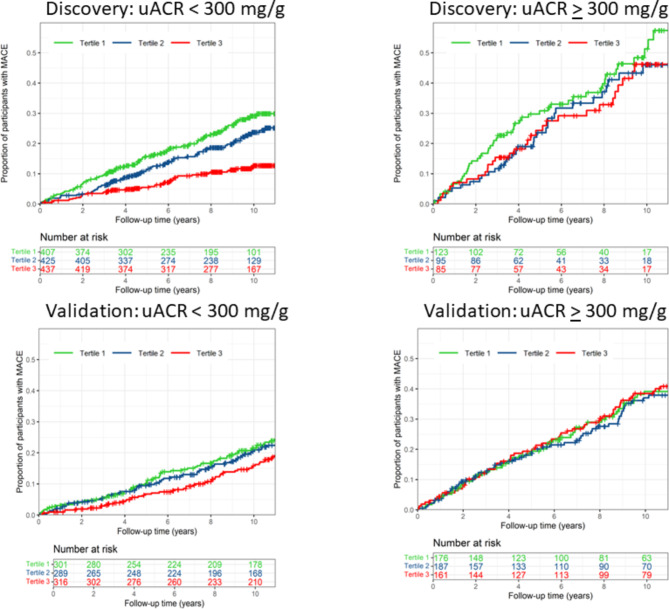
Results: During a median of 8.2 years of follow-up, 341 MACE events were identified in discovery cohort. Compared to the lowest tertile, participants with potassium intake in the top tertile had 34% lower risk for MACE after adjustment for cardio-renal risk factors (adjusted hazard ratio, aHR [95% CI], 0.66 [0.49-0.89]). This inverse association was more pronounced in participants with normal or moderately elevated albuminuria as compared to those with severely elevated albuminuria (urine albumin-to-creatinine ratio > 300 mg/g, p for interaction < 0.05). In consistence, a higher potassium intake was independently associated with a lower risk of MACE in CRIC participants with diabetes and moderately elevated albuminuria (aHR 0.61 [0.42-0.90], top vs. lowest tertile).
Conclusions: A high level potassium intake estimated from urine potassium excretion was independently associated with a low risk of MACE in patients with type 2 diabetes. Increasing potassium intake may be a potential effective strategy for cardiovascular risk reduction beyond controlling traditional risk factors.
Keywords: All-cause mortality; Major adverse cardiovascular event; Potassium intake; Type 2 diabetes; Urine potassium excretion.
© 2024. The Author(s).
Conflict of interest statement
Declarations. Ethics approval and consent to participate: This study was conducted in accordance with the principles laid by Declaration of Helsinki. KTPH-DKD study was approved by the Singapore National Healthcare Group Domain Specific Review Committee (DSRB 2017/00662, May 2019). All participants gave written informed consent. Consent from CRIC participants for the current study was waived by NIDDK. Consent for publication: Not applicable. Competing interests: The authors declare no competing interests.
Figures
References
-
- Gregg EW, Li Y, Wang J, Burrows NR, Ali MK, Rolka D, Williams DE, Geiss L. Changes in diabetes-related complications in the United States, 1990–2010. N Engl J Med. 2014;370(16):1514–23. - PubMed
-
- Sattar N, McMurray J, Boren J, Rawshani A, Omerovic E, Berg N, Halminen J, Skoglund K, Eliasson B, Gerstein HC, et al. Twenty years of cardiovascular complications and risk factors in patients with type 2 diabetes: a nationwide Swedish cohort study. Circulation. 2023;147(25):1872–86. - PubMed
-
- Liu JJ, Choo RWM, Liu S, Gurung RL, Wee SL, Lim SC. Cause-specific mortality in multiethnic South East Asians with type 2 diabetes mellitus. Asia Pac J Public Health. 2019;31(4):306–14. - PubMed
-
- Gregg EW, Cheng YJ, Srinivasan M, Lin J, Geiss LS, Albright AL, Imperatore G. Trends in cause-specific mortality among adults with and without diagnosed diabetes in the USA: an epidemiological analysis of linked national survey and vital statistics data. Lancet. 2018;391(10138):2430–40. - PubMed
-
- Sarwar N, Gao P, Seshasai SR, Gobin R, Kaptoge S, Di Angelantonio E, Ingelsson E, Lawlor DA, Selvin E, Stampfer M, et al. Diabetes mellitus, fasting blood glucose concentration, and risk of vascular disease: a collaborative meta-analysis of 102 prospective studies. Lancet. 2010;375(9733):2215–22. - PMC - PubMed
Publication types
MeSH terms
Substances
Grants and funding
LinkOut - more resources
Full Text Sources
Medical
