


Pregnancy and perinatal outcomes in women with recurrent pregnancy loss-A case-control study
- PMID: 39711128
- PMCID: PMC11782061
- DOI: 10.1111/aogs.15039
Pregnancy and perinatal outcomes in women with recurrent pregnancy loss-A case-control study
Abstract
Introduction: Recurrent pregnancy loss (RPL), defined as two or more pregnancy losses, might be associated with elevated obstetrical and perinatal risks in the following pregnancies. RPL and pregnancy problems related to placental development may have similar etiological features. This study explores the incidences of pregnancy and perinatal outcomes in women with RPL.
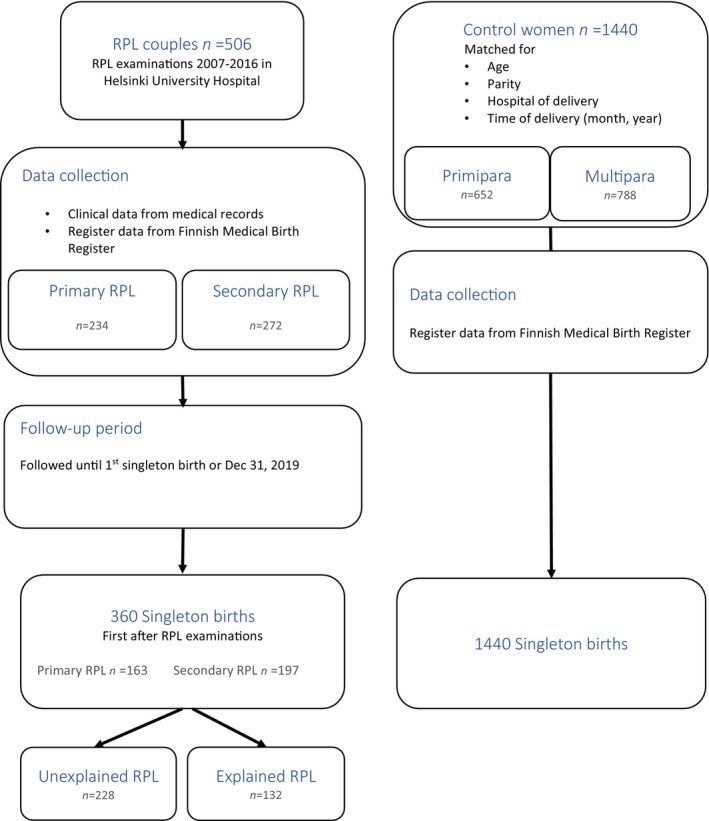
Material and methods: This retrospective case-control study investigated the outcomes of the next subsequent singleton pregnancy after thorough RPL examination (n = 360) in Helsinki University Hospital, Finland, in 2007-2016. Data for cases and four control women for each case, matched for age, parity, delivery month, year, and hospital (n = 1440), were retrieved from the Medical Birth Register. Primary outcomes were pregnancy and delivery complications, perinatal outcomes, and characteristics of pregnancy follow-up. Secondary outcomes were maternal and neonatal diagnoses. Associations between RPL and outcomes were estimated with risk ratios with 95% confidence intervals (CI). In sub-analyses, we compared the outcomes of secondary RPL with multipara controls and women with unexplained or explained RPL.
Results: Women with RPL had a higher risk for gestational hypertension (3.1% vs. 1.4%, risk ratio [RR] 2.20 [Confidence interval (CI) 1.06-4.55], p = 0.03), preterm birth (8.9% vs. 5.8%, RR 1.54 [CI 1.04-2.28], p = 0.04), malpresentation of the fetus (3.3% vs. 1.5%, RR 2.18 [CI 1.09-4.37], p = 0.02), premature rupture of membranes (5.6% vs. 2.4%, RR 2.35 [CI 1.37-4.04], p = 0.002), and had more prenatal visits than controls. Mode of delivery was comparable between the study groups, although RPL women had more induced labor (28.1% vs. 22.2%, RR 1.26 [CI 1.04-1.53], p = 0.02). Mean birthweight was lower (3387 ± 680 g) in RPL women's newborns than in the control group (3482 ± 564 g, p = 0.02), and the risk of umbilical artery pH <7.10 (6.7% vs. 3.6%, RR 1.85 [CI 1.15-2.95], p = 0.03) was higher. Risk ratio for small for gestational age was higher in the secondary RPL group than in multipara controls (5.1% vs. 2.0%, RR 2.50 [CI 1.15-5.42], p = 0.02).
Conclusions: Women with a history of RPL seem to have higher risks in their subsequent pregnancies and should therefore be monitored carefully. These findings support the theory of placental development being the common nominator behind hypertensive pregnancy disorders and RPL.
Keywords: perinatal and neonatal diagnoses; perinatal outcome; placental problems; pregnancy outcome; recurrent pregnancy loss; risk pregnancy; subsequent pregnancy.
© 2024 The Author(s). Acta Obstetricia et Gynecologica Scandinavica published by John Wiley & Sons Ltd on behalf of Nordic Federation of Societies of Obstetrics and Gynecology (NFOG).
Conflict of interest statement
The authors declare no conflict of interest.
Figures
References
-
- Dimitriadis E, Menkhorst E, Saito S, Kutteh WH, Brosens JJ. Recurrent pregnancy loss. Nat Rev Dis Primers. 2020;6:98. - PubMed
-
- Quenby S, Gallos ID, Dhillon‐Smith RK, et al. Miscarriage matters: the epidemiological, physical, psychological, and economic costs of early pregnancy loss. Lancet. 2021;397:1658‐1667. - PubMed
-
- Burton GJ, Jauniaux E. Pathophysiology of placental‐derived fetal growth restriction. Am J Obstet Gynecol. 2018;218:S745‐S761. - PubMed
MeSH terms
Grants and funding
- TYH2020207/Government's Research Financing Government Research Funding Helsinki University Hospital Finnish Government science grant the State Subsidy to Hospitals
- TYH2024329/Government's Research Financing Government Research Funding Helsinki University Hospital Finnish Government science grant the State Subsidy to Hospitals
- Juhani Aho Foundation for Medical Research
- 00220291/The Finnish Cultural Foundation
- Emil Aaltonen Foundation
LinkOut - more resources
Full Text Sources
