


Utilizing T-Lymphocyte Activation-Related Cytokines to Predict Non-Responsiveness to Treatment in Pediatric Kawasaki Disease
- PMID: 39711577
- PMCID: PMC11662628
- DOI: 10.2147/PHMT.S489512
Utilizing T-Lymphocyte Activation-Related Cytokines to Predict Non-Responsiveness to Treatment in Pediatric Kawasaki Disease
Abstract
Objective: To investigate the predictive value of T-lymphocyte activation-related cytokines in non-responsive Kawasaki disease.
Methods: Eighty-two children with Kawasaki disease, hospitalized from June 2022 to December 2023, were divided into two groups based on treatment response: the sensitive Kawasaki disease group (n=71) and the non-responsive Kawasaki disease group (n=11). Serum levels of T-lymph activation-related cytokines, including interleukin-2, 6, 7, 12, 15, 17, and tumor necrosis factor alpha, were measured before and after IVIG treatment in both groups. The differences in cytokine levels between the two groups were compared pre- and post-treatment. The ability of these cytokines to discriminate non-responsive Kawasaki disease was evaluated using ROC curves to determine the cut-off value.
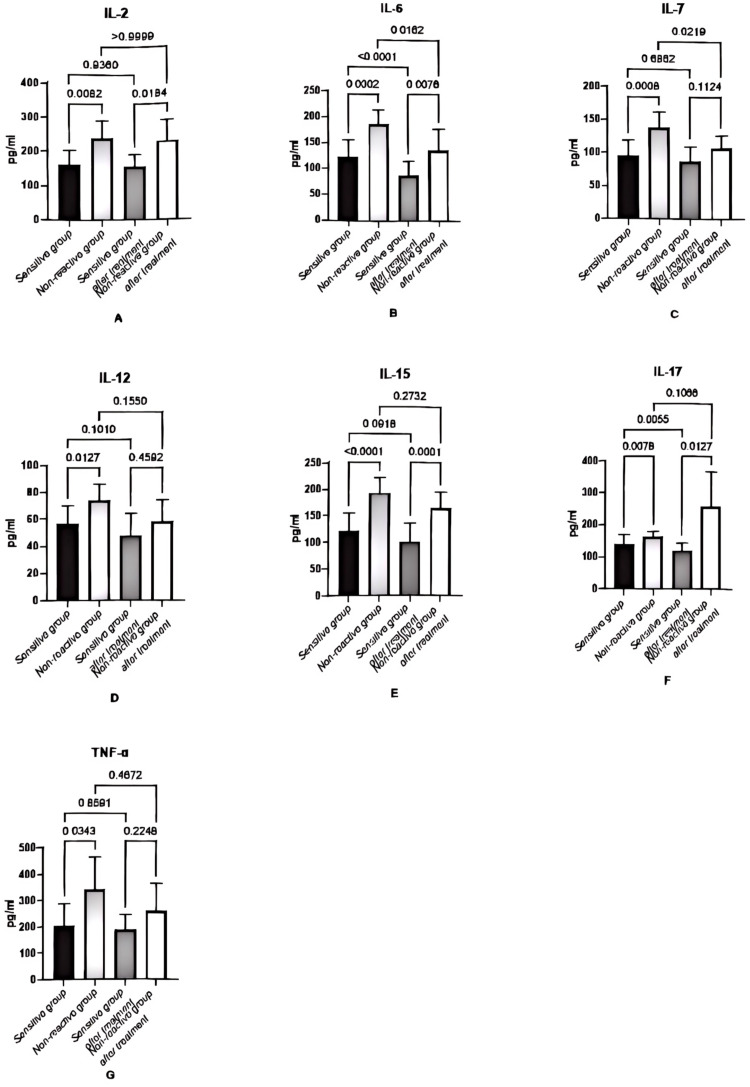
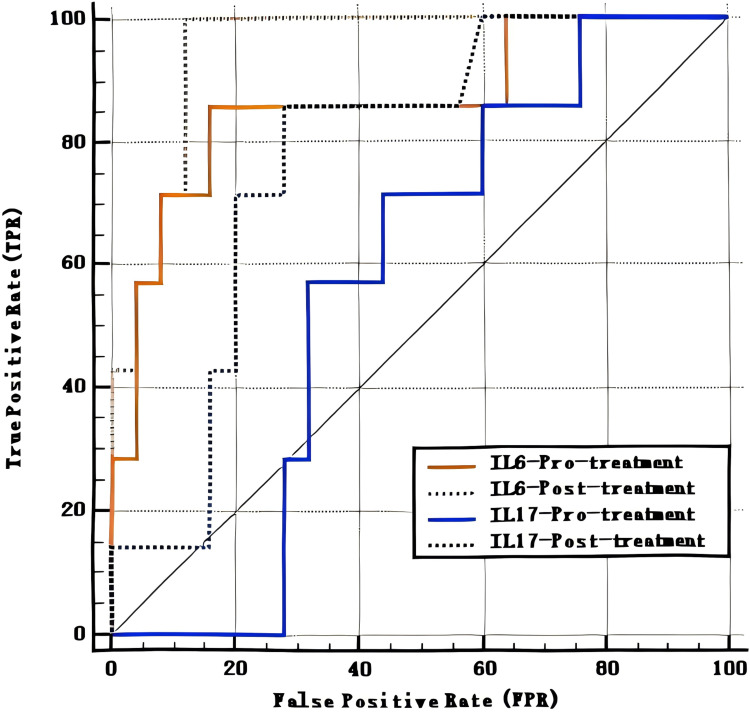
Results: Before initial treatment, IL-2, IL-6, IL-7, IL-12, IL-15, IL-17, and tumor necrosis factor-α values were significantly higher in the non-responsive Kawasaki disease group compared to the sensitive Kawasaki disease group. Comparisons before and after initial treatment showed significant decreases in IL-6 and 17 in the sensitive Kawasaki disease group and significant decreases in IL-6 and 7 in the non-responsive Kawasaki disease group. IL-6 and 17 significantly increased in the sensitive group compared to the non-responsive group after initial treatment. The ROC curves indicated that IL-6 predicted the area under the curve (AUC) for non-responsive Kawasaki disease to be 0.859 before treatment and 0.920 after treatment. Similarly, IL-17 had AUC values of 0.699 before treatment and 0.884 after treatment.
Conclusion: Reassessing IL-6 and IL-17 following the initial treatment for Kawasaki disease may improve early warning signals for unresponsive Kawasaki disease.
Keywords: Kawasaki disease; T-lymphocyte activation; cytokines; immunoglobulin; unresponsive Kawasaki disease.
© 2024 Ye et al.
Conflict of interest statement
The authors declare that the research was conducted without any commercial or financial relationships that might be interpreted as potential conflicts of interest.
Figures
References
-
- Takekoshi N, Kitano N, Takeuchi T, et al. Analysis of age, sex, lack of response to intravenous immunoglobulin, and development of coronary artery abnormalities in children with Kawasaki disease in Japan. JAMA Netw Open. 2022;5(6):e2216642. doi: 10.1001/jamanetworkopen.2022.16642 - DOI - PMC - PubMed
LinkOut - more resources
Full Text Sources
