


The Role of Leukemia Inhibitory Factor in Cardiovascular Disease: Signaling in Inflammation, Coagulation, and Angiogenesis
- PMID: 39712364
- PMCID: PMC11659708
- DOI: 10.18502/jthc.v19i1.15531
The Role of Leukemia Inhibitory Factor in Cardiovascular Disease: Signaling in Inflammation, Coagulation, and Angiogenesis
Abstract
Background: Cardiovascular disease (CVD) is one of the principal causes of mortality in the world. Various factors have been identified in the pathogenesis of CVD. Leukemia inhibitory factor (LIF) as a secretory cytokine is one of these factors. The LIF receptor is located on endothelial cells and plays a role in the expression of specific genes in these cells. Endothelial cells are the innermost cells of blood vessels, and defects in these cells cause endothelial dysfunction and eventually CVD.
Methods: The present study is based on PubMed database information (1982-2022) using the following words: "cardiovascular disease," "endothelial cells," "leukemia inhibitory factor," and "angiogenesis."
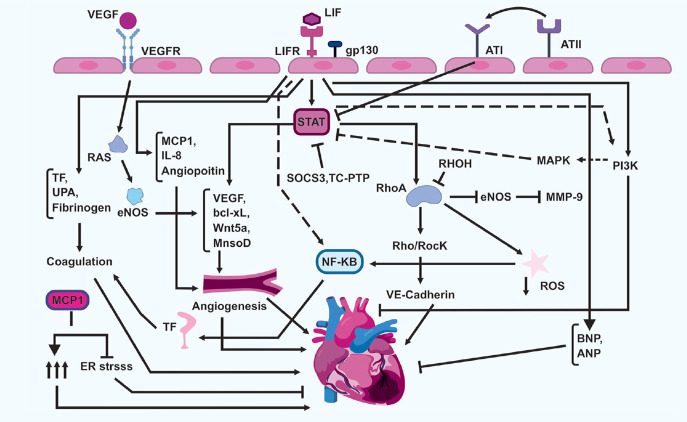
Results: LIF can cause arteriosclerotic plaques by activating inflammatory mechanisms in monocytes through the induction of intercellular adhesion molecule-1 and vascular cell adhesion molecule-1 expression. LIF can also induce vascular endothelial growth factor expression by activating signaling pathways, eventually leading to angiogenesis. Additionally, it can activate the coagulation cascade by factor VII production promotion within endothelial cells.
Conclusion: Understanding the interplay between LIF and the inflammation pathways, coagulation, and angiogenesis as key factors in CVD occurrence raises the possibility of targeting this factor as a potential strategy to mitigate CVD risk.
Keywords: Angiogenesis; Cardiovascular disease; Endothelial cells; Leukemia inhibitory factor.
Copyright© 2024 Tehran University of Medical Sciences. Published by Tehran University of Medical Sciences.
Figures
References
-
- Chistiakov DA, Shkurat TP, Melnichenko AA, Grechko AV, Orekhov AN. The role of mitochondrial dysfunction in cardiovascular disease: a brief review. Ann Med 2018;50:121–127. - PubMed
-
- Virani SS, Alonso A, Benjamin EJ, Bittencourt MS, Callaway CW, Carson AP, Chamberlain AM, Chang AR, Cheng S, Delling FN, Djousse L, Elkind MSV, Ferguson JF, Fornage M, Khan SS, Kissela BM, Knutson KL, Kwan TW, Lackland DT, Lewis TT, Lichtman JH, Longenecker CT, Loop MS, Lutsey PL, Martin SS, Matsushita K, Moran AE, Mussolino ME, Perak AM, Rosamond WD, Roth GA, Sampson UKA, Satou GM, Schroeder EB, Shah SH, Shay CM, Spartano NL, Stokes A, Tirschwell DL, VanWagner LB, Tsao CW, American Heart Association Council on Epidemiology and Prevention Statistics Committee and Stroke Statistics Subcommittee . Heart Disease and Stroke Statistics-2020 Update: A Report From the American Heart Association. Circulation 2020;141:e139–e596. - PubMed
-
- Schwartz SM, Schwartz HT, Horvath S, Schadt E, Lee SI. A systematic approach to multifactorial cardiovascular disease: causal analysis. Arterioscler Thromb Vasc Biol 2012;32:2821–2835. - PubMed
-
- Zhao L, Varghese Z, Moorhead JF, Chen Y, Ruan XZ. CD36 and lipid metabolism in the evolution of atherosclerosis. Br Med Bull. 2018. Jun 1;126(1):101–112. - PubMed
Publication types
LinkOut - more resources
Full Text Sources