


Deep Learning-Based Automatic Segmentation Combined with Radiomics to Predict Post-TACE Liver Failure in HCC Patients
- PMID: 39712947
- PMCID: PMC11663388
- DOI: 10.2147/JHC.S499436
Deep Learning-Based Automatic Segmentation Combined with Radiomics to Predict Post-TACE Liver Failure in HCC Patients
Abstract
Objective: To develop and validate a deep learning-based automatic segmentation model and combine with radiomics to predict post-TACE liver failure (PTLF) in hepatocellular carcinoma (HCC) patients.
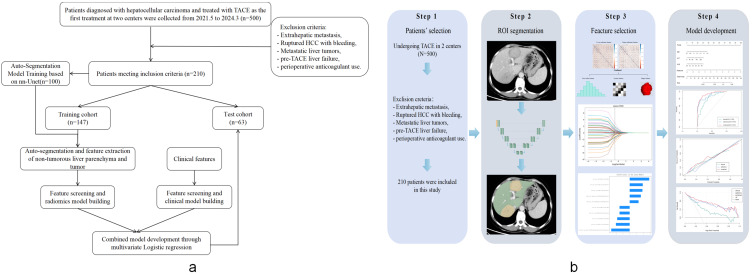
Methods: This was a retrospective study enrolled 210 TACE-trated HCC patients. Automatic segmentation model based on nnU-Net neural network was developed to segment medical images and assessed by the Dice similarity coefficient (DSC). The screened clinical and radiomics variables were separately used to developed clinical and radiomics predictive model, and were combined through multivariate logistic regression analysis to develop a combined predictive model. The area under the curve (AUC), calibration curve, and decision curve analysis (DCA) were applied to compare the performance of the three predictive models.
Results: The automatic segmentation model showed satisfactory segmentation performance with an average DSC of 83.05% for tumor segmentation and 92.72% for non-tumoral liver parenchyma segmentation. The international normalized ratio (INR) and albumin (ALB) was identified as clinically independent predictors for PTLF and used to develop clinical predictive model. Ten most valuable radiomics features, including 8 from non-tumoral liver parenchyma and 2 from tumor, were selected to develop radiomics predictive model and to calculate Radscore. The combined predictive model achieved the best and significantly improved predictive performance (AUC: 0.878) compared to the clinical predictive model (AUC: 0.785) and the radiomics predictive model (AUC: 0.815).
Conclusion: This reliable combined predictive model can accurately predict PTLF in HCC patients, which can be a valuable reference for doctors in making suitable treatment plan.
Keywords: TACE; deep learning; hepatocellular carcinoma; liver failure; radiomics.
© 2024 Li et al.
Conflict of interest statement
The authors declare that they have no competing interests.
Figures


References
-
- European Association for the Study of the Liver. Electronic address: easloffice@easloffice.eu. and European Association for the Study of the Liver. EASL clinical practice guidelines: management of hepatocellular carcinoma. J Hepatol. 2018;vol. 69(1):182–236. doi: 10.1016/j.jhep.2018.03.019 - DOI - PubMed
LinkOut - more resources
Full Text Sources
Miscellaneous
