


This is a preprint.
UniFORM: Towards Universal ImmunoFluorescence Normalization for Multiplex Tissue Imaging
- PMID: 39713407
- PMCID: PMC11661071
- DOI: 10.1101/2024.12.06.626879
UniFORM: Towards Universal ImmunoFluorescence Normalization for Multiplex Tissue Imaging
Update in
-
Toward universal immunofluorescence normalization for multiplex tissue imaging with UniFORM.Cell Rep Methods. 2025 Sep 15;5(9):101172. doi: 10.1016/j.crmeth.2025.101172. Epub 2025 Sep 8. Cell Rep Methods. 2025. PMID: 40925367 Free PMC article.
Abstract
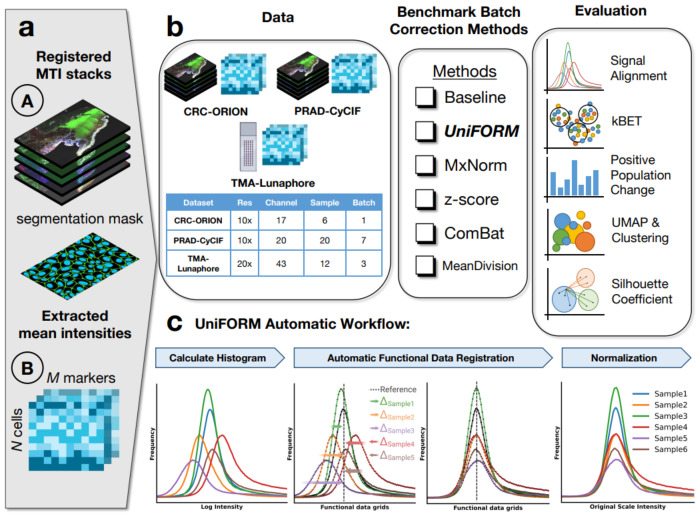
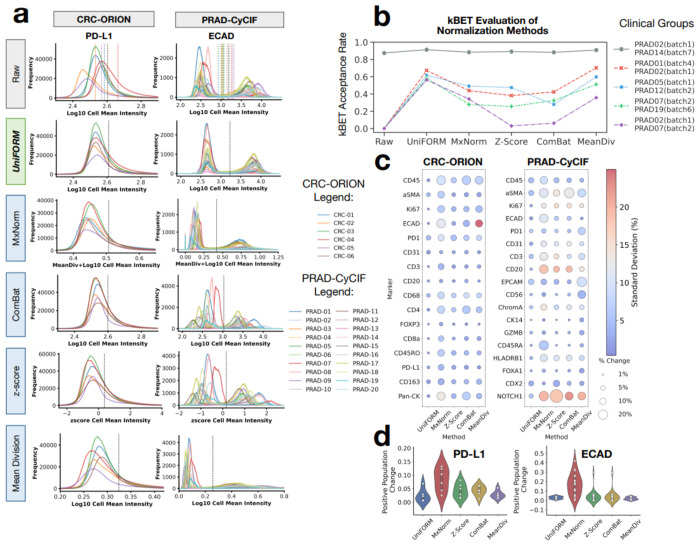
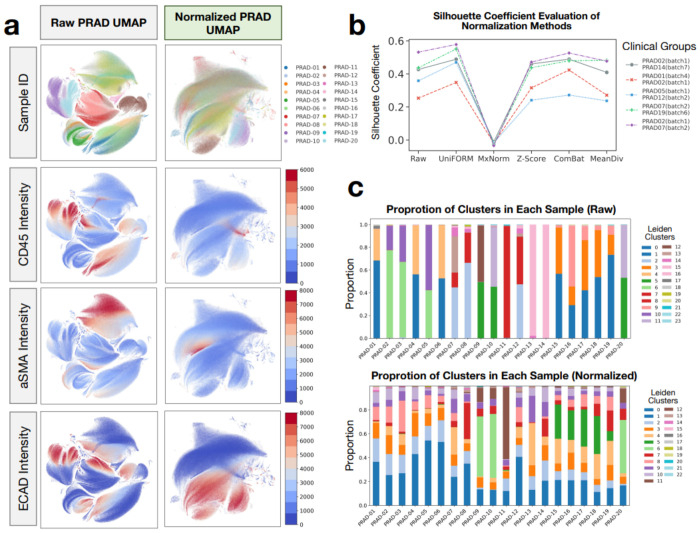
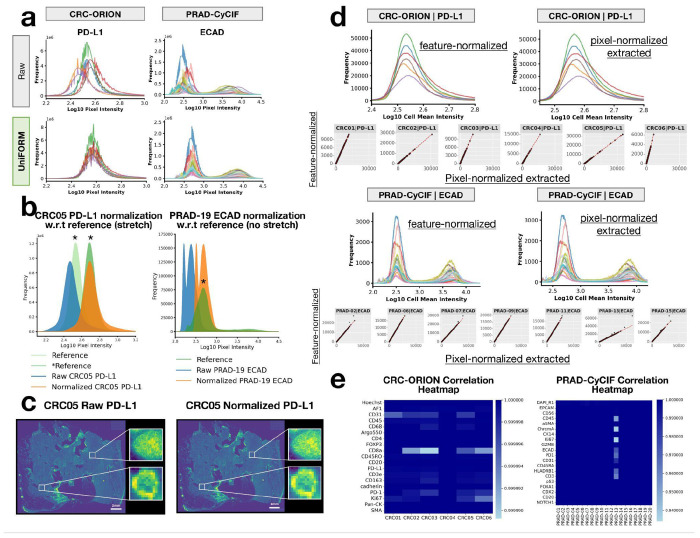
Multiplexed tissue imaging (MTI) technologies enable high-dimensional spatial analysis of tumor microenvironments but face challenges with technical variability in staining intensities. Existing normalization methods, including Z-score, ComBat, and MxNorm, often fail to account for the heterogeneous, right-skewed expression patterns of MTI data, compromising signal alignment and downstream analyses. We present UniFORM, a non-parametric, Python-based pipeline that uses an automated rigid landmark functional data registration approach for normalizing both feature- and pixel-level MTI data. Designed specifically for the distributional characteristics of MTI datasets, UniFORM operates without prior distributional assumptions and performs robustly regardless of distribution modality, including both unimodal and bimodal patterns. It removes technical variation by aligning the biologically invariant component of the signal, typically the negative (non-expressing) population, while preserving biologically meaningful variation in the positive population, thereby maintaining tissue-specific expression patterns essential for downstream analysis. Benchmarking across three distinct MTI platform datasets demonstrates that UniFORM outperforms existing methods in mitigating batch effects while maintaining biological signal fidelity. This is evidenced by improved marker distribution alignment and positive population preservation, enhanced kBET and Silhouette scores, and improved downstream analyses such as UMAP visualizations and Leiden clustering. UniFORM also introduces a novel guided fine-tuning option for complex and heterogeneous datasets. Although optimized for fluorescence-based platforms, UniFORM provides a scalable and robust solution for MTI data normalization, enabling accurate and biologically meaningful interpretations.
Conflict of interest statement
Competing interests The authors declare the following competing interests: G.B.M. is a SAB member or Consultant: for Amphista, Astex, AstraZeneca, BlueDot, Chrysallis Biotechnology, Ellipses Pharma, GSK, ImmunoMET, Infinity, Ionis, Leapfrog Bio, Lilly, Medacorp, Nanostring, Nuvectis, PDX Pharmaceuticals, Qureator, Roche, Signalchem Lifesciences, Tarveda, Turbine, Zentalis Pharmaceuticals. G.B.M. has Stock/Options/Financial relationships with: Bluedot, Catena Pharmaceuticals, ImmunoMet, Nuvectis, SignalChem, Tarveda, and Turbine. G.B.M. has Licensed Technology: HRD assay to Myriad Genetics, DSP patents with Nanostring. G.B.M. has Sponsored research with AstraZeneca. The other authors declare no competing interests.
Figures
References
-
- Harms P. W. et al. Multiplex Immunohistochemistry and Immunofluorescence: A Practical Update for Pathologists. Mod. Pathol. Off. J. U. S. Can. Acad. Pathol. Inc 36, 100197 (2023). - PubMed
Publication types
Grants and funding
LinkOut - more resources
Full Text Sources
