. 2024 Dec 3;9(50):49545-49556.
doi: 10.1021/acsomega.4c07452. eCollection 2024 Dec 17.

Cysteine-Grafted Cu MOF/ZnO/PANI Nanocomposite for Nonenzymatic Electrochemical Sensing of Dopamine

Affiliations

Cysteine-Grafted Cu MOF/ZnO/PANI Nanocomposite for Nonenzymatic Electrochemical Sensing of Dopamine

Mariam Basharat et al. ACS Omega. .

Abstract

Electrochemical sensing has shown great promise in monitoring neurotransmitter levels, particularly dopamine, essential for diagnosing neurological illnesses like Parkinson's disease. Such techniques are easy, cost-effective, and extremely sensitive. The present investigation discusses the synthesis, characterization, and potential use of a cysteine-grafted Cu MOF/ZnO/PANI nanocomposite deposited on the modified glassy carbon electrode surface for nonenzymatic electrochemical sensing of dopamine. The synthesized nanocomposite was confirmed through X-ray diffraction, Fourier transform infrared, Raman, and scanning electron microscopy characterization techniques. Additionally, electrochemical analysis was conducted using cyclic voltammogram, differential pulse voltammetry, and chronoamperometry. The process was determined to be the diffusion-controlled oxidation of dopamine. Dopamine underwent spontaneous adsorption on the electrode surface through an electrochemically reversible mechanism. Despite various biological interfering factors, the nonenzymatic electrochemical sensor demonstrated a remarkable level of selectivity toward dopamine. Cysteine-grafted Cu MOF/ZnO/PANI produced the lowest dopamine detection limit, at 0.39 μM, and the sensitivity was observed as 122.57 μAmM-1 cm-2. Results have demonstrated that enhanced catalytic and conductive properties of MOFs, combined with nanostructured materials, are the primary factors affecting the sensor's performance.


Conflict of interest statement

The authors declare no competing financial interest.

Figures

Figure 1
Figure 1
SEM results of (A) Cu MOF, (B) Cys/Cu MOF composite, (C) PANI nanotubes, (D) Cu MOF/PANI composite, (E) Cys/Cu MOF/PANI composite, (F) ZnO NPs, (G) Cu MOF/ZnO composite, (H) Cu MOF/ZnO/PANI composite, and (I) Cys/Cu MOF/ZnO/PANI nanocomposite.
Figure 2
Figure 2
XRD Results of Cu MOF, Cys/Cu MOF composite, PANI nanotubes, Cu MOF/PANI composite, Cys/Cu MOF/PANI composite, ZnO NPs, Cu MOF/ZnO composite, Cu MOF/ZnO/PANI composite, and Cys/Cu MOF/ZnO/PANI nanocomposite.
Figure 3
Figure 3
FTIR analysis of Cu MOF, Cys/Cu MOF composite, PANI nanotubes, Cu MOF/PANI composite, Cys/Cu MOF/PANI composite, ZnO NPs, Cu MOF/ZnO composite, Cu MOF/ZnO/PANI composite, and Cys/Cu MOF/ZnO/PANI nanocomposite.
Figure 4
Figure 4
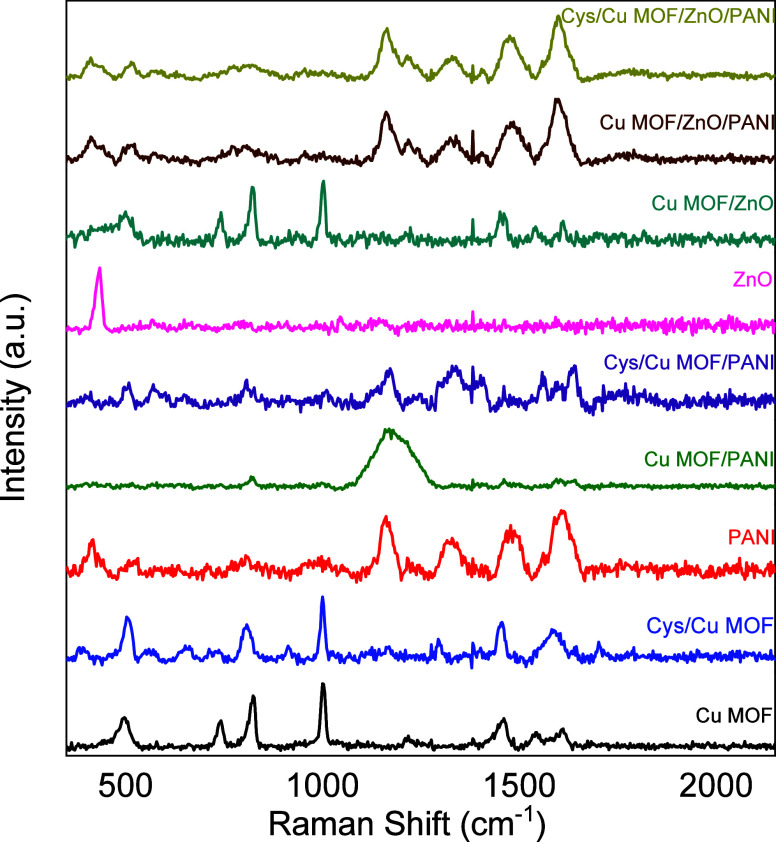
RAMAN spectra observed for Cu MOF, Cys/Cu MOF composite, PANI nanotubes, Cu MOF/PANI composite, Cys/Cu MOF/PANI composite, ZnO NPs, Cu MOF/ZnO nanocomposite, Cu MOF/ZnO/PANI nanocomposite, and Cys/Cu MOF/ZnO/PANI nanocomposite.
Figure 5
Figure 5
Cyclic voltammograms recorded in the presence of 0.2 mM dopamine (DA) and 0.1 M PBS electrolyte at a scan rate of 50 mVs–1 for bare GCE, Cu MOF, Cys/Cu MOF, Cu MOF/PANI, Cu MOF/ZnO, Cys/Cu MOF/PANI, Cu MOF/ZnO/PANI, and Cys/Cu MOF/ZnO/PANI nanocomposite.
Figure 6
Figure 6
(a) Cyclic voltammograms recorded for Cys/Cu MOF/ZnO/PANI in the presence of 0.2 mM dopamine (DA) and 0.1 M PBS electrolyte at different scan rates from 10–100 mVs–1. (b) Corresponding plot of oxidation peak current (Ipa) against the square root of the scan rate.
Figure 7
Figure 7
Cyclic voltammogram of Cys/Cu MOF/ZnO/PANI modified GCE in the presence of different concentrations of dopamine (DA) at a scan rate of 50 mVs–1.
Figure 8
Figure 8
(a) DPV curves of different concentrations of DA, i.e., 0.02 mM to 1 mM in 0.1 M PBS on Cys/Cu MOF/ZnO/PANI in the range of −0.1 to 3.0 V at a scan rate of 50 mVs–1. (b) Corresponding linear calibration curve of peak current vs DA concentration.
Figure 9
Figure 9
Cys/Cu MOF/ZnO/PANI modified GCE was tested with CVs of 0.2 mM DA in 0.1 M PBS at different pHs (1.0, 3.0, 7.0, and 11.0) at a scan rate of 50 mVs–1.
Figure 10
Figure 10
Measurements of the anodic peak current of 0.8 mM DA in 0.1 M PBS (pH 7.0) at a scan rate of 50 mVs–1 were conducted for (a) 11 instances at the Cys/Cu MOF/ZnO/PANI modified GCE, (b) four distinct electrodes, and (c) different storage periods.
Figure 11
Figure 11
Chronoamperometric curve was gathered for a modified Cys/Cu MOF/ZnO/PANI electrode. The curve was generated by adding dopamine (DA) and common interferences, ascorbic acid, glucose, and urea, with a voltage of 0.25 V.

References

    1. Carlsson A. Perspectives on the discovery of central monoaminergic neurotransmission. Annu. Rev.Neurosc. 1987, 10 (1), 19–40. 10.1146/annurev.ne.10.030187.000315. - DOI - PubMed
    1. Reis H. J.; Guatimosim C.; Paquet M.; Santos M.; Ribeiro F. M.; Kummer A.; Schenatto G.; Salgado J. V.; Vieira L. B.; Teixeira A. L. Neuro-transmitters in the central nervous system & their implication in learning and memory processes. Curr. Med. Chem. 2009, 16 (7), 796–840. 10.2174/092986709787549271. - DOI - PubMed
    1. Mehler-Wex C.; Riederer P.; Gerlach M. Dopaminergic dysbalance in distinct basal ganglia neurocircuits: implications for the pathophysiology of Parkinson’s disease, schizophrenia and attention deficit hyperactivity disorder. Neurotox. Res. 2006, 10, 167–179. 10.1007/BF03033354. - DOI - PubMed
    1. Wei N.; Zhao X.-E.; Zhu S.; He Y.; Zheng L.; Chen G.; You J.; Liu S.; Liu Z. Determination of dopamine, serotonin, biosynthesis precursors and metabolites in rat brain microdialysates by ultrasonic-assisted in situ derivatization–dispersive liquid–liquid microextraction coupled with UHPLC-MS/MS. Talanta 2016, 161, 253–264. 10.1016/j.talanta.2016.08.036. - DOI - PubMed
    1. Dutta G.; Tan C.; Siddiqui S.; Arumugam P. U. Enabling long term monitoring of dopamine using dimensionally stable ultrananocrystalline diamond microelectrodes. Mater. Res. Exp. 2016, 3 (9), 09400110.1088/2053-1591/3/9/094001. - DOI - PMC - PubMed

LinkOut - more resources