


Effect of low- and moderate-intensity endurance exercise on physical functioning among breast cancer survivors: a randomized controlled trial
- PMID: 39714637
- PMCID: PMC11806920
- DOI: 10.1007/s00520-024-09100-2
Effect of low- and moderate-intensity endurance exercise on physical functioning among breast cancer survivors: a randomized controlled trial
Abstract
Purpose: Compare the effects of low-intensity and moderate-intensity exercise on physical functioning in breast cancer survivors.
Methods: Women aged 50 + years and post-primary treatment for stage 0 to III breast cancer were randomly assigned to a 6-month low-intensity (LIG) or moderate-intensity (MIG) exercise group. Participants were instructed to walk (low- or moderate-intensity) for 30 min five days a week, followed by flexibility exercises, and do strengthening and balance exercises twice weekly. Exercise adherence was facilitated with seven individual counseling sessions tapered over six months and a Theory of Planned Behavior-based booklet. Assessments occurred at baseline, 6 months (post-intervention), and 12 months. Primary measures were PROMIS Physical Functioning, PROMIS Global Health, and six-minute walk test (6MWT).
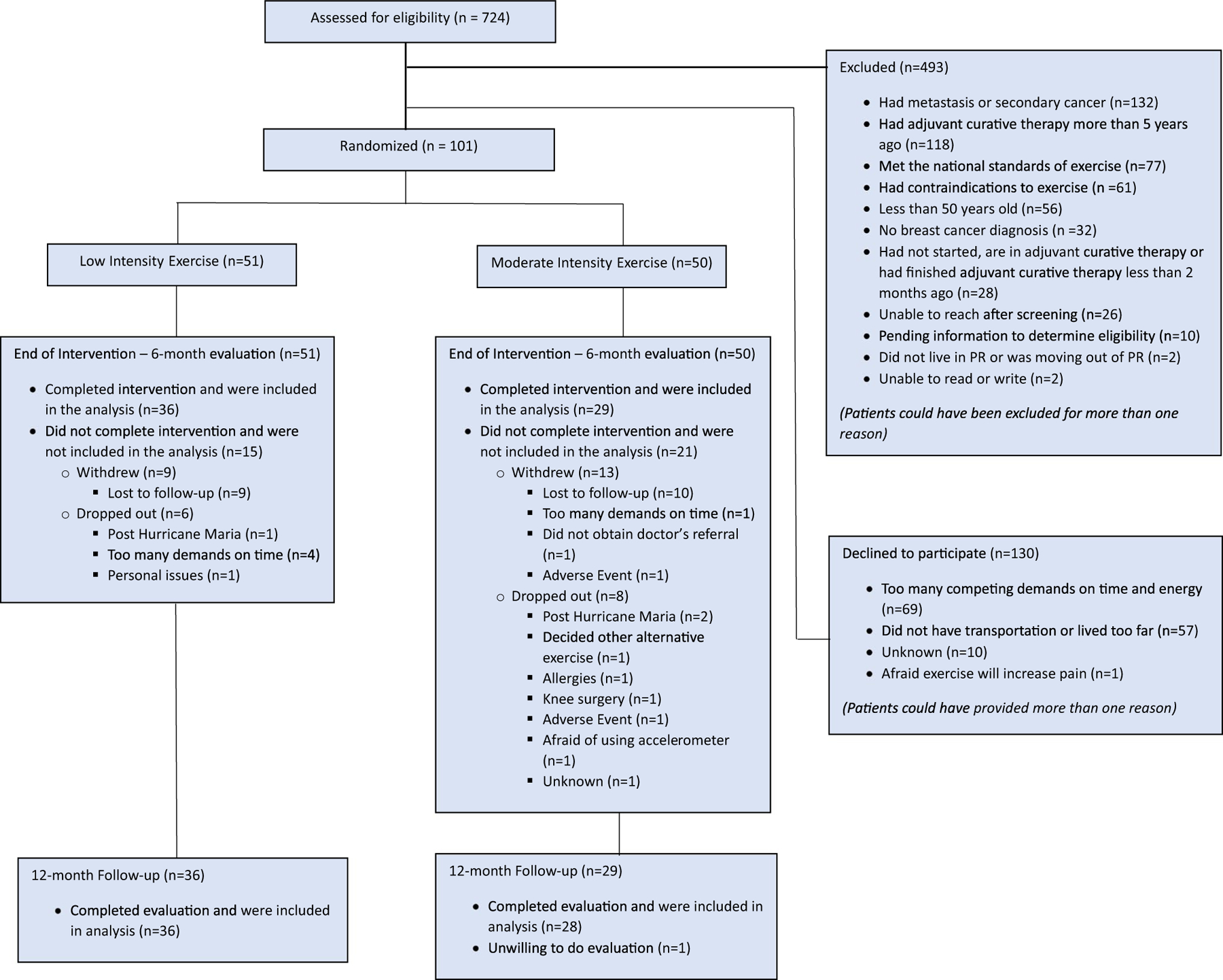
Results: Of 101 women randomized, 65 (64.4%) completed the study. No statistically significant between-group differences occurred at post-intervention or 12 months. Compared to baseline, within-group improvements in PROMIS physical functioning occurred (LIG increased from 45.87 ± 7.58 to 48.37 ± 7.13 post-intervention (p = 0.01); MIG increased from 45.26 ± 7.27 to 49.53 ± 8.80 post-intervention (p = 0.002) and 48.91 ± 9.29 at 12 months (p = 0.02)). Similarly, Global Health physical health improved (LIG increased from 46.04 ± 5.00 to 49.19 ± 5.76 post-intervention (p = 0.001); MIG increased from 45.06 ± 6.59 to 48.20 ± 7.33 post-intervention (p = 0.005) and 48.49 ± 7.89 at 12 months (p = 0.007)). 6MWT improved between post-intervention and 12 months for the LIG (469.99 ± 64.69 m to 492.19 ± 68.64 m, p = 0.008) and between baseline and post-intervention for the MIG (471.01 ± 62.69 m to 495.88 ± 66.64 m, p = 0.006).
Conclusion: Both low and moderate-intensity exercise led to significant improvement in physical functioning. When feasible and acceptable, prescribing low-intensity exercise can yield important benefits.
Trial registration number: ClinicalTrials.gov identifier: NCT02982564.
Keywords: Breast cancer; Exercise; Physical function; Survivorship.
© 2024. The Author(s), under exclusive licence to Springer-Verlag GmbH Germany, part of Springer Nature.
Conflict of interest statement
Declarations. Competing interests: The authors declare no competing interests.
References
-
- Globocan. Global Cancer Observatory (2022) Puerto Rico. https://gco.iarc.who.int/media/globocan/factsheets/populations/630-puert.... Accessed 18 Nov 2024
-
- Kahán Z, Szántó I, Dudás R, et al. (2022) Breast cancer survivorship programme: follow-up, rehabilitation, psychosocial oncology care. 1st Central-Eastern European professional consensus statement on breast cancer. Pathol Oncol Res 28:1610391. Published 2022 Jun 2. 10.3389/pore.2022.1610391 - DOI - PMC - PubMed
Publication types
MeSH terms
Associated data
Grants and funding
LinkOut - more resources
Full Text Sources
Medical
Research Materials
