. 2024 Dec 23;14(1):30613.
doi: 10.1038/s41598-024-83627-6.

A shorter linker in the bispecific antibody RmAb158-scFv8D3 improves TfR-mediated blood-brain barrier transcytosis in vitro

Affiliations

A shorter linker in the bispecific antibody RmAb158-scFv8D3 improves TfR-mediated blood-brain barrier transcytosis in vitro

Inga Petersen et al. Sci Rep. .

Abstract

Transferrin Receptor (TfR)-mediated transcytosis across the blood-brain barrier (BBB) enables the uptake of bispecific therapeutic antibodies into the brain. At therapeutically relevant concentrations, bivalent binding to TfR appears to reduce the transcytosis efficiency by receptor crosslinking. In this study, we aimed to improve BBB transcytosis of symmetric antibodies through minimizing their ability to cause TfR crosslinking. We created variants of the previously published RmAb158-scFv8D3, where the linker length between RmAb158 and the mTfR-targeting scFv8D3 was adjusted. We investigated the effect of the linker length on the antibodies' binding kinetics to mTfR using ELISA and LigandTracer assays, and their ability to transcytose across BBB endothelial cells (In-Cell BBB-Trans assay). We show that even a direct fusion without a linker does not alter the antibodies' apparent affinities to mTfR indicating their valency is unlikely affected by the linker length. However, the shortest linker variants demonstrated BBB transcytosis levels comparable to that of the monovalent control at a high antibody concentration and showed an almost two-fold higher level of BBB transcytosis compared to the longer-linker variants at the high concentration. Our new RmAb158-scFv8D3 short-linker variants are examples of symmetric, therapeutic antibodies with improved TfR-binding characteristics to facilitate more efficient brain uptake. We hypothesize that bivalent binding to TfR as such does not negatively affect BBB transcytosis in vitro, but a very short distance between TfR-targeting domains lowers the probability of receptor crosslinking. This study provides valuable insights into antibody-TfR interaction kinetics, contributing to future development of TfR-targeting antibody-based treatments for brain diseases.

Keywords: Bispecific antibodies; Blood-brain-barrier (BBB) shuttle; Monovalent and bivalent binding; Receptor crosslinking; RmAb158-scFv8D3; Transferrin receptor (TfR).


Conflict of interest statement

Declarations. Competing interests: The authors declare no competing interests.

Figures
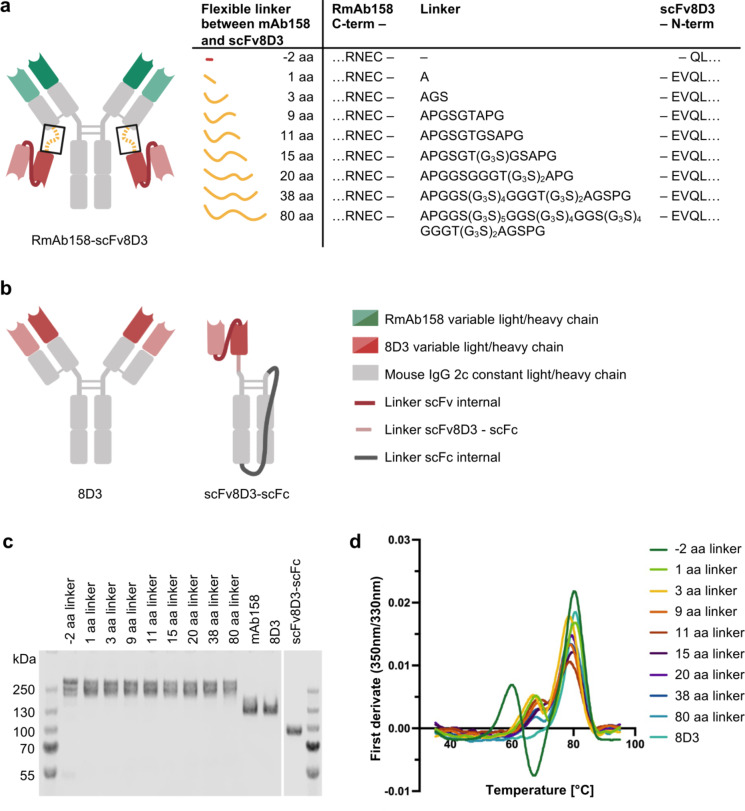
Fig. 1
Fig. 1
Design and structural integrity analysis of antibodies used in this study. (a) The original RmAb158-scFv8D3 design with an 11 aa linker between RmAb158 and scFv8D3, and the eight variants of RmAb158-scFv8D3 with only the length of the linker altered (yellow). (b) Antibody controls 8D3 for bivalent TfR-binding and scFv8D3-scFc for monovalent TfR-binding. (c) SDS-PAGE with Coomassie staining of the purified RmAb158-scFv8D3 variants and control antibodies under non-reducing conditions. 1 µg protein/lane. Complete gel and SDS-PAGE under reducing conditions can be found in Supplementary Fig. S2a,b. (d) Thermal stability of purified RmAb158-scFv8D3 variants and 8D3 measured by the change of the antibodies’ intrinsic fluorescence at 330 nm and 350 nm over a temperature ramp. Inflection temperatures, represented as peaks in the first derivate of the fluorescence intensity ratio 350 nm/330 nm, indicate major unfolding events. Raw data can be seen in Supplementary Fig. S2c and Table S1.
Fig. 2
Fig. 2
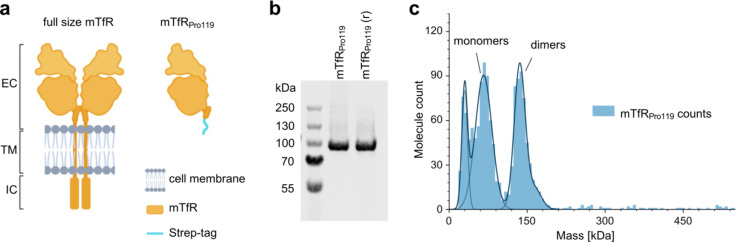
Design and mass distribution analysis of mTfRPro119 used for cell-free in vitro assays. (a) Full size murine TfR (mTfR) consists of an extracellular (EC), transmembrane (TM), and intracellular (IC) domain where the TM domain cannot easily be produced recombinantly in solution. mTfRPro119 comprising of the mTfR ectodomain is commonly used as TfR construct for in vitro assays. (b) SDS-PAGE with Coomassie staining of mTfR Pro119 under non-reducing and reducing (r) conditions (1 µg protein/lane). The complete gel can be seen in Supplementary Fig. S2d. (c) Mass distribution of purified mTfR Pro119 at 119 nM in PBS measured by mass photometry. Peak volumes represent counts of molecules of a defined mass (kDa). The first peak likely represents buffer impurities.
Fig. 3
Fig. 3
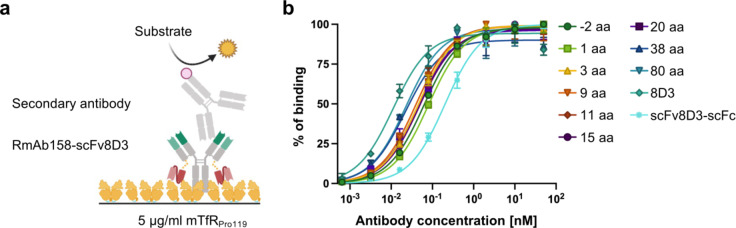
Indirect mTfRPro119 ELISA with RmAb158-scFv8D3 variants and controls binding to high mTfRPro119 coating density. (a) Schematic illustration of the indirect ELISA setup with RmAb158-scFv8D3 binding to mTfRPro119. (b) ELISA curves of RmAb158-scFv8D3 variants and controls binding to 5 µg/ml mTfRPro119 coating. The data were normalized to maximum binding signal of each antibody. Non-linear regression curves were created using a “one site – specific binding” model in GraphPad Prism. Data points are presented as mean ± SD (n = 2). The non-normalized curves can be seen in Supplementary Fig. S5. The raw data can be found in Supplementary Table S3.
Fig. 4
Fig. 4
Kinetic evaluation of the interaction of RmAb158-scFv8D3 variants, 8D3 or scFv8D3-scFc with mTfRPro119 by LigandTracer. (a) Schematic illustration of the experimental setup with mTfRPro119 coating and 125I-labeled RmAb158-scFv8D3 variants or 8D3 added in solution. (bg) Interaction curves for 125I-labeled RmAb158-scFv8D3 variants, 125I-labeled 8D3 or 125I-labeled scFv8D3-scFc with mTfRPro119 recorded by LigandTracer. Two consecutive association phases were performed with 10 nM and 30 nM 125I-labeled antibody. The subsequent dissociation phase was performed with 30 nM of the respective unlabeled antibody. Kinetic evaluation was done in TraceDrawer using a “one-to-one depletion corrected” fit model. Fitting curves are represented in red. (h) Overlay representation of interaction traces with RmAb158-scFv8D3 variants and 8D3 during the dissociation phase. Signal intensities of each curve were normalized to maximum signal at the beginning of the dissociation phase. The raw data can be found in Supplementary Table S4.
Fig. 5
Fig. 5
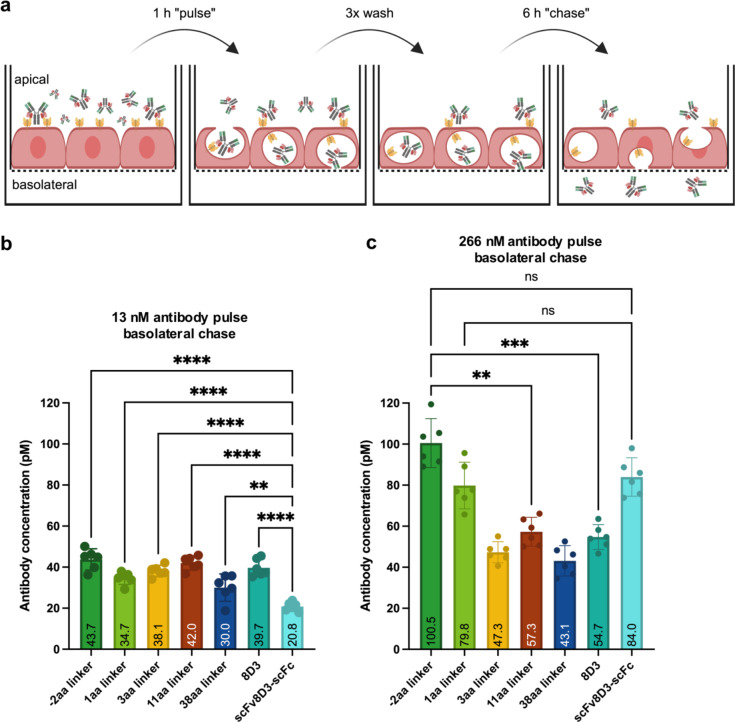
In vitro BBB assay comparing transcytosis efficiency of RmAb158-scFv8D3 variants, 8D3 and scFv8D3-scFc across a BBB endothelial cell monolayer. (a) Schematic illustration of experimental setup with cEND cells grown on porous cell culture inserts treated with 13.3 nM or 266 nM antibodies for 1 h, washed and incubated in fresh medium for 6 h. Average antibody concentrations in “chase” samples taken from the basolateral compartment after 6 h were measured by a sandwich ELISA (b,c). Results are presented as means with 95% confidence intervals. One-way ANOVA with Tukey multiple comparison was applied. (*p < 0.05; **p < 0.01; ***p < 0.001; ****p < 0.0001; ns: p > 0.05). (6 wells per condition). The raw data can be found in Supplementary Table S5.

References

    1. Lyu, X. et al. The global landscape of approved antibody therapies. Antib. Ther.5 (4), 233–257 (2022). - PMC - PubMed
    1. Bard, F. et al. Peripherally administered antibodies against amyloid β-peptide enter the central nervous system and reduce pathology in a mouse model of Alzheimer disease. Nat. Med.6 (8), 916–919 (2000). - PubMed
    1. St-Amour, I. et al. Brain bioavailability of human intravenous immunoglobulin and its transport through the murine blood-brain barrier. J. Cereb. Blood Flow Metab. Off. J. Int. Soc. Cereb. Blood Flow. Metab.33 (12), 1983–1992 (2013). - PMC - PubMed
    1. Boado, R. J., Zhang, Y., Wang, Y. & Pardridge, W. M. Engineering and expression of a chimeric transferrin receptor monoclonal antibody for blood-brain barrier delivery in the mouse. Biotechnol. Bioeng.102 (4), 1251–1258 (2009). - PMC - PubMed
    1. Hultqvist, G., Syvänen, S., Fang, X. T., Lannfelt, L. & Sehlin, D. Bivalent brain shuttle increases antibody uptake by Monovalent binding to the transferrin receptor. Theranostics7 (2), 308–318 (2017). - PMC - PubMed

MeSH terms

LinkOut - more resources