


Effects of Tai Chi on physical performance, sleep, and quality of life in older adults with mild to moderate cognitive impairment
- PMID: 39716129
- PMCID: PMC11667984
- DOI: 10.1186/s12906-024-04705-w
Effects of Tai Chi on physical performance, sleep, and quality of life in older adults with mild to moderate cognitive impairment
Abstract
Background: Exercise is a promising nonpharmacological intervention to delay the progression of cognitive impairment and improve physical function and sleep quality in patients, but the evidence remains inconclusive.
Aims: To compare the therapeutic efficacy of an exercise intervention on physical performance, sleep efficiency, and quality of life in older adults with cognitive impairment.
Design: A three-arm randomized controlled trial.
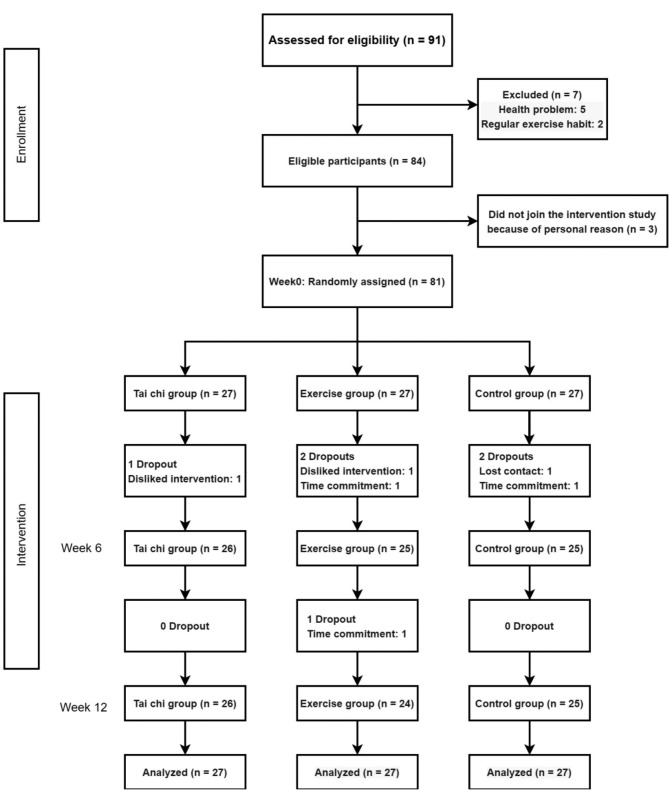
Methods: This study recruited 81 older adults with mild to moderate cognitive impairment at a nursing home from December 2020 to July 2021. Participants were screened and randomized into three groups: a tai chi intervention group (n = 27), a conventional exercise intervention group (n = 27), and a waitlist control group with no intervention (n = 27). The intervention groups underwent 12 weeks of exercise intervention. Participants were assessed at weeks 0, 6, and 12. The primary outcome was the Short Physical Performance Battery score, and the secondary outcomes were sleep efficiency and quality of life. Statistical analysis was conducted with generalized estimating equations (GEEs).
Results: The mean age of the participants was 81.0 ± 7.4 years. The GEE analysis revealed that the Short Physical Performance Battery score, sleep efficiency, and quality of life were significantly higher in both intervention groups than in the control group at week 12, and physical performance improved significantly more in the tai chi group than in the conventional exercise group.
Conclusions: Both exercise interventions improved physical performance, sleep efficiency, and quality of life in older adults with mild to moderate cognitive impairment. According to our results, tai chi may be a more effective therapeutic approach for cognitive impairment than conventional exercise.
Trial registration: University Hospital Medical Information Network number UMIN000042051. Registered 01/12/2020.
Keywords: Cognitive impairment; Nursing intervention; Physical functional performance; Quality of life; Tai Chi.
© 2024. The Author(s).
Conflict of interest statement
Declarations. Ethics approval and consent to participate: The Institutional Review Board of Kobe University approved this study (approval number: 940), which was registered in the University Hospital Medical Information Network (UMIN) Center (registration number: UMIN000042051). Informed written consent was obtained from all participants. Codes were used to replace names to ensure privacy. The data were locked and will be destroyed 3 years after the end of the study. Consent for publication: Not applicable. Competing interests: The authors declare no competing interests.
References
-
- World Health Organization cognitive impairment [EB/OL]. (2021-09-02) [2022-01-04]. https://www.who.int/news-room/fact-sheets/detail/cognitiveimpairment
-
- Jia L, Quan M, Fu Y, Zhao T, Li Y, Wei C, Tang Y, Qin Q, Wang F, Qiao Y, Shi S, Wang YJ, Du Y, Zhang J, Zhang J, Luo B, Qu Q, Zhou C, Gauthier S, Jia J. Cognitive impairment in China: epidemiology, clinical management, and research advances. Lancet Neurol. 2020;19:81–92. 10.1016/s1474-4422(19)30290-x. - DOI - PubMed
-
- Taylor ME, Boripuntakul S, Toson B, Close JCT, Lord SR, Kochan NA, Sachdev PS, Brodaty H, Delbaere K. The role of cognitive function and physical activity in physical decline in older adults across the cognitive spectrum. Aging Ment Health. 2019;23:863–71. 10.1080/13607863.2018.1474446. - DOI - PubMed
-
- Kaneshwaran K, Olah M, Tasaki S, Yu L, Bradshaw EM, Schneider JA, Buchman AS, Bennett DA, De Jager PL, Lim ASP. Sleep fragmentation, microglial aging, and cognitive impairment in adults with and without Alzheimer’s cognitive impairment. Sci Adv. 2019;5:eaax7331. 10.1126/sciadv.aax7331. - DOI - PMC - PubMed
Publication types
MeSH terms
LinkOut - more resources
Full Text Sources
Medical
