


Complement-mediated hemolytic uremic syndrome associated with postpartum hemorrhage: case series and systematic review of individual participant data
- PMID: 39717280
- PMCID: PMC11665619
- DOI: 10.1016/j.rpth.2024.102579
Complement-mediated hemolytic uremic syndrome associated with postpartum hemorrhage: case series and systematic review of individual participant data
Abstract
Background: Postpartum hemorrhage is considered a risk factor for pregnancy-associated complement-mediated hemolytic uremic syndrome (CM-HUS; previously known as atypical hemolytic uremic syndrome) but has not been systematically studied.
Objectives: To systematically examine the role of postpartum hemorrhage in precipitating CM-HUS and to describe the characteristics of postpartum hemorrhage-associated CM-HUS, its prognosis and recommended management.
Methods: A systematic review of individual participant data from case series and reports in addition to a case series from our institution. Search terms were "thrombotic microangiopathy," "atypical hemolytic uremic syndrome," and "complement mediated" combined with "pregnancy," "postpartum," and/or "postpartum hemorrhage". Cases of thrombotic microangiopathy other than CM-HUS were excluded. Outcomes were clinical and laboratory characteristics of postpartum hemorrhage-associated CM-HUS, treatment, and outcomes.
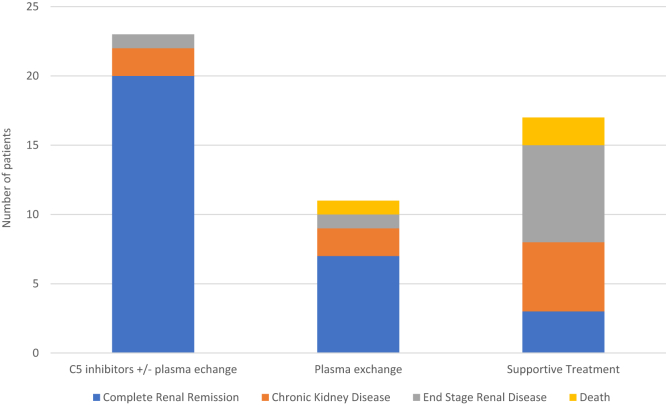
Results: Thirty-three studies comprising 48 women with postpartum hemorrhage-associated CM-HUS and 3 patients from our institution were included in the study. Most women presented at term (28/45; 62%), delivered by cesarean section (21/41; 51%), and had pregnancy complications, mainly preeclampsia (16/51; 31%) or fetal demise (9/51; 18%). Hematological and renal abnormalities usually appeared within the first 24 hours postdelivery. The median platelet count was 46 × 109/L (IQR, 26-72), and the median maximal lactate dehydrogenase was 2638 U/L (IQR, 1620-3588). Renal function normalized in 20/23 (87%) women treated with C5 inhibitors with or without plasma exchange; in 7/11 (63%) women treated with plasma exchange alone, but only in 3/17 (18%) patients treated with supportive care. Patients treated with C5 inhibitors and/or plasma exchange achieved significantly better renal outcomes compared with supportive care alone (P < .001).
Conclusion: CM-HUS is a rare complication following postpartum hemorrhage and occurs mainly in women with preeclampsia and/or following cesarean section. Patients treated with C5 inhibitors and/or plasma exchange had a better renal prognosis compared with patients who received supportive treatment alone.
Keywords: Complement C5 inhibitors; Parturition; acute kidney injury; atypical hemolytic uremic syndrome; postpartum hemorrhage; postpartum period; pregnancy; pregnancy complications; thrombotic microangiopathies; treatment outcome.
© 2024 The Authors.
Figures
References
-
- Huerta A., Arjona E., Portoles J., Lopez-Sanchez P., Rabasco C., Espinosa M., et al. A retrospective study of pregnancy-associated atypical hemolytic uremic syndrome. Kidney Int. 2018;93:450–459. - PubMed
-
- George J.N., Nester C.M., McIntosh J.J. Syndromes of thrombotic microangiopathy associated with pregnancy. Hematol Am Soc Hematol Educ Program. 2015;2015:644–648. - PubMed
-
- Adamski J. Thrombotic microangiopathy and indications for therapeutic plasma exchange. Hematol Am Soc Hematol Educ Program. 2014;2014:444–449. - PubMed
-
- Rosen M., Brauer K.I., Alperin J.B., Hankins G.D., Saade G. Postpartum hemorrhagic shock resulting in thrombotic thrombocytopenic purpura–hemolytic uremic syndrome. J Matern Fetal Neonatal Med. 2003;13:208–210. - PubMed
LinkOut - more resources
Full Text Sources
Miscellaneous
