


Doxycycline post-exposure prophylaxis for preventing bacterial sexually transmitted infections (STIs): Are clinical providers supportive?
- PMID: 39718554
- PMCID: PMC11993814
- DOI: 10.1177/09564624241309433
Doxycycline post-exposure prophylaxis for preventing bacterial sexually transmitted infections (STIs): Are clinical providers supportive?
Abstract
Background: Bacterial sexually transmitted infections (STIs) continue to increase in the United States. Despite evidence of the effectiveness of doxycycline post-exposure prophylaxis (Doxy-PEP) to prevent STIs, little is known about providers' attitudes and willingness to implement Doxy-PEP.
Methods: An online questionnaire was sent to 575 clinical providers in New York State in September 2022.
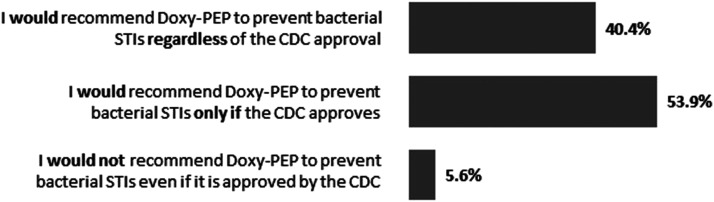
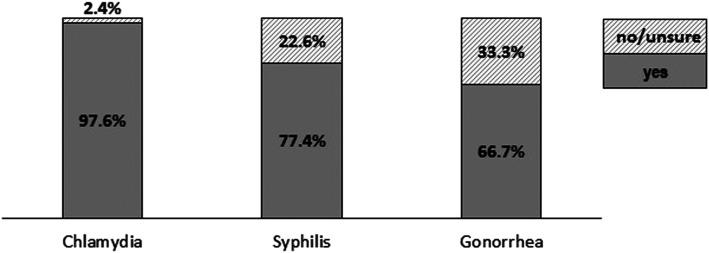
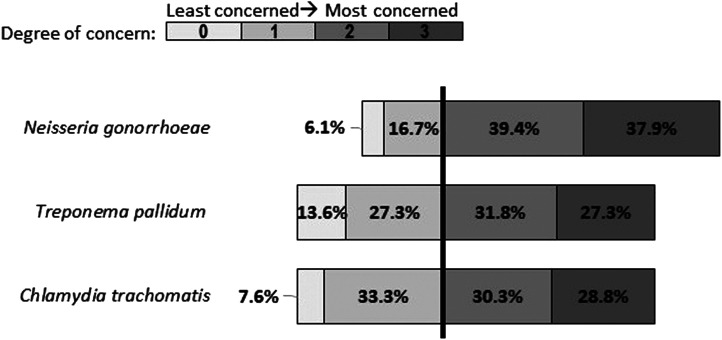
Results: Ninety-one eligible individuals responded. Most providers served men who have sex with men (MSM) (84%); reported willingness to recommend Doxy-PEP (98%, 77%, and 67% for chlamydia, syphilis, and gonorrhea, respectively); preferred Doxy-PEP administration for MSM and transgender populations; believed recurring bacterial STIs (88%) and reported condomless sex (85%) were the most important characteristics to consider for recommending Doxy-PEP; and were concerned about antibiotic resistance (90%) (primarily for Neisseria gonorrhoeae). Insurance costs were the most perceived community-associated barriers (35%). There were no significant differences in providers' recommendations towards Doxy-PEP use when comparing clinicians' years of experience, regions, or professional titles.
Conclusions: Study results suggest high willingness and support for implementing Doxy-PEP. As this survey was administered prior to national guidelines on the use of Doxy-PEP, these data can be used as a baseline to compare to studies conducted after their release to formulate appropriate messages for providers to improve implementation.
Keywords: Doxycycline prophylaxis; bacterial STIs; post-exposure prophylaxis.
Conflict of interest statement
Declaration of conflicting interestsThe author(s) declared no potential conflicts of interest with respect to the research, authorship, and/or publication of this article.
Figures
References
-
- Sexually transmitted infections (STIs). Available from: https://www.who.int/news-room/fact-sheets/detail/sexually-transmitted-in...
-
- Patel RS, Parmar M. Doxycycline hyclate. In StatPearls. Treasure Island (FL): StatPearls Publishing, 2023. Available from: https://www.ncbi.nlm.nih.gov/books/NBK555888/
-
- Janier M, Unemo M, Dupin N, et al. European guideline on the management of syphilis. Acad Dermatol Venereol 2020; 35(3): 574–588. https://onlinelibrary.wiley.com/doi/10.1111/jdv.16946 - DOI - PubMed
-
- Kong FYS, Tabrizi SN, Fairley CK, et al. The efficacy of azithromycin and doxycycline for the treatment of rectal chlamydia infection: a systematic review and meta-analysis. J Antimicrob Chemother 2015; 70(5): 1290–1297. https://academic.oup.com/jac/article/70/5/1290/691699 - PubMed
-
- Berçot B, Charreau I, Rousseau C, et al. High prevalence and high rate of antibiotic resistance of mycoplasma genitalium infections in men who have sex with men: a substudy of the anrs ipergay pre-exposure prophylaxis trial. Clin Infect Dis 2021; 73(7): e2127–e2133. - PubMed
MeSH terms
Substances
Grants and funding
LinkOut - more resources
Full Text Sources
Medical
Research Materials
Miscellaneous
