


Association of patient- and hospital-level predictors with patterns of initial treatment in patients with rheumatoid arthritis: findings from a national cohort study
- PMID: 39718801
- PMCID: PMC12107036
- DOI: 10.1093/rheumatology/keae717
Association of patient- and hospital-level predictors with patterns of initial treatment in patients with rheumatoid arthritis: findings from a national cohort study
Abstract
Objectives: To update the first-line conventional synthetic DMARDs (csDMARDs) prescribing pattern, describe change and variation across demographical and geographical factors in the RA population, and identify individual and hospital factors associated with it.
Methods: This retrospective cohort study included newly diagnosed RA adult patients from 1 May 2018 to 1 April 2023 in the UK. We used adjusted multinomial logistic regression with random effect to explore associations with different first-line csDMRAD prescription and to account for hospital-level clustering.
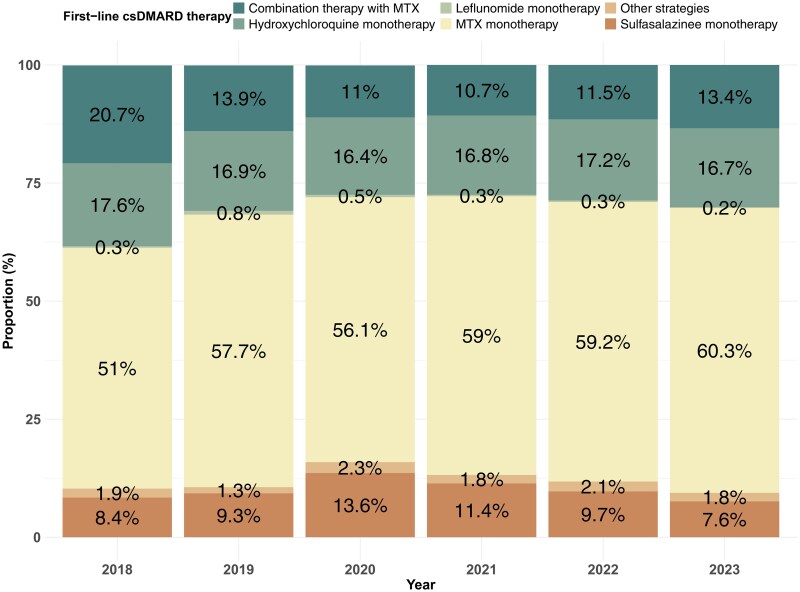
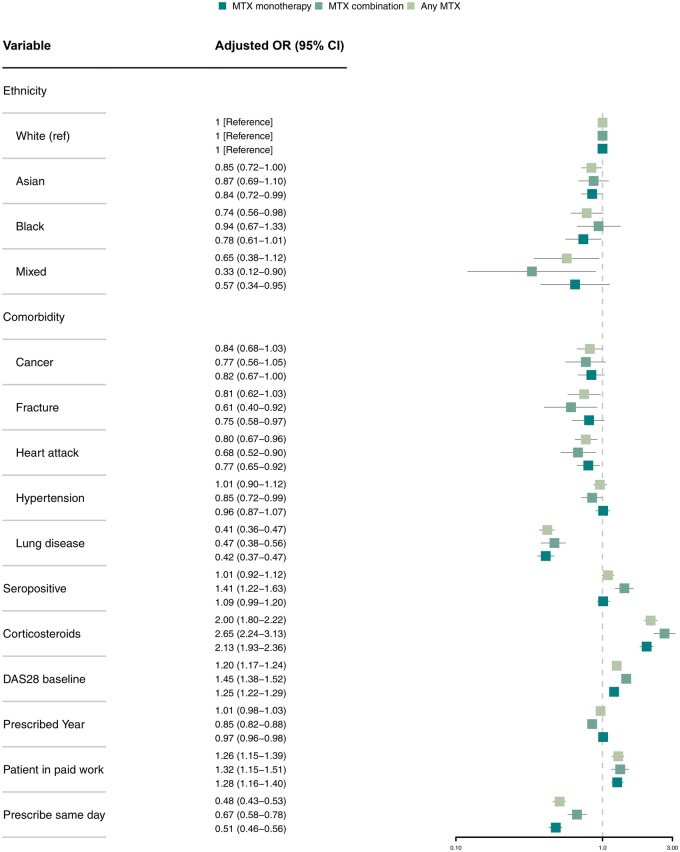
Results: We identified 15 462 RA patients who received csDMARD treatment. Overall, 57% received MTX monotherapy and 14% received MTX combination therapy as first-line treatment. MTX is the most frequently medication, following by HCQ and SSZ. Compared with non-MTX prescription, prescription of MTX monotherapy [adjusted odds ratio (aOR) 1.25 95% CI (1.22-1.29)] and MTX combination therapy [aOR 1.45 (1.38-1.52)] was significantly higher in patients with higher DAS28, but lower in the non-White individuals with comorbidities: lung disease, cancer, fracture and heart attack. Among those who received MTX, monotherapy is more likely be prescribed in patients with higher DAS28 [aOR 1.08 (1.05-1.11)] and without lung disease [aOR 0.5 (0.44-0.56)], compared with combination therapy. Around 20% of the variability in first-line csDMARD prescribing was attributed to the hospital level.
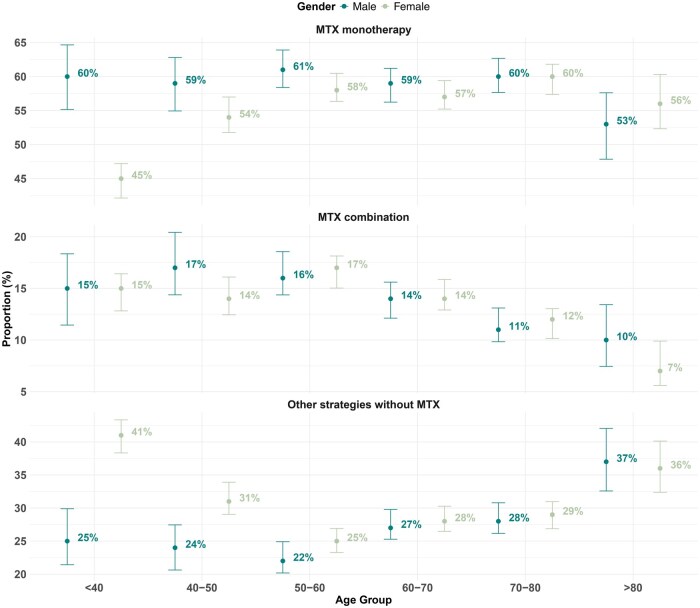
Conclusion: In this cohort study of new-onset RA population, both individual- and institution-level variation in first-line csDMARD treatment strategy was evident. Gender, ethnicity, disease activity, and comorbidities, especially lung disease, were associated with disparities at the individual level.
Keywords: conventional synthetic disease-modifying antirheumatic drugs; methotrexate; rheumatoid arthritis; treatment strategy.
© The Author(s) 2024. Published by Oxford University Press on behalf of the British Society for Rheumatology.
Figures
References
-
- Wong JB, Ramey DR, Singh G. Long-term morbidity, mortality, and economics of rheumatoid arthritis. Arthritis Rheum 2001;44:2746–9. - PubMed
-
- Finckh A, Liang MH, van Herckenrode CM, de Pablo P. Long-term impact of early treatment on radiographic progression in rheumatoid arthritis: a meta-analysis. Arthritis Care Res 2006;55:864–72. - PubMed
-
- Nell VPK, Machold KP, Eberl G et al. Benefit of very early referral and very early therapy with disease-modifying anti-rheumatic drugs in patients with early rheumatoid arthritis. Rheumatology 2004;43:906–14. - PubMed
-
- Niemantsverdriet E, Dougados M, Combe B, van der Helm-van Mil AHM. Referring early arthritis patients within 6 weeks versus 12 weeks after symptom onset: an observational cohort study. Lancet Rheumatol 2020;2:e332–8. - PubMed
MeSH terms
Substances
LinkOut - more resources
Full Text Sources
Medical
Miscellaneous
