


PREVENTion and treatment of incontinence-associated dermatitis through a codesigned manual (PREVENT-IAD): a study protocol for a feasibility cluster randomised controlled trial with a nested process evaluation
- PMID: 39719286
- PMCID: PMC11667359
- DOI: 10.1136/bmjopen-2024-092338
PREVENTion and treatment of incontinence-associated dermatitis through a codesigned manual (PREVENT-IAD): a study protocol for a feasibility cluster randomised controlled trial with a nested process evaluation
Abstract
Introduction: Incontinence is commonly experienced by adults who receive care support in a residential facility or in their own home. These individuals are at risk of developing incontinence-associated dermatitis (IAD), which is caused by prolonged and repeated exposure of the skin to urine or faeces. An IAD manual was developed providing an evidence-based clinical algorithm and an e-learning training programme for the prevention and treatment of IAD. The aim of the study is to establish the feasibility of conducting a definitive trial to examine the clinical and cost-effectiveness of the IAD manual. The objectives are to assess recruitment and attrition rates, acceptability of the IAD manual and intervention fidelity.
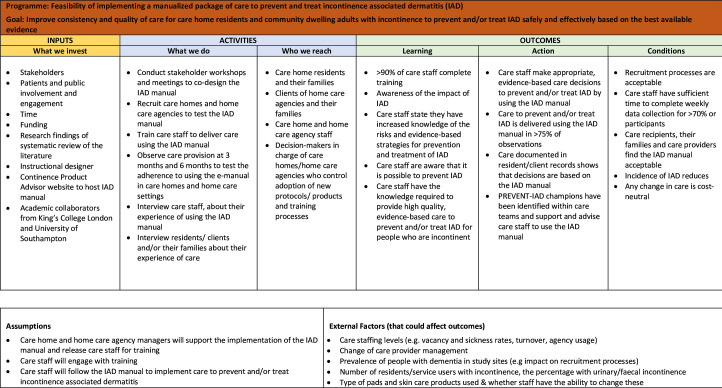
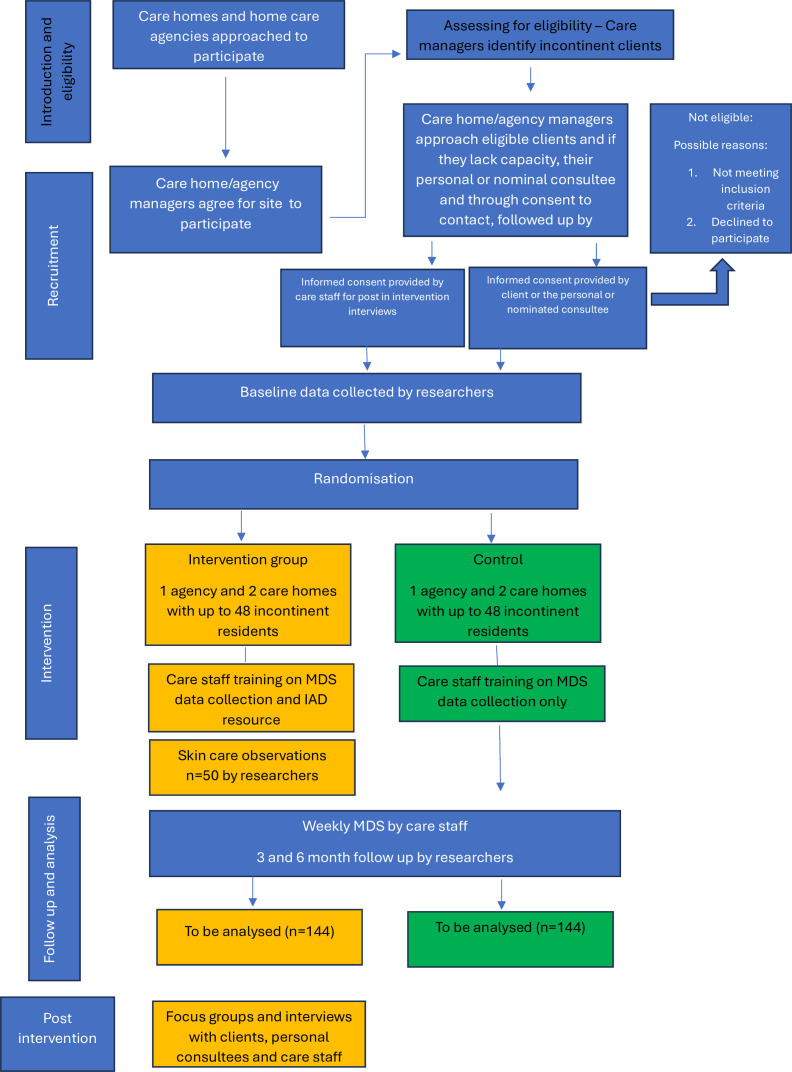
Methods and analysis: A feasibility cluster randomised controlled trial will be conducted in residential nursing homes and in the homes of people receiving formal care support in London and Hampshire, England. A total of six clusters including n=248 participants who are incontinent of urine, or faeces will be included. At each intervention site, care staff will be trained to implement the IAD manual over a 6-month period. Quantitative outcomes include IAD incidence and severity, IAD-related pain, satisfaction with care and mental health. A qualitative evaluation of care staff and care receivers' experiences of participation will be conducted. Rates and proportions of each feasibility outcome will be described informing the sample size estimation for a definitive cluster randomised controlled trial. A thematic analysis of the qualitative data will be guided by a logic model detailing potential factors impacting on both the study methodology and adoption of the IAD manual into routine care.
Ethics and dissemination: The study received the approval of the Queens Square Ethics Committee Health Research Authority 23/LO/036, (Project ID 296167). Results will be disseminated through peer-reviewed open-access journals and international conferences TRIAL REGISTRATION NUMBER: ISRCTN70866724.
Keywords: Clinical Trial; DERMATOLOGY; Feasibility Studies; Urinary incontinences; WOUND MANAGEMENT.
© Author(s) (or their employer(s)) 2024. Re-use permitted under CC BY. Published by BMJ Group.
Conflict of interest statement
Competing interests: DB declares the following conflict of interest: Molnlycke Health Care US, LLC (Independent Contractor—Consultant); Urgo Medical North America, LLC (Independent Contractor—Consultant); 3M Company (Independent Contractor—Consultant). JK declares the following conflicts of interest: Molnlycke Health Care US; LLC (Independent Contractor—Consultant); Hartman AG (Independent Contractor—Consultant); Arjo (Grant/Contract); 3M Company (Independent Contractor). CN declares the following conflicts of interest: Speaker fees from: Janssen, WebMD, Medscape, Merck Pharmaceutical; Tillotts Pharma UK; Pfizer advisory board. CC declares the following conflicts: Attends UK Ltd—presentation funding; Clinisupplies UK Ltd—presentation/conference funding. SW; TG; SS; MF; RH; PW; FF; JMF declare no conflicts of interest.
Figures
References
Publication types
MeSH terms
LinkOut - more resources
Full Text Sources
Medical
