


Would you be healthier if you had more social capital? Focusing on university students' social media use in Japan
- PMID: 39719653
- PMCID: PMC11667995
- DOI: 10.1186/s40359-024-02278-4
Would you be healthier if you had more social capital? Focusing on university students' social media use in Japan
Abstract
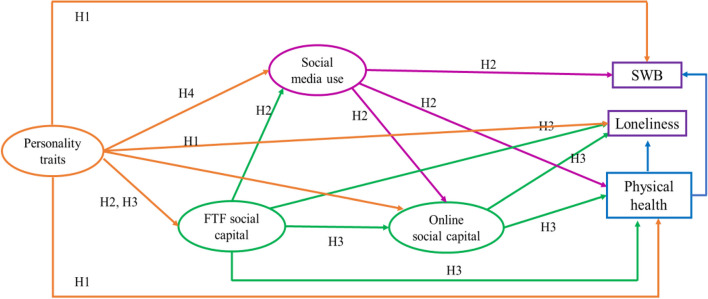
Background: This study examined how university students' social media use is related to their mental health (subjective well-being [SWB] and loneliness) and perceived physical health. A cognitive bias model and a social network mediation model were used to compare social capital formed via face-to-face and online communication, considering the effects of personality traits (i.e., social skills, generalized trust, and social tolerance).
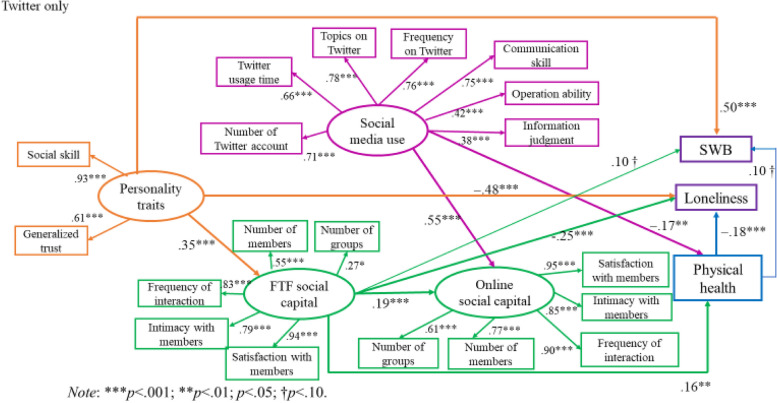
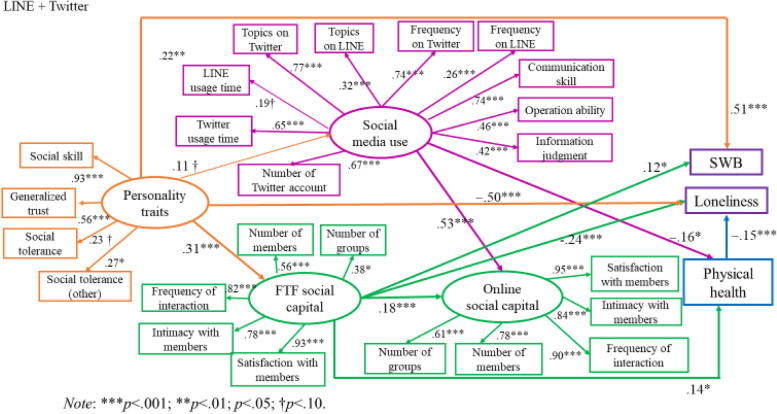
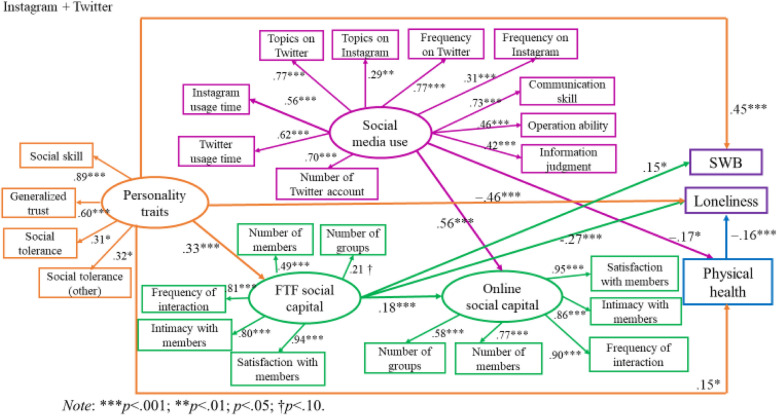
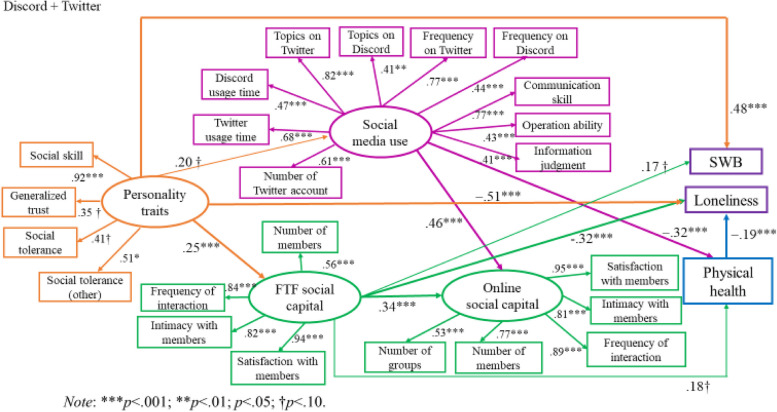
Methods: We conducted a self-report survey with 409 university students in Japan from August to September 2022. Four patterns of social media use were analyzed: (1) Twitter only, (2) LINE + Twitter, (3) Instagram + Twitter, and (4) Discord + Twitter. Relationships between the variables were investigated with a structural equation modeling analysis using SmartPLS 4.0.
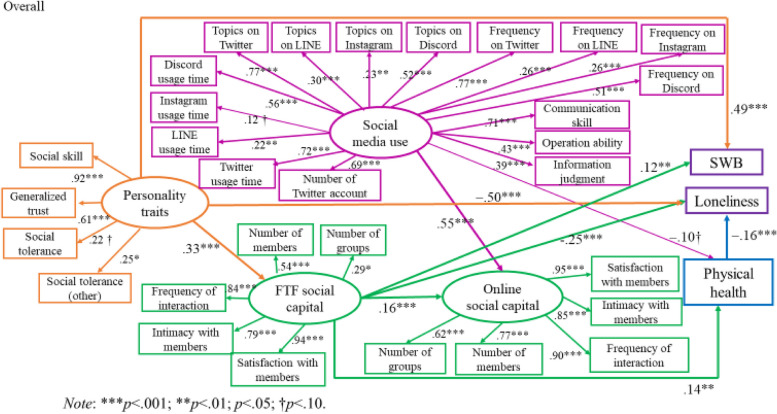
Results: Overall, regardless of social media use patterns, personality traits had positive direct effects on mental health and also had positive effects on social capital via face-to-face (FTF) communication, which had mediating effects on the improvement of mental health. FTF social capital had a positive relationship with online social capital, which did not have relationships with mental or perceived physical health. Additionally, perceived physical health decreased loneliness but was not associated with SWB. Social media use negatively affected perceived physical health but had no effect on SWB or loneliness. Finally, different relationships between personality traits and social media use, FTF social capital and SWB, social media use and perceived physical health were observed among the four patterns of social media use.
Conclusion: This study has implications for improving the health of young adults in the "mobile x social era." In particular, we provide suggestions to help young adults improve their mental health.
Keywords: Mental health; Perceived physical health; Personality traits; Social capital; Social media use.
© 2024. The Author(s).
Conflict of interest statement
Declarations. Consent for publication: No consent is required for publication. Competing interests: The authors declare no competing interests.
Figures
References
-
- Nakai N. (2020.09.03). Study: Japanese children rank low in mental satisfaction. The Asahi Shimbun. Available online: https://www.asahi.com/ajw/articles/13693460. (accessed on 2024.05.01).
-
- Fukuzawa, A., Katagiri, K., Harada, K., Masumoto, K., Chogahara, M., Kondo, N., & Okada S. A longitudinal study of the moderating effects of social capital on the relationships between changes in human capital and ikigai among Japanese older adults. Asian J Soc Psychol. 2019;22(2):172−182. 10.1111/ajsp.12353.
-
- Fukuzawa A, Sugawara I. Social support and participation as factors relating to ikigai and life satisfaction in lonely older Japanese. Ageing Int. 2023;48(2):465–81. 10.1007/s12126-022-09486-6. - DOI
-
- Fukuzawa A, Shigemasu E, Sugawara I. The relationship between cultural construal of self and happiness: A comparison across generations among Japanese. Japan J Gerontol. 2021;42(4):327−336. 10.34393/rousha.42.4_327.
MeSH terms
LinkOut - more resources
Full Text Sources
Medical
