


Global, Regional, and National Burden of Cardiovascular Disease, 1990-2021: Results From the 2021 Global Burden of Disease Study
- PMID: 39720386
- PMCID: PMC11668263
- DOI: 10.7759/cureus.74333
Global, Regional, and National Burden of Cardiovascular Disease, 1990-2021: Results From the 2021 Global Burden of Disease Study
Abstract
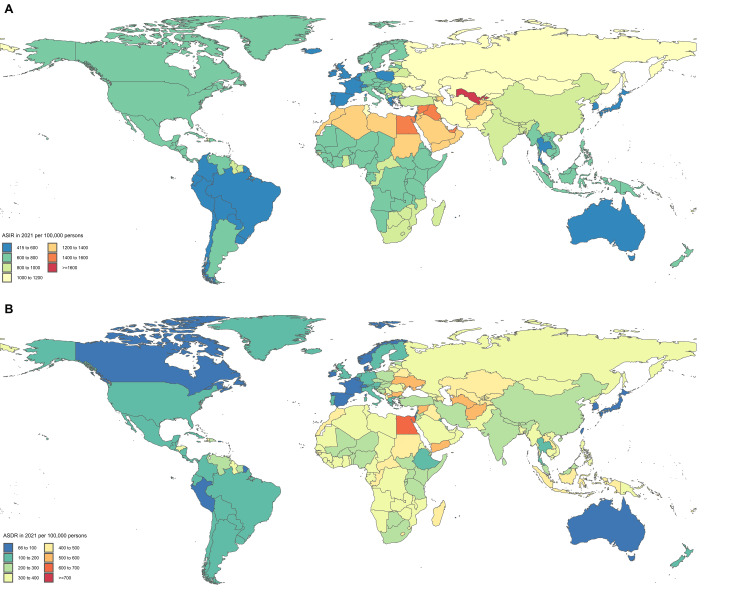
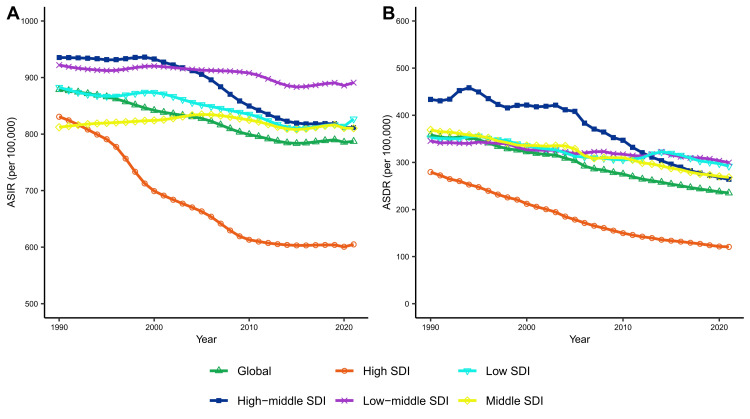
Background Cardiovascular diseases (CVD), including coronary artery disease, ischemic heart disease, stroke, cardiomyopathy, and atrial fibrillation and flutter, are the leading cause of mortality worldwide, resulting in significant economic and health costs. Recognizing trends and geographical differences in the global burden of CVD facilitates health authorities in particular nations to assess the disease burden and forecast future epidemiological trends. Public health authorities in each country can better understand the differences in disease data and, by learning from the experiences and practices of successful countries and considering the characteristics of their diseases, allocate health resources more rationally and formulate more targeted healthcare strategies to reduce the disease burden. This study aims to comprehensively assess CVD trends and geographic variations from 1990 to 2021. Methods This study focuses on analyzing global trends in the epidemiology of all-age CVD incidence and death over the past 30 years. A vital registration system, cause-of-death inference records, and a cause-of-death ensemble model (CODEm) were used to estimate cause-specific mortality for CVD, with CODEm estimates adjusted using a cause-of-death correction (CoDCorrect) algorithm. Incidence data were extracted from insurance claims and inpatient discharge sources and analyzed with Disease Modeling Meta-Regression, Version 2.1 (DisMod-MR 2.1). Data were extracted from the 2021 Global Burden of Disease Study (GBD 2021) on the number of incident cases and deaths, as well as age-standardized incidence rates (ASIR) and age-standardized death rates (ASDR) for CVD for each year from 1990 to 2021. We visualized and reported this data at the global, regional, and national levels. To explore the association between the burden of CVD and sociodemographic factors, we used the sociodemographic index (SDI), which categorizes the world's 204 nations into five SDI regions. Because the GBD results are a combination of data and estimates, 95% uncertainty intervals (UI) are provided for each count and rate (per 100,000 populations). Results Globally, the number of CVD incident cases and deaths increased from 34.74 million and 12.33 million in 1990 to 66.81 million and 19.42 million in 2021, representing a 92.3% and 57.5% rise, respectively. However, the global ASIR and ASDR for CVD have decreased by 10.4% and 34.3%, respectively, since 1990. Notably, among the 21 regions of the world, the ASIR for CVD is on a downward trend from 1990 to 2021, except for East and Central Asia, where the ASIR for CVD increased by 3% and 14.3%, respectively. Similarly, the global ASDR for CVD is only on an upward trend in sub-Saharan Africa, increasing by 12%, while all other regions are on a downward trend. Among the five SDI regions, the high SDI region has much lower ASIR and ASDR compared to the world average, and these rates have decreased significantly over the years. Conclusion Despite a significant increase in the number of CVD incident cases and deaths worldwide over the last three decades, ASIR and ASDR have been declining. Over the past 30 years, both ASIR and ASDR for CVD have declined significantly in high SDI areas, while CVD continues to pose a serious public health threat in regions with low SDI.
Keywords: cardiovascular disease; death; epidemiology; global burden; incidence; public health.
Copyright © 2024, Wang et al.
Conflict of interest statement
Human subjects: All authors have confirmed that this study did not involve human participants or tissue. Animal subjects: All authors have confirmed that this study did not involve animal subjects or tissue. Conflicts of interest: In compliance with the ICMJE uniform disclosure form, all authors declare the following: Payment/services info: All authors have declared that no financial support was received from any organization for the submitted work. Financial relationships: All authors have declared that they have no financial relationships at present or within the previous three years with any organizations that might have an interest in the submitted work. Other relationships: All authors have declared that there are no other relationships or activities that could appear to have influenced the submitted work.
Figures
References
-
- Global, regional, and national death, and disability-adjusted life-years (DALYs) for cardiovascular disease in 2017 and trends and risk analysis from 1990 to 2017 using the Global Burden of Disease Study and implications for prevention. Li Z, Lin L, Wu H, Yan L, Wang H, Yang H, Li H. Front Public Health. 2021;9:559751. - PMC - PubMed
-
- Socioeconomic factors and cardiovascular disease: a review of the literature. Kaplan GA, Keil JE. Circulation. 1993;88:1973–1998. - PubMed
-
- Global trends and regional differences in incidence and mortality of cardiovascular disease, 1990-2019: findings from 2019 Global Burden of Disease Study. Li Y, Cao GY, Jing WZ, Liu J, Liu M. Eur J Prev Cardiol. 2023;30:276–286. - PubMed
LinkOut - more resources
Full Text Sources
Miscellaneous