Review
. 2024 Nov 26;27(12):111477.
doi: 10.1016/j.isci.2024.111477. eCollection 2024 Dec 20.

Therapeutic potential of 5-aminolevulinic acid in metabolic disorders: Current insights and future directions

Affiliations
Review

Therapeutic potential of 5-aminolevulinic acid in metabolic disorders: Current insights and future directions

Olexandr Kuryata et al. iScience. .

Abstract

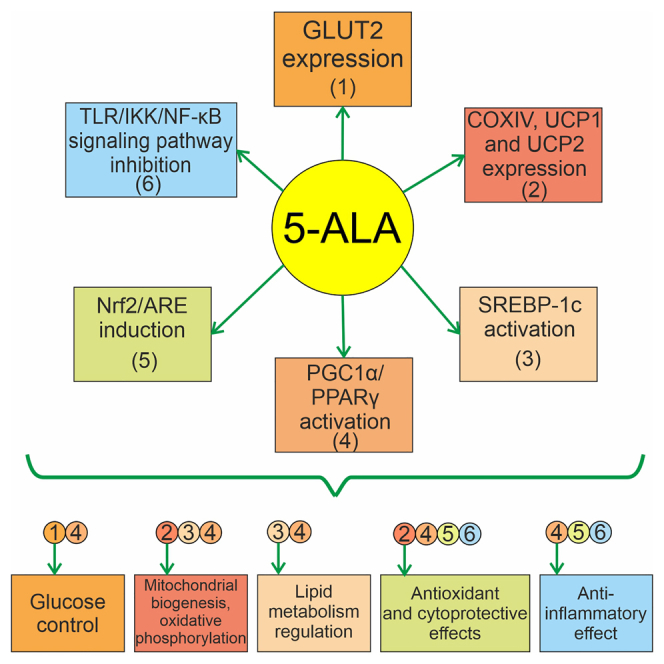
5-Aminolevulinic acid (5-ALA) is an essential compound in the biosynthesis of heme, playing a critical role in various physiological processes within the human body. This review provides the thorough analysis of the latest research on the molecular mechanisms and potential therapeutic benefits of 5-ALA in managing metabolic disorders. The ability of 5-ALA to influence immune response and inflammation, oxidative/nitrosative stress, antioxidant system, mitochondrial functions, as well as carbohydrate and lipid metabolism, is mediated by molecular mechanisms associated with the suppression of the transcription factor NF-κB signaling pathway, activation of the transcription factor Nrf2/heme oxygenase-1 (HO-1) system leading to the formation of heme-derived reaction products (carbon monoxide, ferrous iron, biliverdin, and bilirubin), which may contribute to HO-1-dependent cytoprotection through antioxidant and immunomodulatory effects. Additionally, it regulates the expression of peroxisome proliferator-activated receptor gamma coactivator 1-alpha, cytochrome c oxidase subunit IV, uncoupling proteins UCP1 and UCP2, glucose transporters GLUT1 and GLUT2, and sterol regulatory element-binding protein 1c in relevant tissues. Randomized controlled trials have confirmed the effects of 5-ALA on glucose control in both prediabetic and diabetic patients, noting its safety and tolerability, as well as the safety of its combined use with oral hypoglycemic agents. Only minor side effects have been reported. However, the impact of 5-ALA on markers of systemic inflammation, oxidative and nitrosative stress, and dyslipidemia was not evaluated in these studies. At the same time, preparations of 5-ALA may potentially be effective not only in the treatment of prediabetes and type 2 diabetes mellitus (T2DM), but also in other conditions associated with systemic inflammation, oxidative or nitrosative stress, mitochondrial dysfunction, as well as disorders of carbohydrate and lipid metabolism. It has been concluded that the promising advancement of formulations containing 5-ALA may pave the way for new strategies in preventing and treating these diseases, with subsequent preclinical and clinical trials likely to follow.

Keywords: biological sciences; endocrinology; health sciences; medical specialty; medicine; natural sciences; physiology; therapeutics.


Conflict of interest statement

Authors declare no competing interests.

Figures
None
Graphical abstract
Figure 1
Figure 1
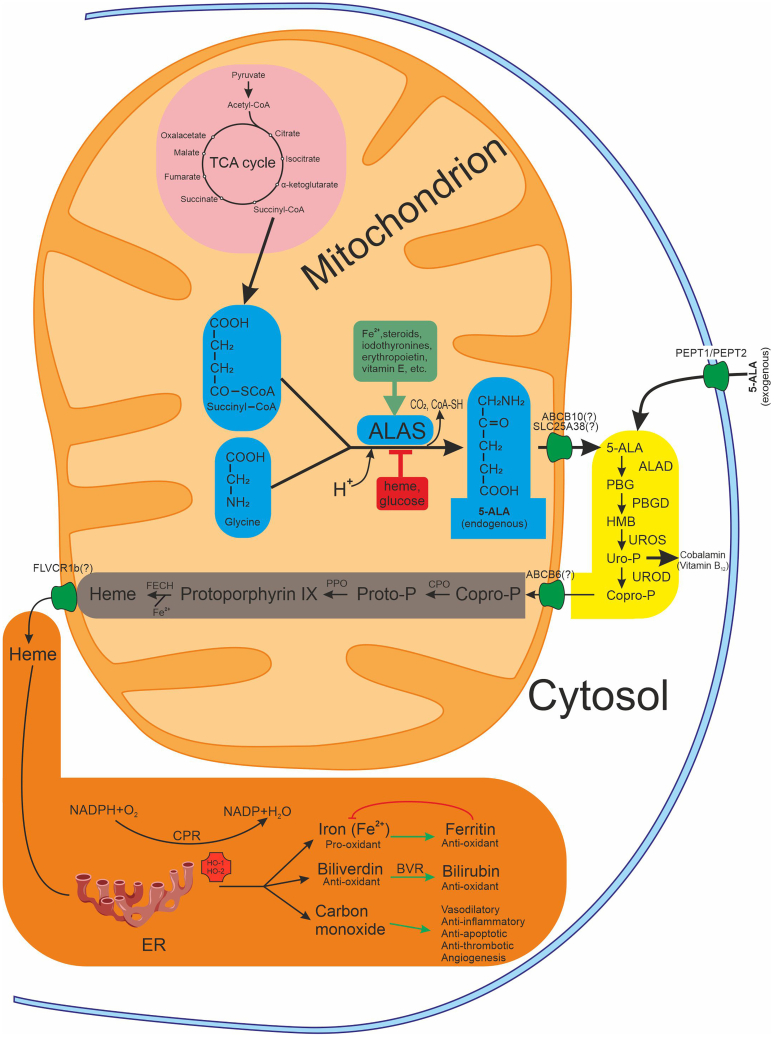
Biosynthetic reaction of the 5-ALA and its downstream pathways The figure is divided into three parts: central carbon metabolic pathway—TCA cycle (pink), 5-ALA synthetic pathway (blue), cytoplasmic and mitochondrial sections of downstream pathways (yellow and gray, respectively), and heme downstream metabolic pathway (orange). The green line indicates positive regulation, the red line indicates inhibition. Abbreviations: ABCB6, ATP-binding cassette subfamily B member 6; ABCB10, ATP-binding cassette subfamily B member 10; 5-ALA, 5-aminolevulinic acid; ALAD, 5-aminolevulinic acid dehydratase; ALAS, 5-aminolevulinic acid synthase; BVR, biliverdin reductase; CoA-SH, coenzyme A; Copro-P, coproporphyrinogen; CPO, coproporphyrinogen oxidase; CPR, cytochrome P450 reductase; ER, endoplasmaic reticulum; FECH, ferrochelatase; FLVCR1b, feline leukemia virus subgroup C cellular receptor 1b; HMB, hydroxymethylbiline; HO-1, heme oxygenase-1; HO-2, heme oxygenase-2; NADP, nicotinamide adenine dinucleotide phosphate; PBG, porphobilinogen; PBGD, porphobilinogen deaminase; PEPT1, peptide transporter 1; PEPT2, peptide transporter 2; PPO, protoporphyrinogen oxidase; Proto-P, protoporphyrinogen; SLC25A38, solute carrier family 25 member 38; TCA, tricarboxylic acid; UROD, uroporphyrinogen decarboxylase; Uro-P, uroporphyrinogen; UROS, uroporphyrinogen III synthase.
Figure 2
Figure 2
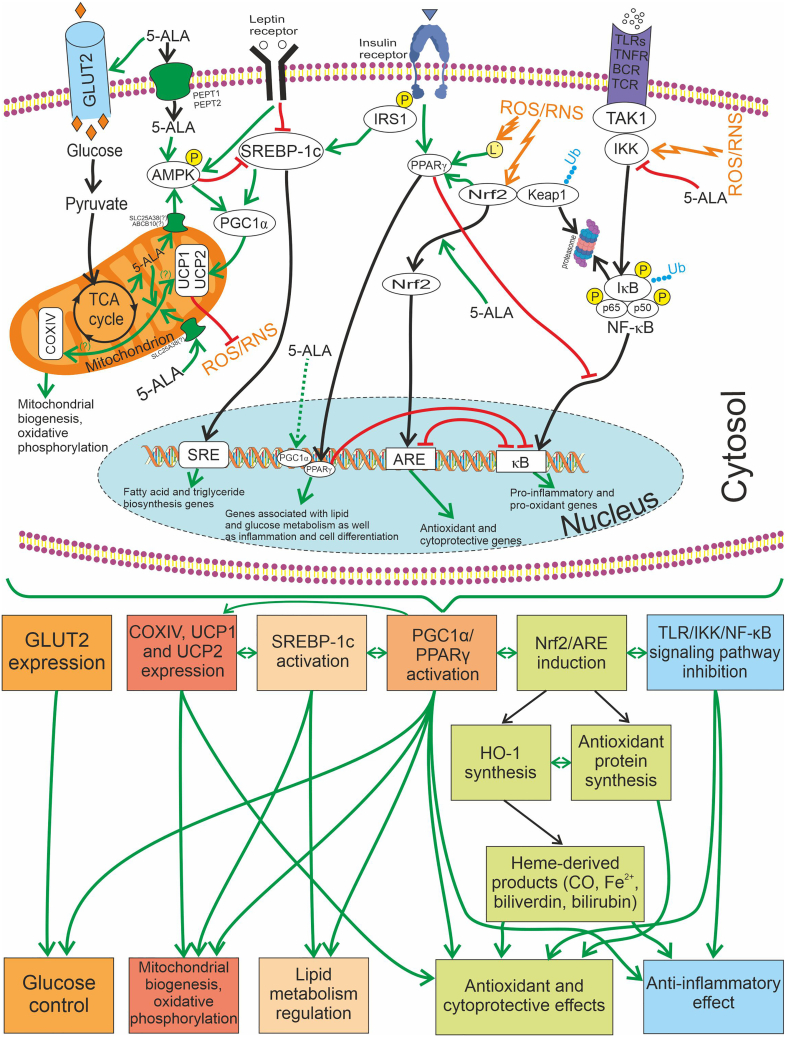
The molecular mechanisms underlying the physiological and pharmacological effects of 5-ALA (in the presence of Fe2+) The green line indicates positive regulation, the red line indicates inhibition, the dashed line represents indirect effects. 5-ALA reveals an anti-inflammatory effect by inhibiting the NF-κB signaling pathway through IKK and activating PPARγ signaling (via PGC1α). Its impact on pro-oxidant cascades is mitigated by its ability to induce the Nrf2/ARE signaling pathway and PPARγ. Enhanced Nrf2-dependent synthesis of HO-1 leads to the production of heme-derived reaction products (CO, ferrous iron, biliverdin, and bilirubin), which may contribute to cytoprotection through antioxidant and immunomodulatory effects. Additionally, 5-ALA, whether imported into the mitochondrion exogenously (possibly via transport proteins like SLC25A38) or endogenously produced, regulates the expression of mitochondrial proteins (COXIV, UCP1, and UCP2), promoting mitochondrial biogenesis and activating oxidative phosphorylation. The increase in SREBP-1c expression driven by 5-ALA enhances the biosynthesis of fatty acids and triglycerides; however, it is subject to inhibitory control by another target of 5-ALA, AMPK. Furthermore, AMPK activates UCP1 and UCP2 via PGC1α. The decrease in mitochondrial membrane potential (ΔΨ) due to UCP2 may reduce the potential for ROS/RNS formation in mitochondria: this occurs by decreasing the efficiency of electron transport, which reduces the likelihood of free radical formation. By increasing the expression of GLUT1 and GLUT2, 5-ALA enhances the cellular uptake of glucose. Once inside the cell, glucose can undergo glycolysis, a metabolic process that generates ATP. This promotes glucose uptake and utilization, supporting the energy requirements of the cell, thus ensuring proper cellular function and metabolism. Abbreviations: ABCB10, ATP-binding cassette subfamily B member 10; 5-ALA, 5-aminolevulinic acid; AMPK, adenosine monophosphate-activated protein kinase; ARE, antioxidant response element; BCR, B cell receptor; COXIV, cytochrome c oxidase subunit IV; GLUT1, glucose transporter 1; GLUT2, glucose transporter 2; HO-1, heme oxygenase-1; IκB, NF-κB inhibitory protein; IKK, IκB kinase; IRS-1, insulin receptor substrate 1; Keap1, Kelch-like ECH-associated protein 1; L˙, lipid radical; NF-κB, nuclear factor κB; Nrf2, nuclear factor erythroid 2-related factor 2; P, phosphorylation; PEPT1, peptide transporter 1; PEPT2, peptide transporter 2; PGC1α, peroxisome proliferator-activated receptor γ coactivator 1α; PPARγ, peroxisome proliferator-activated receptor γ; ROS, reactive oxygen species; RNS, reactive nitrogen species; SLC25A38, solute carrier family 25 member 38; SRE, sterol regulatory element; SREBP-1c, sterol regulatory element-binding protein 1c; TAK1, transforming growth factor-β-activated kinase; TCA, tricarboxylic acid; TCR, T cell receptor; TLRs, Toll-like receptors; TNFR, tumor necrosis factor receptor; Ub, ubiquitination; UCP1, uncoupling protein 1; UCP 2, uncoupling protein 2.

References

    1. Jiang M., Hong K., Mao Y., Ma H., Chen T., Wang Z. Natural 5-Aminolevulinic Acid: Sources, Biosynthesis, Detection and Applications. Front. Bioeng. Biotechnol. 2022;10 doi: 10.3389/fbioe.2022.841443. - DOI - PMC - PubMed
    1. Kang Z., Zhang J., Zhou J., Qi Q., Du G., Chen J. Recent advances in microbial production of δ-aminolevulinic acid and vitamin B12. Biotechnol. Adv. 2012;30:1533–1542. doi: 10.1016/j.biotechadv.2012.04.003. - DOI - PubMed
    1. Wang X., Tian Y., Liao X., Tang Y., Ni Q., Sun J., Zhao Y., Zhang J., Teng Z., Lu G. Enhancing selective photosensitizer accumulation and oxygen supply for high-efficacy photodynamic therapy toward glioma by 5-aminolevulinic acid loaded nanoplatform. J. Colloid Interface Sci. 2020;565:483–493. doi: 10.1016/j.jcis.2020.01.020. - DOI - PubMed
    1. Sansaloni-Pastor S., Lange N. Unleashing the potential of 5-Aminolevulinic acid: Unveiling a promising target for cancer diagnosis and treatment beyond photodynamic therapy. J. Photochem. Photobiol., B. 2023;247 doi: 10.1016/j.jphotobiol.2023.112771. - DOI - PubMed
    1. Simmons B.J., Griffith R.D., Falto-Aizpurua L.A., Nouri K. An update on photodynamic therapies in the treatment of onychomycosis. J. Eur. Acad. Dermatol. Venereol. 2015;29:1275–1279. doi: 10.1111/jdv.12950. - DOI - PubMed

LinkOut - more resources