


Cardiovascular Involvement in Tuberculosis Patients Treated in Southern Africa
- PMID: 39720579
- PMCID: PMC11667022
- DOI: 10.1016/j.jacadv.2024.101427
Cardiovascular Involvement in Tuberculosis Patients Treated in Southern Africa
Abstract
Background: Tuberculosis (TB) is the leading cause of death among people with HIV and a major global health challenge. Subclinical cardiovascular manifestations of TB are poorly documented in high TB and HIV burden countries.
Objectives: The purpose of this study was to quantify the prevalence of cardiovascular involvement in TB patients and investigate changes after completion of anti-TB treatment.
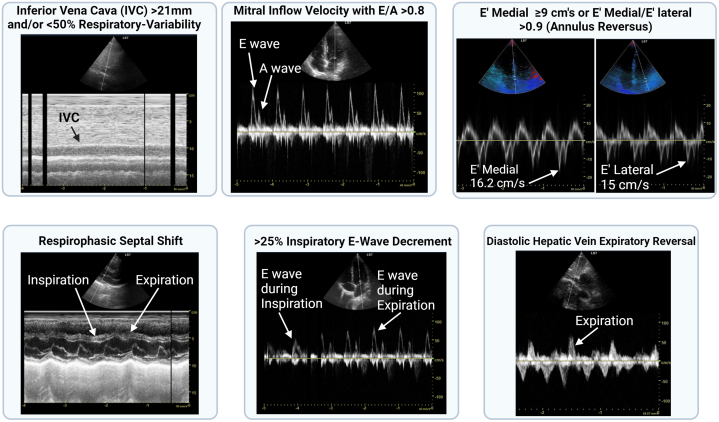
Methods: HIV-positive and HIV-negative patients diagnosed with pulmonary TB between October 2022 and November 2023 were enrolled from 2 tertiary care hospitals in Zambia and South Africa. Standardized transthoracic echocardiography (TTE) was conducted at TB diagnosis and after 6 months of anti-TB treatment. Cross-sectional and longitudinal analyses assessed pericardial effusion, thickening, or calcification, with and without signs of pericardial constriction.
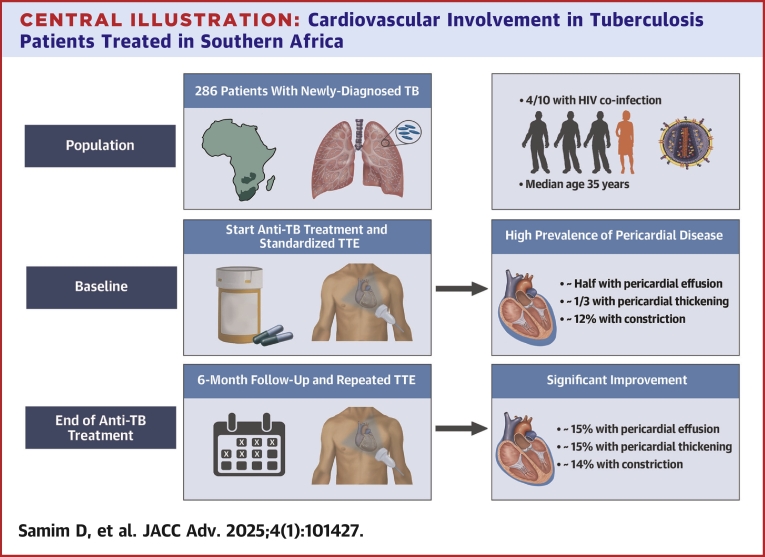
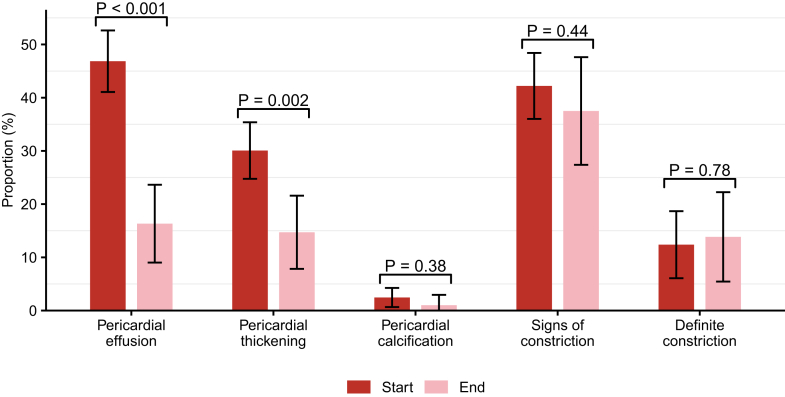
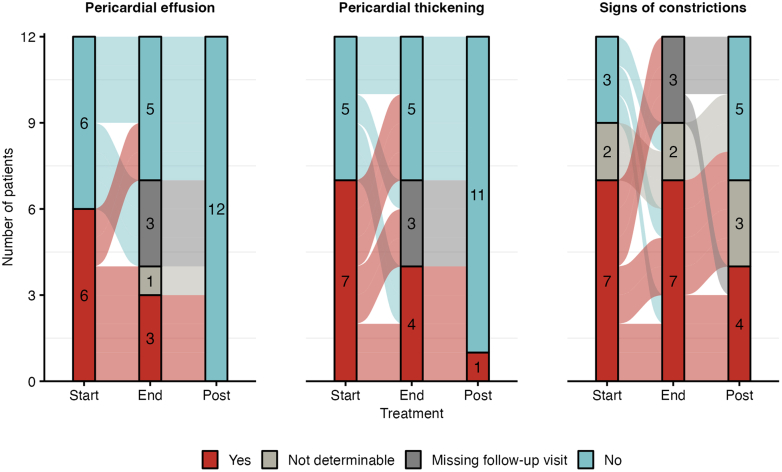
Results: A total of 286 TB patients (218 [76%] men, 109 [38%] people with HIV, median age 35 years) underwent TTE at TB diagnosis, of whom 105 participants had a second TTE after completion of treatment. At TB diagnosis, 134 (47%) had pericardial effusions, 86 (30%) thickening, 7 (2%) calcifications, 103 (42%) signs of constriction, and 13 (12%) had definite diagnosis of constriction. After TB treatment, pericardial effusions (47% vs 16%, P < 0.001) and pericardial thickenings (30% vs 15%, P = 0.002) became less prevalent. Pericardial calcifications (2% vs 1%, P = 0.4), signs of constrictions (42% vs 38%, P = 0.4), and definite diagnosis of constriction (12% vs 14%, P = 0.8) were similar.
Conclusions: Cardiac involvement is frequent in newly diagnosed TB patients. Early pericardial changes may be reversed with anti-TB treatment. Echocardiographic screening facilitates early detection and timely management of cardiovascular involvement in TB patients.
Keywords: HIV; constrictive pericarditis; echocardiography; pericardial effusion; tuberculosis.
© 2024 The Authors.
Conflict of interest statement
Research reported in this publication was supported by the 10.13039/100000060National Institute of Allergy And Infectious Diseases of the 10.13039/100000002National Institutes of Health under Award Number U01AI069924 and the Swiss National Science Foundation (SNSF grant 32FP30-189498). The content is solely the responsibility of the authors and does not necessarily represent the official views of the National Institutes of Health or the SNSF. Dr Pilgrim reports research grants to the institution from Biotronik, Boston Scientific, Edwards Lifesciences, and consultancy/speaker fees from Biotronik, Edwards Lifesciences, Abbott, Biosensors, Medtronic, and HighLife. Dr Samim received funding for an online course from Edwards Lifesciences. All other authors have reported that they have no relationships relevant to the contents of this paper to disclose.
Figures
References
-
- Obonyo N.G., Etyang A.O. Cardiovascular health priorities in sub-saharan Africa. SN Compr Clin Med. 2023;5(1):262.
-
- Keates A.K., Mocumbi A.O., Ntsekhe M., Sliwa K., Stewart S. Cardiovascular disease in Africa: epidemiological profile and challenges. Nat Rev Cardiol. 2017;14(5):273–293. - PubMed
Grants and funding
LinkOut - more resources
Full Text Sources
