


Digital health literacy and use of patient portals among Spanish-preferred patients in the United States: a cross-sectional assessment
- PMID: 39720810
- PMCID: PMC11666482
- DOI: 10.3389/fpubh.2024.1455395
Digital health literacy and use of patient portals among Spanish-preferred patients in the United States: a cross-sectional assessment
Abstract
Objective: Individuals with Limited English Proficiency (LEP), including Spanish-preferred patients, face healthcare challenges due to language barriers. Despite the potential of digital health technologies to improve access and outcomes, there is a "digital divide" with underutilization among vulnerable populations, including Spanish-speaking LEP individuals, highlighting a need for increased understanding and equitable digital health solutions.
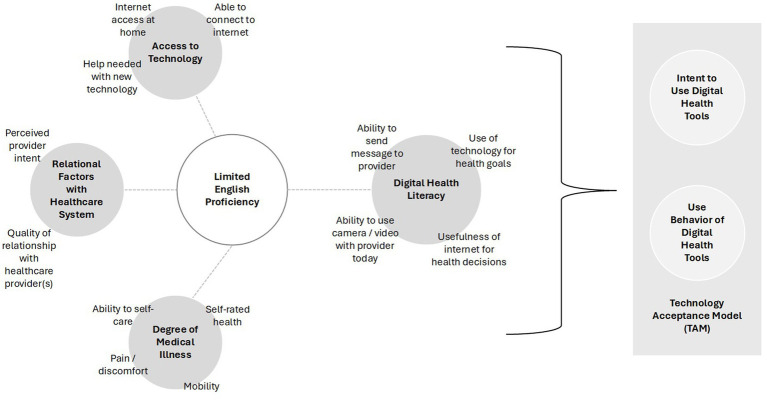
Materials and methods: A multi-mode, multi-language cross-sectional survey was built based on the Technology Acceptance Model and deployed from a multi-state healthcare practice. Measures included patient-reported comfort level with reading and speaking English, internet and computer access and satisfaction, ability to perform healthcare-related online tasks, and the eHEALS scale of digital health literacy.
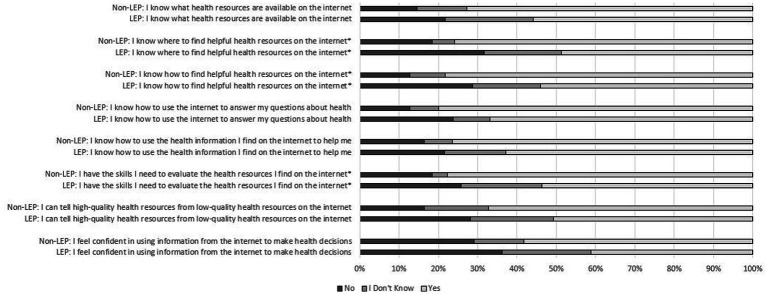
Results: A total of 212 Spanish-preferred patients completed the survey (response rate, 212/2,726 = 7.8%), of which 73.6% indicated lack of comfort in reading or writing in English (LEP n = 156). Spanish-speaking individuals with LEP reported higher rates of needing help when learning how to use new technology or devices, reporting difficulty in the evaluation of health information on the internet and being able to differentiate high-quality information from low-quality online health resources, feeling confident in using health information found online to make health decisions, and having lower access to health-related online services than Spanish-speaking individuals without LEP.
Discussion: Improving equitable accessibility to digital tools for individuals with LEP seeking healthcare can help to improve their engagement with their providers and promote self-efficacy in their care. Opportunities exist with emerging technologies to develop language-concordant healthcare resources that will improve outcomes for Spanish-preferred patients.
Keywords: Limited English Proficiency; Spanish preferred; Technology Acceptance Model; digital health; digital health literacy; patient portals.
Copyright © 2024 Philpot, Ramar, Roellinger, McIntee and Ebbert.
Conflict of interest statement
The authors declare that the research was conducted in the absence of any commercial or financial relationships that could be construed as a potential conflict of interest.
Figures
References
-
- Zeigler K, Camarota S. 67.3 million in the United States spoke a foreign language at home in 2018: Center for Immigration Studies; (2019). Available at: https://cis.org/Report/673-Million-United-States-Spoke-Foreign-Language-....
-
- Census Bureau , Census Bureau releases 2020 demographic analysis estimates: U.S. (2021). Available at: https://www.census.gov/newsroom/press-releases/2020/2020-demographic-ana...
-
- Limited English proficiency: U.S. Department of Health and Human Services; (2023). Available at: https://www.hhs.gov/civil-rights/for-individuals/special-topics/limited-...
-
- Betancourt JR, Tan-McGrory A. Creating a safe, high-quality healthcare system for all: meeting the needs of limited English proficient populations; comment on “patient safety and healthcare quality: the case for language access”. Int J Health Policy Manag. (2014) 2:91–4. doi: 10.15171/ijhpm.2014.21, PMID: - DOI - PMC - PubMed
MeSH terms
LinkOut - more resources
Full Text Sources
Medical
Miscellaneous
