


Anticipated facilitators and barriers for long-acting injectable antiretrovirals as HIV treatment and prevention in Vietnam: a qualitative study among healthcare workers
- PMID: 39722011
- PMCID: PMC11669199
- DOI: 10.1186/s12879-024-10352-w
Anticipated facilitators and barriers for long-acting injectable antiretrovirals as HIV treatment and prevention in Vietnam: a qualitative study among healthcare workers
Abstract
Background: Long-acting injectable antiretrovirals (LAI-ARVs) for HIV prevention and treatment have been demonstrated in clinical trials to be non-inferior to daily oral medications, providing an additional option to help users overcome the challenges of daily adherence. Approval and implementation of these regimens in low- and middle-income settings have been limited.
Method: This study describes the anticipated barriers and facilitators to implementing LAI-ARVs in Vietnam to inform future roll-out. From July to August 2022, we conducted 27 in-depth interviews with healthcare workers and public health stakeholders involved in HIV programs at national, provincial, and clinic levels across four provinces in Vietnam. The interviews followed a semi-structured questionnaire and were audio recorded. Data were analyzed using a rapid thematic analysis approach to identify facilitators and barriers to the adoption of LAI-ARVs.
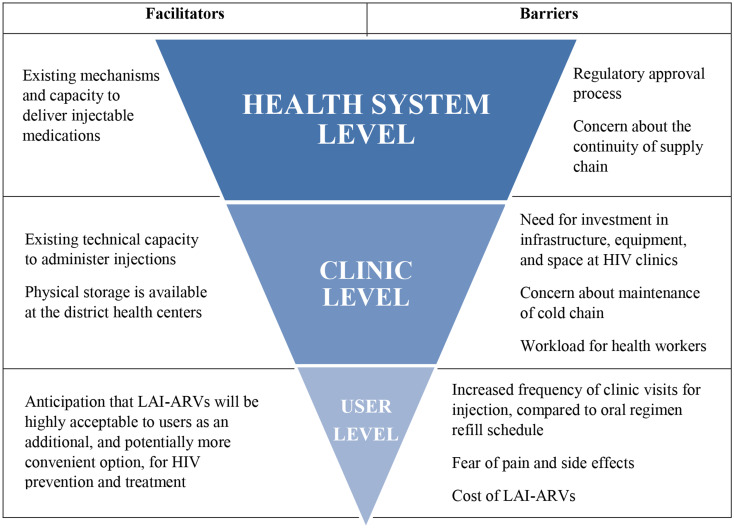
Results: In total, 27 participants from 4 provinces were interviewed including 14 (52%) men and 13 (48%) women. Participants median age was 48 years and they had 11.5 years of experience with HIV services and programs. Perceived user-level facilitators included the greater convenience of injectables in comparison to oral regimens, while barriers included the increased frequency of visits, fear of pain and side effects, and cost. Clinic-level facilitators included existing technical capacity to administer injections and physical storage availability in district health centers, while barriers included lack of space and equipment for administering injections for HIV-related services, concerns about cold chain maintenance for LAI-ART, and workload for healthcare workers. Health system-level facilitators included existing mechanisms for medication distribution, while barriers included regulatory approval processes and concerns about supply chain continuity.
Conclusion: Overall, participants were optimistic about the potential impact of LAI-ARVs but highlighted important considerations at multiple levels needed to ensure successful implementation in Vietnam.
Clinical trial number: Not applicable.
Keywords: HIV; Healthcare worker; Implementation; Long-acting injectable antiretrovirals; Prevention; Treatment; Vietnam.
© 2024. The Author(s).
Conflict of interest statement
Declarations. Ethics approval and consent to participate: This study was conducted in full compliance with the ethical principles outlined in the Declaration of Helsinki and adhered to relevant national guidelines and regulations. The study was reviewed and approved by the Institutional Review Boards of Beth Israel Deaconess Medical Center (#2022P000341) in Boston, USA and Hanoi University of Public Health (#022–116/DD-YTCC) in Hanoi, Vietnam. All participants provided informed consent prior to participation. Consent for publication: Not applicable. Competing interests: Todd M. Pollack receives funding from Gilead Sciences through a grant to Beth Israel Deaconess Medical Center (Boston, MA, USA) and has received travel support from Gilead Sciences. All other authors have no financial or non-financial interests to disclose.
Figures
References
-
- World Health Organization. Updated recommendations on first-line and second-line antiretroviral regimens and post-exposure prophylaxis and recommendations on early infant diagnosis of HIV: interim guidelines. Supplement to the 2016 consolidated guidelines on the use of antiretroviral drugs for treating and preventing HIV infection. Geneva, WHO. 2018. https://iris.who.int/bitstream/handle/10665/277395/WHO-CDS-HIV-18.51-eng.... Accessed 1 October 2023.
-
- World Health Organization. Update of recommendations on first- and second-line antiretroviral regimens. Geneva, WHO., 2019. https://iris.who.int/bitstream/handle/10665/325892/WHO-CDS-HIV-19.15-eng.... Accessed 1 October 2023.
-
- Margaret A, Chesney J. Factors affecting adherence to antiretroviral therapy. Clinical Infectious Diseases, 2000;30(2):S171–76. 10.1086/313849. - PubMed
MeSH terms
Substances
Grants and funding
LinkOut - more resources
Full Text Sources
Medical
