


Multi-omics analysis reveals interactions between host and microbes in Bama miniature pigs during weaning
- PMID: 39723142
- PMCID: PMC11668797
- DOI: 10.3389/fmicb.2024.1482925
Multi-omics analysis reveals interactions between host and microbes in Bama miniature pigs during weaning
Erratum in
-
Erratum: Multi-omics analysis reveals interactions between host and microbes in Bama miniature pigs during weaning.Front Microbiol. 2025 Jan 23;16:1556615. doi: 10.3389/fmicb.2025.1556615. eCollection 2025. Front Microbiol. 2025. PMID: 39916862 Free PMC article.
Abstract
Introduction: There are complex interactions between host and gut microbes during weaning, many of the mechanisms are not yet fully understood. Previous research mainly focuses on commercial pigs, whereas limited information has been known about the host and gut microbe interactions in miniature pigs.
Methods: To address the issue in Bama miniature piglets that were weaned 30 days after birth, we collected samples on days 25 and 36 for metabolomics, transcriptomics, and microgenomics analysis.
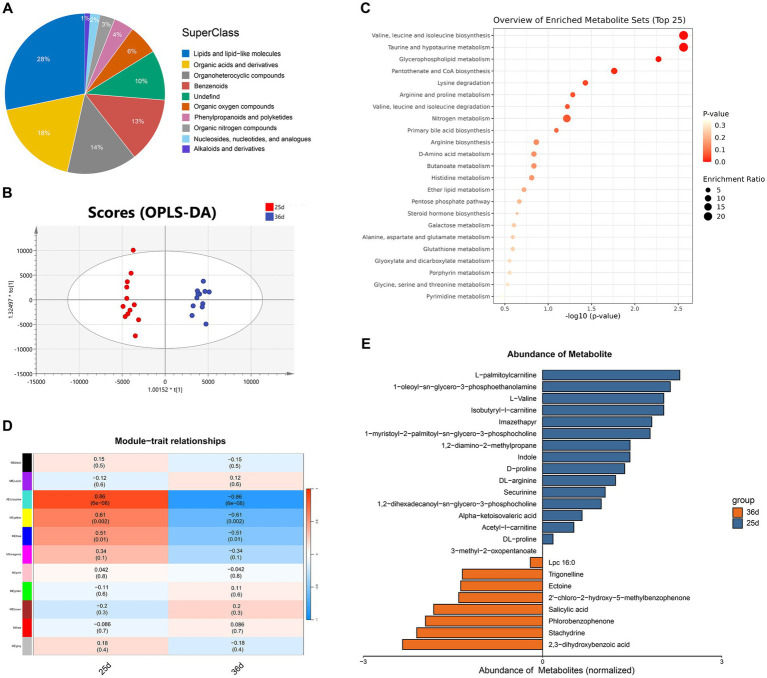
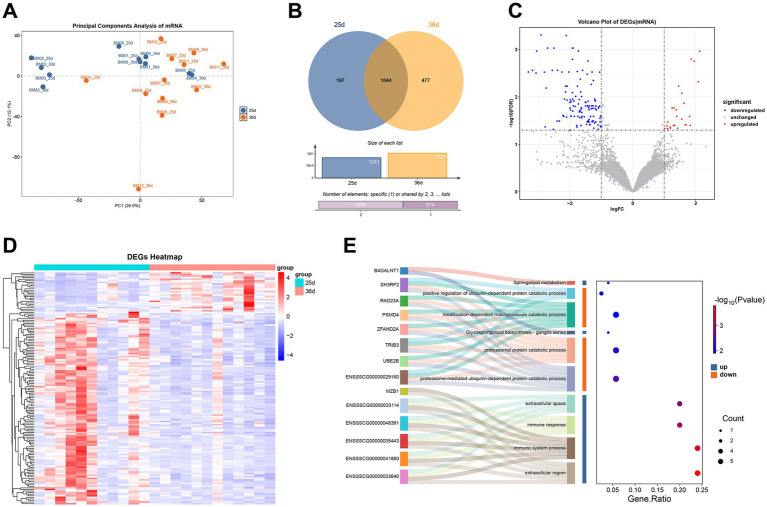
Results and discussion: The average daily weight gain of piglets during weaning was only 58.1% and 40.6% of that during 0-25 days and 36-60 days. Metabolomic results identified 61 significantly different metabolites (SDMs), of which, the most significantly increased and decreased SDMs after weaning were ectoine and taurocholate, respectively, indicating the occurrence of inflammation. Metagenomic analysis identified 30 significantly different microbes before and after weaning. Bacteria related to decreasing intestinal inflammation, such as Megasphaera, Alistipes and Bifidobacterium, were enriched before weaning. While bacteria related to infection such as Chlamydia, Clostridium, Clostridioides, and Blautia were enriched after weaning. The carbohydrate enzymes CBM91, CBM13, GH51_1, and GH94 increase after weaning, which may contribute to the digestion of complex plant fibers. Furthermore, we found the composition of antibiotic resistance genes (ARGs) changed during weaning. Transcriptomic analysis identified 147 significantly differentially expressed genes (DEGs). The upregulated genes after weaning were enriched in immune response categories, whereas downregulated genes were enriched in protein degradation. Combining multi-omics data, we identified significant positive correlations between gene MZB1, genera Alistipes and metabolite stachydrine, which involve anti-inflammatory functions. The reduced abundance of bacteria Dialister after weaning had strong correlations with the decreased 2-AGPE metabolite and the downregulated expression of RHBDF1 gene. Altogether, the multi-omics study reflects dietary changes and gut inflammation during weaning, highlighting complex interactions between gut microbes, host genes and metabolites."
Keywords: gene expression; gut microbes; interactions; metabolites; multi-omics; weaning.
Copyright © 2024 Ma, Yin, Hu, Liu, Guo, Zhong, Qiu and Li.
Conflict of interest statement
LY, BZ, and HQ were employed by Chengdu Dossy Experimental Animal Co., Ltd. ZG was employed by Dossy Biological Engineering (Chongqing) Co., Ltd. The remaining authors declare that the research was conducted in the absence of any commercial or financial relationships that could be construed as a potential conflict of interest.
Figures



References
-
- Ames S. R., Lotoski L. C., Azad M. B. (2023). Comparing early life nutritional sources and human milk feeding practices: personalized and dynamic nutrition supports infant gut microbiome development and immune system maturation. Gut Microbes 15:2190305. doi: 10.1080/19490976.2023.2190305, PMID: - DOI - PMC - PubMed
LinkOut - more resources
Full Text Sources
