


Contribution of social activity participation to the relationship between sensory impairment, physical performance and cognitive decline: a longitudinal study in China
- PMID: 39723154
- PMCID: PMC11668813
- DOI: 10.3389/fnagi.2024.1498354
Contribution of social activity participation to the relationship between sensory impairment, physical performance and cognitive decline: a longitudinal study in China
Abstract
Objectives: This study examined the impact of sensory impairment (hearing and/or vision) combined with poor physical performance on cognitive decline and assessed whether social activity participation mediated this relationship.
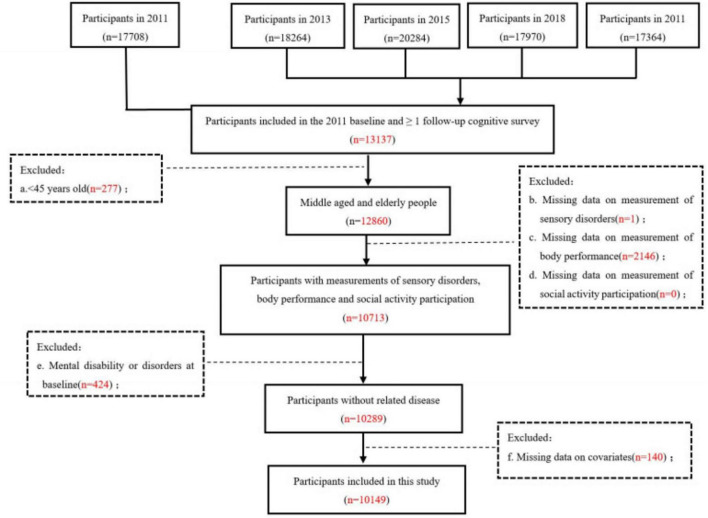
Methods: Multilevel models were used to explore the relationships between sensory impairment, physical performance, their combination, and cognitive decline. A multilevel mediation model analyzed the mediating effect of social activity participation. The study included 10,149 adults aged 45 and older (mean age 53.84) from five waves (2011-2020) of the China Health and Retirement Longitudinal Study (CHARLS). The exposure variable, body function (BF), was categorized into six groups based on sensory impairment and physical performance. Cognitive function was measured using an adapted Chinese Mini-Mental State Examination (MMSE).
Results: Compared to BF group 1 (normal physical performance without sensory impairment), individuals in BF group 4 (low physical performance without sensory impairment) (β = -0.670, P < 0.001), BF group 5 (low physical performance with single sensory impairment) (β = -1.029, P < 0.001), and BF group 6 (low physical performance with dual sensory impairment) (β = -1.630, P < 0.001) showed worse cognitive function. Only BF group 4 (β = -0.670, P < 0.001) had a faster cognitive decline. Mediation analysis revealed a significant indirect effect of social activity participation on cognitive function in BF group 4 (β = -0.03, P < 0.01, mediation proportion: 4.32%).
Conclusion: The combined effect of sensory impairment and low physical performance on cognitive decline may be accumulative, and social activity participation could mitigate this effect. Prioritizing social activity participation is crucial for health professionals and policymakers.
Keywords: cognitive function; mediation analyses; physical performance; sensory impairment; social activity participation.
Copyright © 2024 Lei, Zhou, Ye and Yang.
Conflict of interest statement
The authors declare that the research was conducted in the absence of any commercial or financial relationships that could be construed as a potential conflict of interest.
Figures
References
-
- Ahn S. H., Choi J. H., Im C. S., Kim T. S., Kim J. L. (2017). A comparison of the severe cognitive impairment rating scale with the mini-mental state examination and delirium rating scale-revised-98 for delirium: a cross-sectional study. Psychosomatics 58 643–651. 10.1016/j.psym.2017.08.002 - DOI - PubMed
-
- Andresen E. M., Malmgren J. A., Carter W. B., Patrick D. L. (1994). Screening for depression in well older adults: evaluation of a short form of the CES-D (Center for Epidemiologic Studies Depression Scale). Am. J. Prev. Med. 10 77–84. - PubMed
LinkOut - more resources
Full Text Sources
Miscellaneous
