


Boredom and curiosity: the hunger and the appetite for information
- PMID: 39723406
- PMCID: PMC11669060
- DOI: 10.3389/fpsyg.2024.1514348
Boredom and curiosity: the hunger and the appetite for information
Abstract
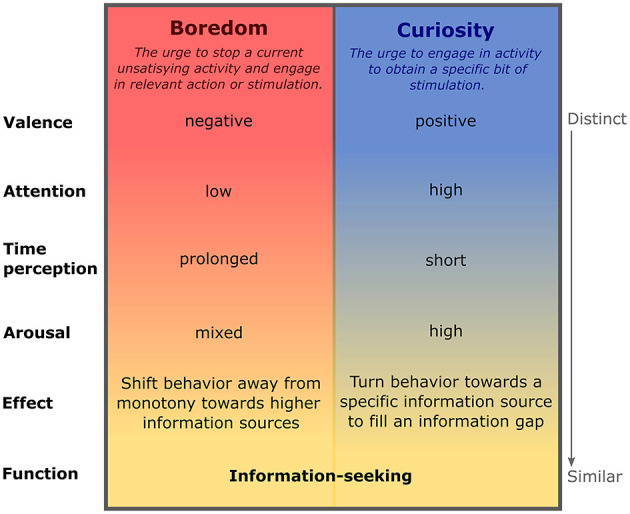
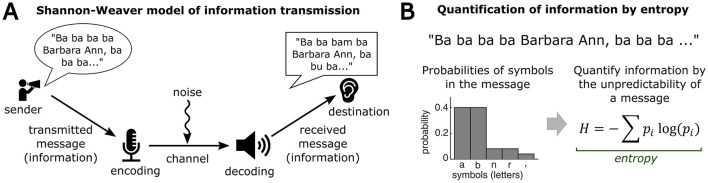
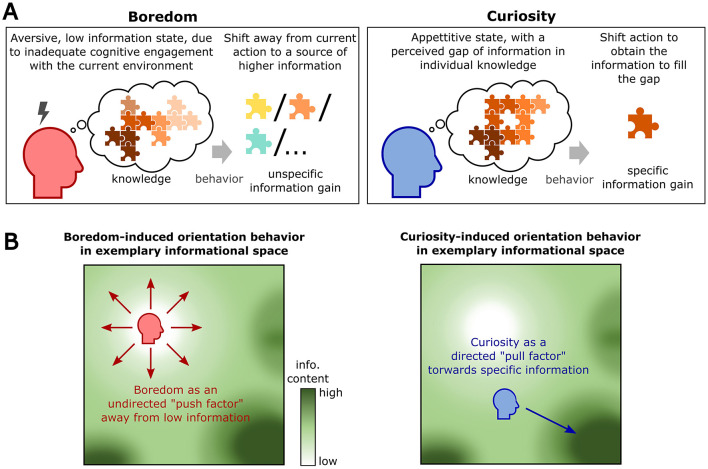
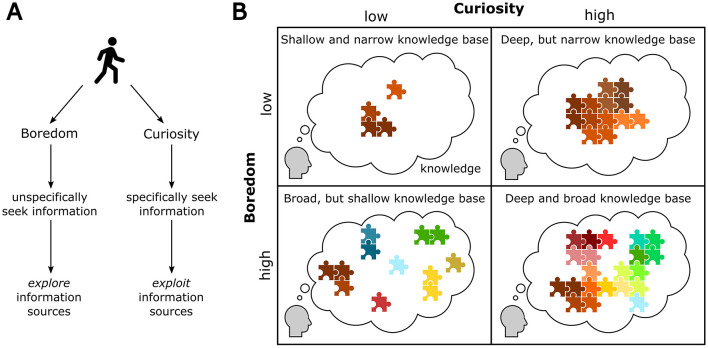
Boredom and curiosity are common everyday states that drive individuals to seek information. Due to their functional relatedness, it is not trivial to distinguish whether an action, for instance in the context of a behavioral experiment, is driven by boredom or curiosity. Are the two constructs opposite poles of the same cognitive mechanism, or distinct states? How do they interact? Can they co-exist and complement each other? Here, we systematically review similarities and dissimilarities of boredom and curiosity with respect to their subjective experience, functional role, and neurocognitive implementation. We highlight the usefulness of Information Theory for formalizing information-seeking in the context of both states and provide guidelines for their experimental investigation. Our emerging view is that despite their distinction on an experiential level, boredom and curiosity are closely related on a functional level, providing complementary drives on information-seeking: boredom, similar to hunger, arises from a lack of information and drives individuals to avoid contexts with low information yield, whereas curiosity constitutes a mechanism similar to appetite, pulling individuals toward specific sources of information. We discuss predictions arising from this perspective, concluding that boredom and curiosity are independent, but coalesce to optimize behavior in environments providing varying levels of information.
Keywords: boredom; curiosity; exploration; exploration and exploitation; information; information-seeking.
Copyright © 2024 Seiler and Dan.
Conflict of interest statement
The authors declare that the research was conducted in the absence of any commercial or financial relationships that could be construed as a potential conflict of interest.
Figures
References
-
- Bauhoff S. (2014). “Self-report bias in estimating cross-sectional and treatment effects,” in Encyclopedia of Quality of Life and Well-Being Research, ed. A.C. Michalos. (Dordrecht: Springer Netherlands), 5798–5800.
Publication types
LinkOut - more resources
Full Text Sources
