


Abnormalities of resting-state EEG microstates in older adults with cognitive frailty
- PMID: 39724459
- PMCID: PMC12181508
- DOI: 10.1007/s11357-024-01475-8
Abnormalities of resting-state EEG microstates in older adults with cognitive frailty
Abstract
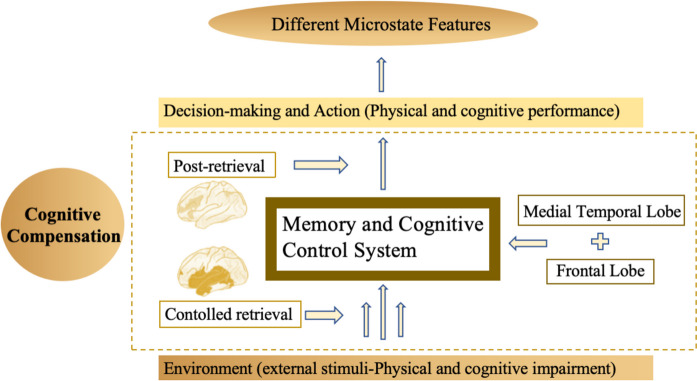
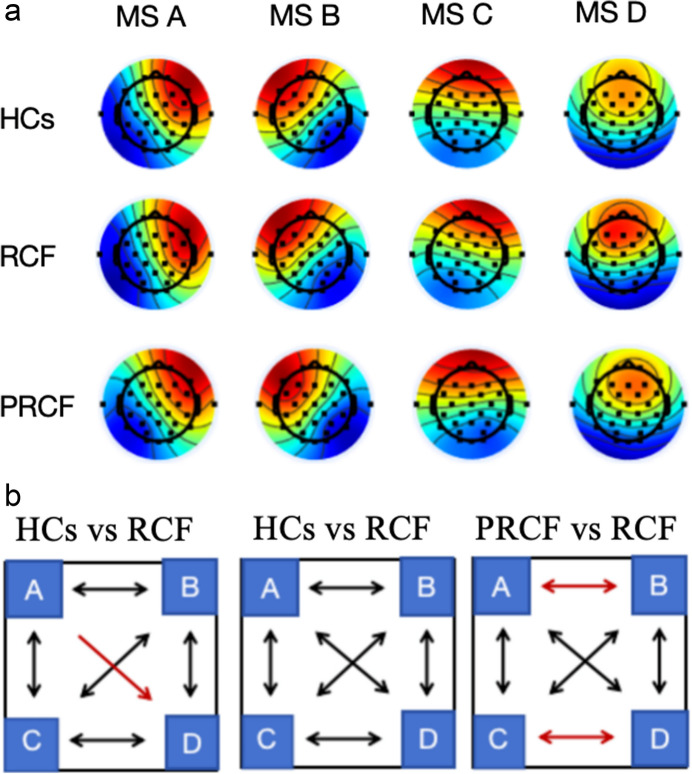
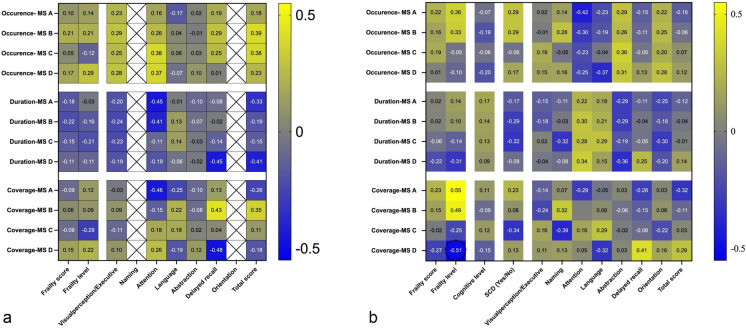
This study aims to analyze the characteristics of EEG microstates across different cognitive frailty (CF) subtypes, providing insights for the prevention and early diagnosis of CF. This study included 60 eligible older adults. Their resting-state EEG microstates were analyzed using agglomerative adaptive hierarchical clustering. Microstate temporal parameters were extracted through global field power peak-based backfitting. Spearman's partial correlation analysis and linear mixed-effects models were employed to investigate the relationship between microstate temporal parameters and CF. Statistical differences were observed in transition probabilities (TPs) from microstate B to A between healthy controls (HCs) and reversible cognitive frailty (RCF) group (t = -2.076, P = 0.042). Potentially reversible cognitive frailty (PRCF) and RCF group also exhibited statistical differences in the TPs from microstate B to A (t = 3.122, P = 0.003). In the RCF group, the occurrence of microstates A and B differed significantly from microstate C (tAC = 3.455, PAC = 0.002; tBC = 3.108, PBC = 0.004). In the PRCF group, the occurrence of microstates A, B, and C differed significantly from microstate D (tAD = -3.688, PAD = 0.001; tBD = -3.334, PBD = 0.002; tCD = -4.188, PCD < 0.001). The neural networks and processing modes engaged by microstate D during executive memory tasks differ between RCF and PRCF. A decreased occurrence of microstate C and higher TPs of microstates A and B may serve as early warning signals for RCF. Conversely, an increased occurrence of microstate D and decreased TPs of microstates C and D indicate the onset of PRCF.
Keywords: Cognitive frailty; Electroencephalogram; Microstate; Nursing homes.
© 2024. The Author(s), under exclusive licence to American Aging Association.
Conflict of interest statement
Declarations. Competing Interests: The authors declare no competing interests.
Figures
References
-
- Panza F, Solfrizzi V, Sardone R, Dibello V, Castellana F, Zupo R, Stallone R, Lampignano L, Bortone I, Mollica A, Berardino G, Ruan Q, Altamura M, Bellomo A, Daniele A, Lozupone M. Depressive and biopsychosocial frailty phenotypes: impact on late-life cognitive disorders. J Alzheimers Dis. 2023;94:879–98. 10.3233/jad-230312. - DOI - PubMed
-
- Chen B, Wang M, He Q, Wang Y, Lai X, Chen H, Li M. Impact of frailty, mild cognitive impairment and cognitive frailty on adverse health outcomes among community-dwelling older adults: a systematic review and meta-analysis. Front Med (Lausanne). 2022;9:1009794. 10.3389/fmed.2022.1009794. - DOI - PMC - PubMed
MeSH terms
Grants and funding
LinkOut - more resources
Full Text Sources
Medical
